
Regulatory Shifts in AI and Their Impact on Tech Sector Valuations: Antitrust Enforcement, Market Concentration, and Innovation-Driven Investing
In 2025, the U.S. tech sector faces a pivotal juncture as antitrust enforcement intensifies in response to the rapid rise of artificial intelligence (AI). Regulators, including the Department of Justice (DOJ) and Federal Trade Commission (FTC), are scrutinizing algorithmic pricing tools, mergers, and market concentration metrics like the Herfindahl-Hirschman Index (HHI). These developments are reshaping investment strategies, with venture capital (VC) firms recalibrating their focus on innovation-driven startups while navigating a regulatory landscape that prioritizes competition over unchecked consolidation.
Antitrust Enforcement and Algorithmic Pricing: A New Frontier
The DOJ and FTC have escalated their focus on AI-driven pricing algorithms, which are increasingly implicated in anticompetitive behavior. Assistant Attorney General Gail Slater emphasized that regulators are “on high alert for exclusionary behavior in the AI industry,” particularly regarding data access and vertical integration [1]. High-profile lawsuits against companies like RealPage and Yardi in 2024–2025 highlight concerns that algorithmic pricing tools could facilitate collusion or price-fixing under Section 1 of the Sherman Act. The DOJ has even advocated for applying the per se rule to algorithmic collusion, signaling a hardline stance against practices that undermine market fairness [2].
For investors, this regulatory scrutiny introduces compliance risks. The DOJ's updated Guidance on Corporate Compliance Programs now explicitly includes AI and algorithmic tools, urging firms to conduct due diligence on shared algorithm inputs and maintain human oversight in pricing decisions [3]. Startups leveraging AI for dynamic pricing must balance innovation with antitrust safeguards to avoid litigation.
Market Concentration and the HHI: A Tipping Point?
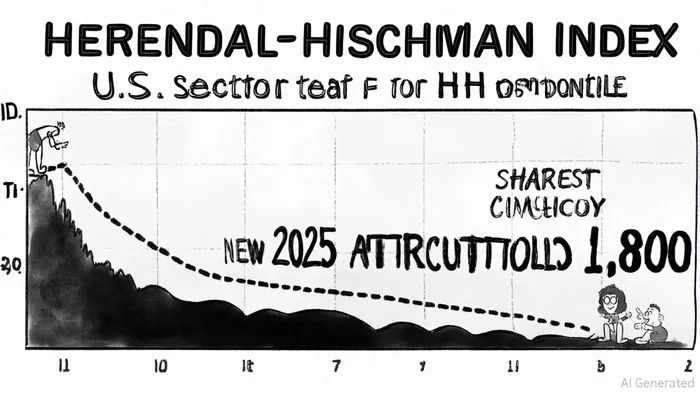
The tech sector's market concentration, as measured by the HHI, has reached historically high levels. As of July 2023, the adjusted HHI for the S&P 500 Information Technology sector was 9.6, placing it in the 99th percentile of historical observations—far above the long-term average of 4.9 [4]. This concentration is driven by the dominance of a few mega-cap firms, which have aggressively acquired AI startups and foundational models.
The 2025 Merger Guidelines, which lower the threshold for “highly concentrated” markets from 2,500 to 1,800, have amplified regulatory scrutiny. Mergers that increase the HHI by more than 100 points in already concentrated markets are now presumed to enhance market power [5]. For example, a market with five firms each holding 20% market share would now be deemed highly concentrated under the new rules. This shift suggests that even incremental consolidation in AI could trigger antitrust challenges, particularly for Big Tech firms seeking to acquire smaller innovators.
Venture Capital Trends: Innovation vs. Compliance
Despite regulatory headwinds, AI remains a top sector for VC investment. In Q2 2025, AI accounted for 31% of total VC funding, with LLM vendors commanding valuation multiples of 44.1x revenue [6]. However, investors are adopting a more disciplined approach, favoring startups with strong fundamentals, enterprise adoption, and clear paths to profitability. The rise of advanced models like GPT-5 and Gemini 1.5 has further tilted capital toward companies that can integrate these tools into scalable solutions.
Regional strategies are also diverging. The U.S. continues to prioritize large-scale foundational model development, while Europe emphasizes vertical specialization and regulatory compliance. This bifurcation reflects the growing need for startups to align with regional policy frameworks. For instance, the European Union's potential expansion of the Digital Markets Act to classify AI businesses as “gatekeepers” could mandate interoperability, altering the competitive landscape [7].
Implications for Investors: Navigating the New Normal
The evolving regulatory environment demands proactive compliance strategies. Startups must document independent decision-making when using AI tools and avoid shared algorithm inputs that could signal collusion. For institutional investors, due diligence now includes evaluating antitrust risks in AI-driven pricing strategies and mergers.
Moreover, the HHI's role as a regulatory tool underscores the importance of monitoring market concentration. If the tech sector's HHI remains above 1,800 post-2025, investors may see increased fragmentation as regulators block mergers or enforce structural remedies. This could benefit “Little Tech” startups by creating more exit opportunities beyond acquisition by dominant incumbents [8].
Conclusion: Balancing Innovation and Regulation
The 2025 AI antitrust landscape reflects a delicate balance between fostering innovation and preventing monopolistic practices. While regulatory scrutiny introduces compliance costs, it also creates opportunities for startups that can navigate these challenges. Investors must prioritize antitrust-aware strategies, leveraging granular metrics like HHI and valuation multiples to identify resilient, innovation-driven opportunities. As the DOJ and FTC continue to refine their approach, the tech sector's ability to adapt will determine whether AI becomes a force for democratized competition or entrenched dominance.







Comentarios
Aún no hay comentarios