
Regulatory Scrutiny and Criminal Activity in the Crypto Sector: How Law Enforcement Actions Shape Long-Term Investment Risk and Opportunity in Digital Assets
The cryptocurrency sector has long been a battleground for regulators and law enforcement, with enforcement actions shaping both the legal framework and market dynamics of digital assets. In 2025, a pivotal shift in U.S. policy is redefining the relationship between criminal enforcement and investment risk in the space. As the Department of Justice (DOJ) and Securities and Exchange Commission (SEC) recalibrate their approaches, investors must navigate a landscape where regulatory clarity and innovation are increasingly intertwined.
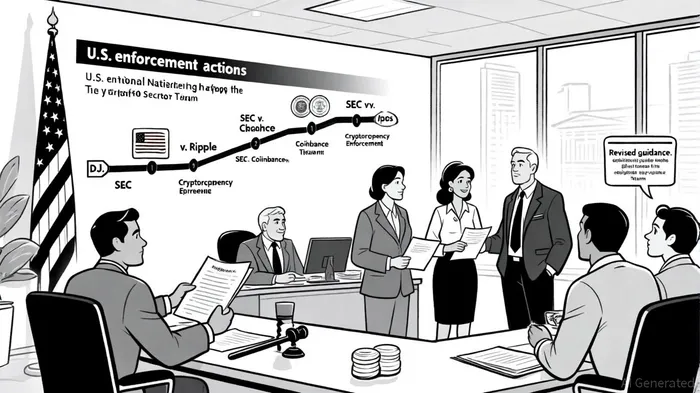
The DOJ's Strategic Retreat from Broad Crypto Enforcement
In April 2025, the DOJ announced the dissolution of its National Cryptocurrency Enforcement Team, a unit previously tasked with aggressively pursuing crypto-related crimes[1]. Deputy Attorney General Todd Blanche emphasized a new focus on prosecuting digital assets used to facilitate terrorism, narcotics trafficking, and human trafficking-excluding broader regulatory violations like unlicensed money transmission or unregistered securities offerings[1]. This shift aligns with the Trump administration's broader deregulatory agenda, which includes endorsing blockchain innovation and launching projects like World Liberty Financial[1].
For investors, this policy change reduces the risk of overreach against compliant crypto platforms. Exchanges, mixing services, and wallet providers are now shielded from prosecution for "unwitting violations" or user misconduct[1]. However, the lack of a centralized enforcement team introduces uncertainty. While the DOJ has stepped back, the SEC and CFTC remain active regulators, creating a fragmented landscape where companies must navigate overlapping jurisdictions[2].
The SEC's Shift from "Regulation by Enforcement"
The SEC has also signaled a recalibration of its enforcement strategy. High-profile cases against Ripple, CoinbaseCOIN--, and Kraken have been either dismissed or settled, reflecting a move away from using litigation to set legal precedents[4]. Instead, the agency is prioritizing clearer guidance, such as rescinding Staff Accounting Bulletin 121 and clarifying that self-mining and mining pools generally do not constitute securities under the Howey test[4].
This shift reduces the immediate threat of enforcement actions for companies adhering to evolving guidelines. However, the SEC's focus on secondary market transactions-exemplified by the interlocutory appeal in SEC v. Coinbase, Inc.-suggests that regulatory scrutiny will remain concentrated on asset classification and market structure[3]. Investors must monitor these cases, as their outcomes could redefine the legal status of tokens and impact everything from fundraising models to trading platforms.
Key Legal Cases Reshaping the Regulatory Framework
The Second Circuit's review of SEC v. Ripple Labs, Inc. and the interlocutory appeal in SEC v. Coinbase, Inc. are two of the most consequential legal battles in 2025[3]. These cases hinge on the application of the Howey test to digital assets, particularly in distinguishing between institutional token sales and programmatic trading activities. A ruling favoring Ripple could limit the SEC's authority to classify tokens as securities, fostering innovation in decentralized finance (DeFi) and tokenized assets[3]. Conversely, a broad interpretation of the Howey test might impose stricter compliance burdens on projects and exchanges.
Balancing Risk and Opportunity in a Shifting Landscape
The DOJ's and SEC's policy shifts present both opportunities and risks for investors. On one hand, reduced enforcement against compliant platforms and clearer guidance lower operational risks for crypto-native businesses. On the other, the absence of a unified regulatory framework creates ambiguity, particularly as political priorities influence enforcement priorities[4]. For instance, a future administration could reverse the DOJ's current stance, reintroducing the threat of broad crypto enforcement.
Investors should also consider the indirect impact of these changes. The focus on serious crimes like terrorism and trafficking may divert resources from combating fraud and market manipulation, potentially increasing risks in less-regulated corners of the ecosystem[1]. Conversely, the emphasis on innovation could spur adoption of blockchain in sectors like cross-border payments and asset tokenization, unlocking new markets for digital assets.
Conclusion
The 2025 regulatory landscape marks a turning point for the crypto sector, where law enforcement actions are increasingly aligned with fostering innovation rather than stifling it. While this reduces immediate enforcement risks, it also introduces long-term uncertainty as legal precedents and political priorities evolve. Investors must remain agile, leveraging clearer guidance while hedging against potential regulatory reversals. As the DOJ and SEC navigate their new roles, the crypto industry's ability to adapt will determine whether this period of deregulation becomes a catalyst for growth or a precursor to instability.





Comentarios
Aún no hay comentarios