
Regulatory Risks and Resilience in Indian Banking Sector
The Indian banking sector, a cornerstone of the nation's economic infrastructure, has long navigated a complex regulatory landscape. In recent years, the Goods and Services Tax (GST) regime has emerged as both a compliance challenge and a regulatory risk multiplier, particularly for large financial institutionsFISI--. The surge in state-level GST appeals—exemplified by cases involving ICICI BankIBN-- and IndusInd Bank—has underscored the operational and reputational vulnerabilities of banks, while also revealing their capacity to adapt and rebuild investor confidence.
Regulatory Risks: A Closer Look
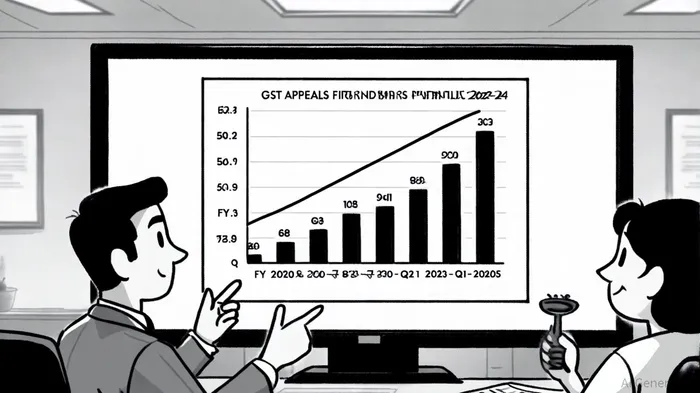
The GST appeals landscape has grown increasingly contentious. According to a report by CNBCTV18, the number of appeals filed by taxpayers under the GST regime rose from 5,499 in FY 2020-21 to over 14,000 in Q1 2023-24[6]. This exponential growth reflects the complexity of GST compliance, particularly for banks, which face dual scrutiny from central and state authorities. For instance, ICICI Bank is contesting combined GST demands of over ₹100 crore from Maharashtra and West Bengal, while IndusInd Bank faces a ₹21.62 crore demand from Gujarat and a ₹30.15 crore penalty from the Central GST department[1][2]. These disputes, rooted in alleged short payments on services like minimum balance charges, highlight the protracted nature of GST litigation and the financial strain it imposes on institutions.
The procedural hurdles are compounded by recent legislative changes. The Finance Act, 2025, mandates a 10% pre-deposit of penalty amounts for appeals, a requirement that has added liquidity pressure for banks already grappling with working capital constraints[5]. This financial burden, coupled with the administrative costs of compliance, has eroded operational efficiency, particularly for public sector banks, which saw declines in Return on Assets (ROA) and Return on Equity (ROE) post-GST implementation[4].
Operational and Reputational Fallout
The reputational impact of GST disputes is starkly visible in stock price volatility. IndusInd Bank's shares fell over 5% in March 2025 following the announcement of a ₹30.15 crore penalty[1]. Similarly, ICICI Bank's stock dipped by 0.09% in December 2024 after raids by Maharashtra GST authorities[3]. While these declines may seem modest, they signal investor unease about governance risks and regulatory exposure.
Credit rating agencies have also reacted. Moody's placed IndusInd Bank's Baseline Credit Assessment under review for a potential downgrade[7], while Fitch upgraded ICICI Bank's financial strength score to 'bb' from 'bb-', citing improved asset quality[8]. This divergence underscores the nuanced impact of GST disputes: while legal challenges can erode trust, strong fundamentals and proactive governance can mitigate long-term damage.
Resilience and Investor Sentiment
Despite these challenges, the Indian banking sector has demonstrated resilience. The operationalization of the GST Appellate Tribunal (GSTAT) in 2025, with its digital filing and hybrid hearing mechanisms, aims to streamline dispute resolution[9]. This procedural clarity could reduce uncertainty, potentially stabilizing investor sentiment.
Moreover, banks like IndusInd have shown signs of recovery. After a 56% decline in its share price over 12 months, the bank surged over 6% in a single trading session in mid-2025, buoyed by broader market optimism and interest rate cuts[10]. New leadership, including CEO Rajiv Anand, has also prioritized transparency and governance reforms, rebuilding trust with stakeholders[10].
Conclusion: Balancing Risk and Resilience
The GST-related regulatory risks facing Indian banks are significant, but they are not insurmountable. While state-level appeals have strained operational efficiency and tested reputational resilience, the sector's adaptability—through legal reforms, credit rating stability, and strategic leadership—offers a counterbalance. For investors, the key lies in distinguishing between short-term volatility and long-term fundamentals. As the GST regime evolves, banks that navigate compliance challenges with agility and transparency are likely to emerge stronger, reinforcing their role as pillars of India's financial ecosystem.





Comentarios
Aún no hay comentarios