
Regulatory Risks in Prediction Markets: Navigating Enforcement Turbulence and Investor Accountability
The rise of prediction markets as a speculative asset class has been accompanied by a volatile regulatory landscape, creating both opportunities and risks for traders. As platforms like Kalshi and Polymarket expand their offerings into sports, politics, and pop culture, they face mounting legal scrutiny from state and federal authorities. This analysis examines the evolving enforcement trends in prediction markets, the implications for investor accountability, and the broader risks for speculative traders navigating this uncharted territory.
The Federal-State Regulatory Tug-of-War
The Commodity Futures Trading Commission (CFTC) has positioned itself as the primary regulator of prediction markets, classifying event contracts as federally regulated derivatives rather than gambling products. This framework has enabled platforms like Kalshi to operate under federal oversight, bypassing state-level gaming laws. However, this federal preemption is under intense legal challenge. By the end of 2025, Kalshi faced lawsuits from six states-including New York, Maryland, and New Jersey-alleging violations of state gaming statutes.
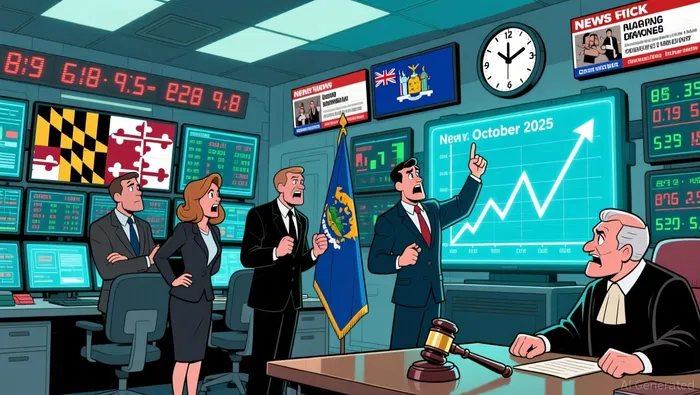 Federal courts have issued conflicting rulings. For instance, preliminary injunctions in Nevada and New Jersey initially favored Kalshi, citing CFTC jurisdiction. Yet, a December 2025 court decision in Maryland denied Kalshi's request for a preliminary injunction, ruling that state sports wagering laws were not preempted by the Commodity Exchange Act. This inconsistency creates regulatory arbitrage, where traders may face divergent legal risks depending on their jurisdiction.
CFTC's Ambiguity and the Crypto.com Ruling
The CFTC's lack of a definitive regulatory framework has exacerbated uncertainty. While the agency granted no-action letters to platforms like Polymarket and LedgerX, it has not clarified whether all prediction market contracts qualify as swaps under the Commodity Exchange Act. This ambiguity was further complicated by the Crypto.com court ruling in late 2025, which held that sports event contracts-unlike traditional swaps-depend on the outcome of an event rather than its occurrence. This decision weakened Kalshi's legal defense, emboldening states to challenge its operations.
For traders, this legal limbo raises the risk of sudden regulatory shifts. A platform deemed compliant today could face enforcement tomorrow if courts or regulators redefine the boundaries of federal preemption.
Investor Accountability in a Gray Zone
Despite the regulatory turbulence, enforcement actions targeting individual traders remain sparse. The CFTC's 2025 enforcement sprint focused on institutional compliance failures, such as recordkeeping breaches, but did not address individual speculative trading. Similarly, the SEC's "back to basics" strategy prioritized traditional fraud cases over crypto-related enforcement.
However, the absence of direct enforcement against traders does not eliminate risk. Platforms like Kalshi have introduced speculative products on their own legal challenges, such as prediction markets on the outcomes of federal appeals. These instruments, while innovative, reinforce the perception of prediction markets as gambling-like, potentially attracting heightened scrutiny from consumer protection advocates.
Implications for Speculative Traders
The regulatory uncertainty creates three key risks for investors:
1. Jurisdictional Exposure: Traders in states like Maryland or Nevada may face stricter enforcement if courts uphold state gaming laws as seen in Maryland.
2. Platform Instability: Legal challenges could force platforms to halt operations or alter product offerings, disrupting liquidity and access as reported in 2025.
3. Reputational Risk: The association of prediction markets with gambling could lead to broader regulatory crackdowns, even if federal agencies currently tolerate them.
For example, Kalshi's $4.39 billion in October 2025 trading volume underscores the market's appeal but also highlights its vulnerability to sudden legal or regulatory changes. Traders must weigh these risks against the potential for high returns, particularly in niche markets like political or pop culture events.
Looking Ahead: A Supreme Court Showdown?
The legal battles over prediction markets are poised to escalate. With multiple states and tribal groups challenging CFTC jurisdiction, the U.S. Supreme Court may soon resolve whether prediction markets are federally preempted or subject to state regulation. A ruling favoring states could trigger a wave of licensing requirements and consumer protection mandates, fundamentally altering the market's structure.
In the interim, traders should monitor enforcement trends closely. The CFTC's recent no-action letters suggest a narrow regulatory window and the SEC's focus on investor protection indicates a cautious approach to enforcement, but the Crypto.com ruling demonstrates that legal precedents are still evolving.
Conclusion
Prediction markets represent a frontier of speculative trading, but their regulatory risks are as significant as their potential rewards. As enforcement actions mount and legal precedents shift, traders must navigate a landscape where federal and state laws collide. While direct investor accountability remains limited, the broader instability of the regulatory framework poses indirect risks that could reshape the market. For now, the path forward hinges on the outcome of pending litigation-and the Supreme Court's eventual verdict.







Comentarios
Aún no hay comentarios