
Regulatory Risks in DeFi: Systemic Vulnerabilities from the Market Structure Bill
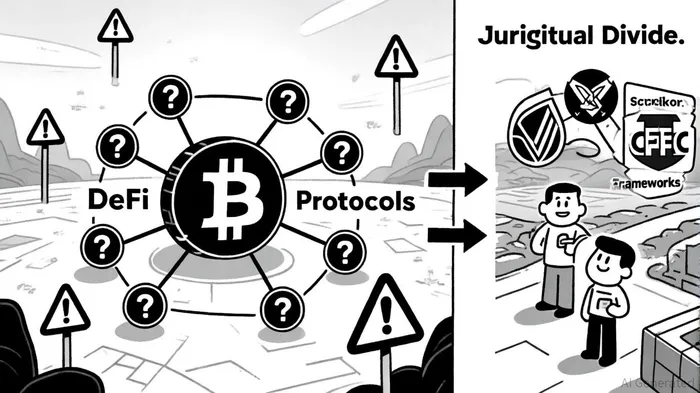
The U.S. Congress's proposed Market Structure Bill—encompassing the House's CLARITY Act and the Senate's Responsible Financial Innovation Act—has sparked intense debate over its implications for decentralized finance (DeFi). While both frameworks aim to clarify regulatory boundaries, their divergent approaches risk creating systemic vulnerabilities in DeFi markets. Investors must grapple with how these legislative proposals could amplify fraud, liquidity risks, and cross-market contagion, even as they seek to foster innovation.
A Fractured Regulatory Framework
The CLARITY Act, passed by the House in July 2025, categorizes digital assets into digital commodities, investment contract assets, and permitted payment stablecoins, assigning jurisdiction to the CFTC and SEC accordingly[1]. This approach hinges on the concept of a "mature blockchain system", which, if achieved, shifts oversight to the CFTC[2]. However, the Senate's RFIA introduces a competing framework, defining "ancillary assets" to exclude certain DeFi tokens from securities laws[3]. This divergence creates a regulatory patchwork where DeFi protocols might exploit jurisdictional loopholes to avoid compliance, increasing the risk of unregulated activity.
Deregulatory Exemptions and Fraud Risks
A critical concern lies in the CLARITY Act's broad exemptions for DeFi actors. The Act subjects DeFi protocols to minimal federal oversight beyond anti-fraud and anti-money laundering (AML) requirements[4]. While this aims to promote innovation, it leaves platforms vulnerable to exploitation. For instance, the Act allows digital commodity issuers to raise up to $75 million annually without SEC registration, provided they meet disclosure thresholds[5]. Critics argue this exemption could incentivize speculative token sales—such as memeMEME-- coins—with inadequate investor protections[4].
Moreover, the Act's focus on decentralization may backfire. By prioritizing algorithmic governance models over centralized structures, DeFi platforms could become breeding grounds for hidden manipulation. A report by Our Financial Security highlights how the lack of accountability in decentralized systems could enable bad actors to exploit governance mechanisms or smart contract vulnerabilities[4]. Such risks are compounded by the interconnectedness of DeFi and traditional finance, where a single fraudulent token could destabilize broader markets.
The Senate's Balancing Act
The Senate's RFIA attempts to mitigate these risks by introducing a "decentralization safe harbor"—a three-year compliance window for blockchain projects to scale without immediate regulatory pressure[3]. Additionally, the Act mandates a "Micro-Innovation Sandbox" for startups to test products under federal supervision[3]. These measures aim to foster innovation while embedding safeguards. However, the RFIA's exclusion of non-custodial DeFi protocols from registration requirements[4] could still leave investors exposed to unregulated platforms.
Systemic Risks and Investor Implications
The CLARITY Act's deregulatory approach raises systemic concerns. By exempting DeFi platforms from CFTC trading standards—such as asset segregation and anti-manipulation systems[6]—the Act creates a two-tiered market. Centralized exchanges face stringent compliance, while DeFi protocols operate with minimal oversight. This disparity could drive capital toward riskier, unregulated venues, increasing the likelihood of cascading failures. For example, a liquidity crisis in a DeFi protocol could spill over into stablecoin markets or even traditional banking systems, as seen in past crypto collapses[6].
Investors must also weigh the Senate's RFIA against the House's CLARITY Act. While the RFIA's "Regulation Crypto" framework caps token offerings at $75 million annually[3], it lacks the CLARITY Act's clear jurisdictional boundaries. This ambiguity could delay implementation and prolong regulatory uncertainty, deterring institutional participation in DeFi.
Conclusion: Navigating the Regulatory Crossroads
The Market Structure Bill's passage will likely hinge on reconciling the House and Senate proposals. However, investors should prepare for a scenario where deregulatory provisions in the CLARITY Act dominate, exacerbating systemic risks in DeFi. Prudent strategies include diversifying exposure to regulated platforms, prioritizing projects with transparent governance, and monitoring enforcement actions by the SEC and CFTC. As the crypto ecosystem evolves, regulatory clarity may come at the cost of stability—or vice versa.







Comentarios
Aún no hay comentarios