
Regulatory Risks in Decentralized Prediction Markets: A Global Shift Unveiled by Norway's Nobel Probe
The Norwegian investigation into suspicious betting activity on Polymarket ahead of the 2025 Nobel Peace Prize announcement has ignited a global conversation about the regulatory risks facing decentralized prediction markets. This case, involving a $90,000 profit from bets placed just hours before the official announcement of Venezuelan opposition leader María Corina Machado as the winner, underscores the growing tension between innovation and oversight in the crypto space. As regulators worldwide grapple with the implications of this incident, the sector faces a pivotal moment that could redefine its trajectory.
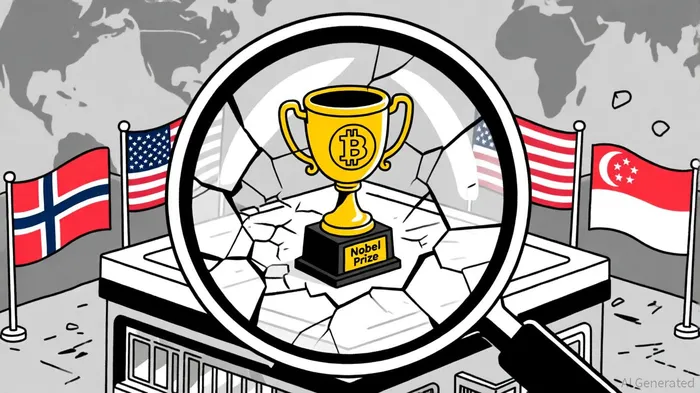
The Norwegian Probe: A Catalyst for Global Scrutiny
According to a Coindesk report, Norwegian officials are investigating whether insider trading occurred on Polymarket, a decentralized platform where bets on Machado surged from $0.08 to $1.00 per contract in a short period. The Nobel Committee, which finalized its decision on October 6, confirmed that the breach of confidentiality was a "serious issue" and that it would review its processes, the committee said in an Altsignals post. Kristian Berg Harpviken, director of the Norwegian Nobel Institute, stated that the situation "seems we have been prey to a criminal actor who wants to earn money on our information," according to a CryptoNews report.
This incident highlights the vulnerabilities of institutions reliant on secrecy in an era where blockchain-based markets enable near-instant, transparent, and pseudonymous transactions. The decentralized nature of platforms like Polymarket-built on blockchains such as EthereumETH-- and Polygon-complicates traditional regulatory frameworks, which often lack jurisdiction over cross-border, peer-to-peer speculation, as explored in The Market Periodical.
A Global Regulatory Tightrope
The Norwegian probe is not an isolated event. Regulatory scrutiny of prediction markets is intensifying globally, with divergent approaches emerging. In the United States, the Commodity Futures Trading Commission (CFTC) has asserted jurisdiction over these platforms, classifying them as binary options or swaps, according to a PYMNTS article. While Kalshi, a regulated U.S. platform, secured approval for election-based contracts after a 2024 legal victory, Polymarket has faced restrictions, including a 2022 settlement with the CFTC over unregistered contracts, per a FinancialContent article.
Meanwhile, jurisdictions like Singapore and Hong Kong are adopting more structured frameworks. Singapore's Financial Institutions (Miscellaneous Amendments) Act 2024 (FIMA Act) now regulates crypto-derivatives, while Hong Kong's Stablecoins Ordinance mandates asset-backed reserves, according to a BolderGroup snapshot. In contrast, countries like Taiwan and France have labeled prediction markets as unlicensed gambling operations, a Holder article notes. These fragmented approaches create a patchwork of compliance challenges for platforms operating across borders.
Investment Implications: Risks and Opportunities
For investors, the Norwegian case signals a shift toward stricter oversight of decentralized markets. Platforms that fail to adapt to evolving regulations-such as implementing robust anti-money laundering (AML) protocols or securing licensing-risk delisting or operational shutdowns. For example, Polymarket's recent probe could deter institutional participation, which has been a key driver of growth in the sector, as noted in a Nasdaq roundup.
Conversely, regulated platforms like Kalshi and Robinhood's international expansion into the UK and Europe may benefit from clearer legal frameworks, according to a Coindesk piece. The latter's collaboration with the UK's Financial Conduct Authority (FCA) exemplifies how compliance can open doors to mainstream adoption. However, investors must weigh the risks of regulatory arbitrage, where platforms migrate to less stringent jurisdictions, potentially undermining market integrity, a StartUs Insights report warns.
The Road Ahead: Innovation vs. Oversight
The Norwegian investigation into the Nobel betting anomaly is a microcosm of the broader struggle between innovation and oversight in crypto. While decentralized prediction markets offer unprecedented efficiency and democratization of information, they also pose risks of manipulation, fraud, and erosion of trust in institutions. Regulators, meanwhile, are racing to catch up with a sector that thrives on decentralization and anonymity.
For investors, the key takeaway is clear: regulatory clarity is both a challenge and an opportunity. Platforms that navigate this landscape with agility-by securing licenses, enhancing transparency, and collaborating with regulators-will likely dominate the next phase of growth. Conversely, those clinging to unregulated models risk obsolescence in a world where trust and compliance are becoming non-negotiable.
As the Nobel Committee's internal review unfolds, one thing is certain: the Norwegian probe has illuminated a fault line in the global crypto ecosystem. How regulators and market participants respond will shape the future of decentralized prediction markets-and the broader crypto industry-for years to come.






Comentarios
Aún no hay comentarios