
Regulatory Risks in Crypto Corporate Deals: Timing Strategies and Market Manipulation in 2025
The 2025 crypto regulatory landscape is a chessboard of shifting rules, enforcement priorities, and global harmonization efforts. For corporate actors navigating mergers, acquisitions, and capital-raising in the digital asset space, timing and vigilance against manipulation have become existential imperatives. The U.S. Securities and Exchange Commission's (SEC) pivot from broad enforcement to targeted fraud crackdowns, coupled with global regulatory convergence, has created a volatile yet structured environment. Investors and executives must now balance compliance with strategic agility to avoid regulatory pitfalls while capitalizing on emerging opportunities.
Regulatory Shifts and Timing Strategies
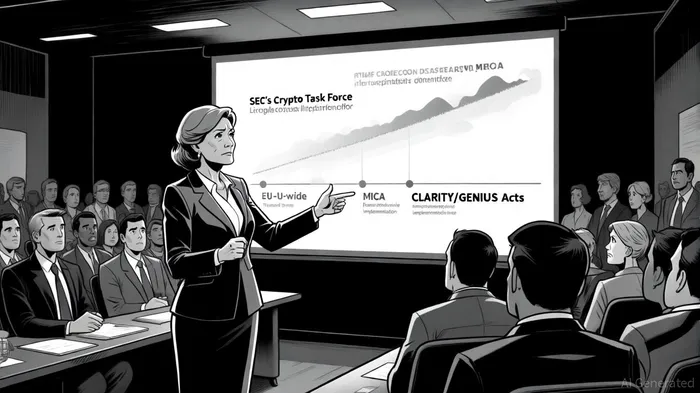
The SEC's 2025 reorientation under the Crypto Task Force, led by Commissioner Hester Peirce, marks a departure from its 2023–2024 enforcement-heavy approach. By prioritizing rulemaking over litigation, the agency has introduced clarity for certain asset classes—such as memeMEME-- coins and stablecoins—while narrowing its focus to fraud and misconduct [1]. For example, the SEC's March 2025 guidance explicitly stated that meme coins, which derive value from social media trends rather than investment contracts, are unlikely to qualify as securities under the Howey test [4]. This distinction allows firms to structure deals around such assets with reduced regulatory friction, provided they avoid tying them to investment enterprises.
However, this clarity is double-edged. The dismissal of the CoinbaseCOIN-- case in February 2025 and the withdrawal of actions against Binance and Payward signal a recalibration of enforcement priorities [5]. While this may reduce short-term legal risks, it also creates uncertainty about the SEC's long-term stance. Corporate actors must time their deals to align with these shifting priorities. For instance, launching a stablecoin-backed acquisition in early 2025, when the SEC's April 2025 stablecoin guidance was still pending, could have exposed firms to regulatory ambiguity. Conversely, post-April deals benefit from clearer parameters, such as the requirement for stablecoins to be fully backed by high-quality liquid assets under the GENIUS Act [1].
Globally, the EU's Markets in Crypto-Assets Regulation (MiCA) has introduced a unified framework, compelling firms to navigate cross-border compliance. The regulation's licensing and transparency requirements for stablecoins and utility tokens have already influenced U.S. and Asian markets, with Singapore and the UAE adopting similar reserve and AML/KYC standards [4]. For multinational corporations, timing cross-border deals to align with MiCA's implementation deadlines (e.g., end of 2024) is critical to avoid operational disruptions.
Market Manipulation and Enforcement Gaps
Despite the SEC's focus on clarity, enforcement actions in 2025 have exposed persistent risks of market manipulation. The May 2025 case against Unicoin, Inc., for example, revealed how social media-driven schemes can exploit regulatory gray areas. The firm sold $100 million in “Unicoins” by falsely claiming they were backed by real estate and pre-IPO equity, leveraging influencer networks to inflate demand [2]. Such tactics highlight the need for corporate due diligence in verifying the legitimacy of digital assets and their underlying collateral.
The SEC's new Cyber and Emerging Technologies Unit (CETU), launched in early 2025, is explicitly targeting these manipulation tactics [3]. Its focus on blockchain-based fraud and social media-driven volatility underscores a growing regulatory emphasis on real-time monitoring. For investors, this means that timing trades around CETU's enforcement cycles—such as avoiding high-volume periods coinciding with influencer campaigns—could mitigate exposure to artificially inflated assets.
Yet, enforcement gaps remain. The SEC's dismissal of the Coinbase case, while reducing immediate legal risks, has left a void in accountability for exchanges that fail to register as securities platforms. This ambiguity creates opportunities for unscrupulous actors to exploit regulatory loopholes, particularly in cross-border deals where enforcement jurisdiction is unclear.
Strategic Recommendations for Investors
- Leverage Regulatory Clarity: Prioritize deals involving assets with clear SEC guidance (e.g., stablecoins post-April 2025) to reduce compliance costs.
- Monitor Enforcement Cycles: Align capital-raising and M&A timelines with periods of heightened SEC focus on fraud (e.g., post-MiCA implementation in the EU).
- Adopt Proactive AML/KYC Protocols: Given the OECD's Crypto-Asset Reporting Framework (CARF) and MiCA's requirements, integrate real-time transaction monitoring to preempt manipulation risks [3].
- Diversify Jurisdictional Exposure: Balance operations across regions with aligned regulatory frameworks (e.g., Singapore and the UAE) to hedge against U.S.-centric enforcement shifts.
Conclusion
The 2025 crypto regulatory environment is a mosaic of clarity and chaos. While structured rulemaking has reduced some uncertainties, the SEC's enforcement recalibration and global regulatory divergence create fertile ground for manipulation. For corporate actors, success hinges on timing strategies that align with evolving rules and a relentless focus on due diligence. As the CLARITY and GENIUS Acts take root, early adopters who navigate these dynamics with precision will likely emerge as the decade's crypto market leaders.





Comentarios
Aún no hay comentarios