
Regulatory Risks in Crypto Arbitrage: Lessons from the $200M PGI Ponzi Scheme Scandal
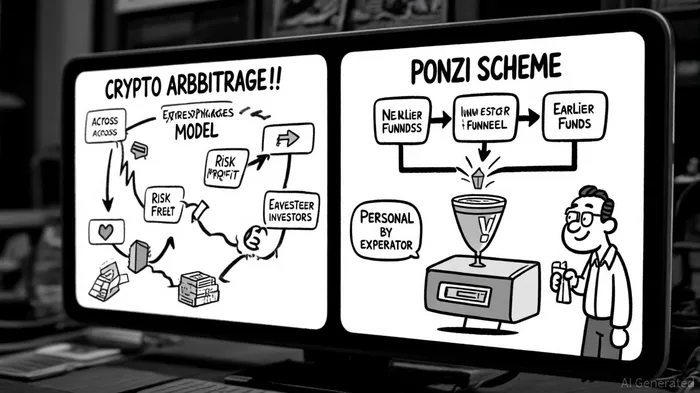
The collapse of Praetorian Group International (PGI) and its CEO Ramil Ventura Palafox's guilty plea for a $200 million BitcoinBTC-- Ponzi scheme[1] has exposed critical vulnerabilities in the regulatory framework governing crypto arbitrage strategies. This case, which defrauded over 90,000 investors globally[2], underscores how unscrupulous actors exploit the complexity of arbitrage to mask fraudulent operations. For investors and regulators alike, the PGI scandal serves as a stark reminder of the systemic risks inherent in crypto markets—and the urgent need for robust safeguards.
The Mechanics of Deception: Arbitrage as a Facade
PGI marketed itself as a cutting-edge crypto trading platform leveraging AI-driven arbitrage to generate daily returns of 0.5% to 3%[3]. In reality, no trading occurred. The scheme relied on a classic Ponzi structure, using funds from new investors to pay returns to earlier participants[4]. This mirrors the tactics of earlier crypto Ponzi schemes, such as BitConnect, but with a twist: Palafox weaponized the buzzword of “arbitrage” to attract technically savvy investors who might otherwise be skeptical of high-yield promises[5].
The arbitrage angle was particularly insidious. Legitimate arbitrage strategies exploit price discrepancies across markets to generate risk-free profits. However, PGI's operations were a farce. According to the DOJ, Palafox spent millions of investor funds on luxury assets—including a $1.7 million Las Vegas mansion, over 20 high-end vehicles, and designer goods from Gucci and Rolex[6]. The SEC's enforcement action, the first major case under Chair Paul Atkins, highlights how fraudsters exploit the ambiguity of arbitrage terminology to obscure their lack of actual trading activity[7].
Regulatory Response: A Dual Approach to Accountability
The parallel civil and criminal charges against Palafox demonstrate a coordinated regulatory strategy to combat crypto fraud. The DOJ secured a guilty plea with a restitution order of $62.7 million, while the SEC emphasized investor education and market transparency. This dual approach reflects a broader shift in regulatory priorities: while the SEC has historically focused on enforcement, the PGI case signals a renewed emphasis on proactive investor protection.
However, the scale of the fraud—$200 million over two years—reveals gaps in oversight. PGI operated across multiple jurisdictions, leveraging the decentralized nature of crypto to evade scrutiny. As noted in a report by Blockonomi, the scheme's collapse in 2021 coincided with a surge in crypto adoption, creating a “perfect storm” for fraudsters to exploit inexperienced investors.
Investor Protection: Red Flags and Systemic Risks
For investors, the PGI case highlights critical red flags:
1. Unrealistic Returns: Promises of 0.5% to 3% daily returns are mathematically unsustainable without external capital inflows.
2. Lack of Transparency: PGI provided no verifiable proof of its trading activities or AI algorithms.
3. Operator Lifestyle: Palafox's luxury expenditures—exceeding $57 million—were a clear indicator of misappropriation.
Systemically, the PGI scandal exacerbates trust issues in crypto markets. A 2025 study by the Journal of Financial Regulation found that Ponzi schemes like PGI erode confidence in crypto arbitrage, deterring institutional participation and stifling innovation. This creates a paradox: the very complexity that makes arbitrage attractive also makes it a prime vector for fraud.
The Path Forward: Strengthening Regulatory Guardrails
The PGI case demands a multi-pronged response:
- Enhanced Due Diligence: Investors must scrutinize the operational and financial transparency of arbitrage platforms.
- Regulatory Harmonization: Cross-border coordination is essential to prevent jurisdictional arbitrage by fraudsters.
- Technology-Driven Oversight: Regulators should adopt blockchain analytics tools to trace fund flows and detect Ponzi-like patterns early.
Conclusion
The PGI Ponzi scheme is not an isolated incident but a symptom of deeper systemic risks in crypto arbitrage. As the market evolves, regulators and investors must remain vigilant. The collapse of PGI—and the subsequent guilty plea—should serve as a catalyst for stronger safeguards, ensuring that the promise of crypto innovation is not overshadowed by the specter of fraud.






Comentarios
Aún no hay comentarios