
Regulatory Risks in Bitcoin Mining Expansion: Community Resistance and Municipal Fragmentation as Scaling Barriers
The Rise of Community Resistance
Bitcoin mining's energy-intensive nature has sparked backlash in communities where operations are concentrated. A prime example is Mitchell Bend, Hood County, Texas, where residents attempted to incorporate a new city in November 2025 to impose noise ordinances on a Marathon Digital Holdings mine. Despite the effort's failure, the case underscores a growing trend: rural communities, once attracted to mining for tax revenue and jobs, are now grappling with noise pollution, heat emissions, and strained energy grids, according to a Cointelegraph report.
Residents in Hood County described the mine's cooling systems as a "constant roar," disrupting their quality of life. Marathon responded with soundproofing measures and immersion cooling upgrades, but tensions persist. This microcosm of conflict highlights a broader issue: Bitcoin mining's environmental footprint is no longer an abstract concern but a tangible source of community friction.
Municipal Fragmentation: A Patchwork of Regulations
The U.S. lacks a unified regulatory framework for Bitcoin mining, creating a jigsaw of state and local rules that complicate scaling. Texas, with its low taxes and cheap energy, has become a crypto haven, hosting 27 mining facilities in 2023 alone. However, even here, counties lack authority to enforce noise regulations, leaving communities vulnerable to industrial-level disruptions, as Cointelegraph later noted.
In contrast, states like New York impose stringent environmental controls, including the controversial BitLicense regime, which critics argue stifles innovation . This regulatory divergence forces companies to adopt a scorched-earth strategy: secure operations in crypto-friendly states while navigating legal battles in others. For instance, OriginClear and Bitmern Mining formed a joint venture to develop sustainable mining facilities in Texas and Arizona, prioritizing locations with favorable energy policies and minimal bureaucratic hurdles, according to a Texas Tribune story.
Regulatory Changes: A New Era of Scrutiny
2025 marked a turning point as lawmakers began targeting Bitcoin mining's environmental impact. A Democratic-led initiative introduced a ban on mining operations using expired air permits and proposed a new tax on the industry, detailed in a StockTitan article. While the bill's passage remains uncertain, it signals a shift in political sentiment. Investors must now factor in the risk of ad hoc legislation that could escalate operational costs or force miners to adopt costly green technologies.
Meanwhile, the European Union's MiCA framework, while aiming for harmonization, leaves energy regulation to member states, creating jurisdictional complexities for cross-border operations, according to a TokenTax guide. This regulatory ambiguity is particularly acute for companies like Northern Data Group (NDG), which sold its Bitcoin mining division for $200 million in 2024 to pivot toward AI and high-performance computing (HPC), as reported in a Yahoo Finance article. The move reflects a broader industry trend: Bitcoin mining's margins are shrinking, while AI workloads offer higher returns per megawatt.
Industry Responses: Sustainability or Exit?
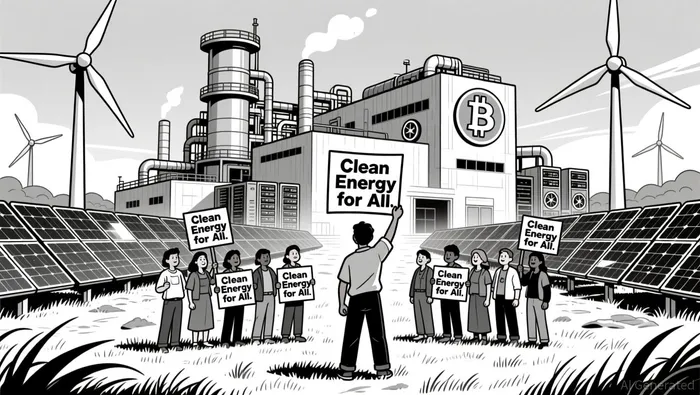
Faced with regulatory and community pressures, companies are splitting into two camps: those doubling down on sustainability and those exiting the sector entirely.
OriginClear and Bitmern's joint venture, for example, emphasizes "sustainable" mining, starting with a 100 MW pilot project and scaling to 500 MW, as the Texas Tribune reported. The initiative includes partnerships with energy providers to integrate renewable sources, a move designed to preempt regulatory backlash. Similarly, Canaan Inc. secured a $72 million investment to refocus on Bitcoin mining hardware and U.S. production, betting on efficiency gains to offset rising costs, according to TokenTax.
Conversely, firms like NDG are abandoning Bitcoin altogether. By 2024, NDG's AI and cloud revenue had tripled to €200 million, dwarfing mining profits, a Yahoo Finance report noted. This pivot underscores a harsh reality: Bitcoin mining's energy consumption model is incompatible with long-term institutional adoption unless paired with breakthroughs in green tech.
Investment Implications: Navigating the New Normal
For investors, the Bitcoin mining sector is no longer a pure play on cryptocurrency price action. Regulatory and community risks now dominate the risk-reward calculus. Key considerations include:
1. Location Arbitrage: Prioritize companies operating in crypto-friendly jurisdictions (e.g., Texas, Wyoming) while hedging against exposure in restrictive regions.
2. Sustainability Premiums: Firms investing in renewable energy integration or AI diversification (e.g., OriginClear, Canaan) are better positioned to withstand regulatory headwinds.
3. Exit Risks: Monitor companies like NDG that are pivoting away from mining, as their reorientation could signal broader industry trends.
The 2025 legislative push in the U.S. and Europe suggests that Bitcoin mining will face escalating compliance costs. For now, the industry's survival hinges on its ability to balance scalability with sustainability-a tightrope walk that will define its next phase.





Comentarios
Aún no hay comentarios