
Regulatory Risk and Stock Valuation in Emerging Markets: Strategic Positioning in Indian Equities Post-Adani Crisis
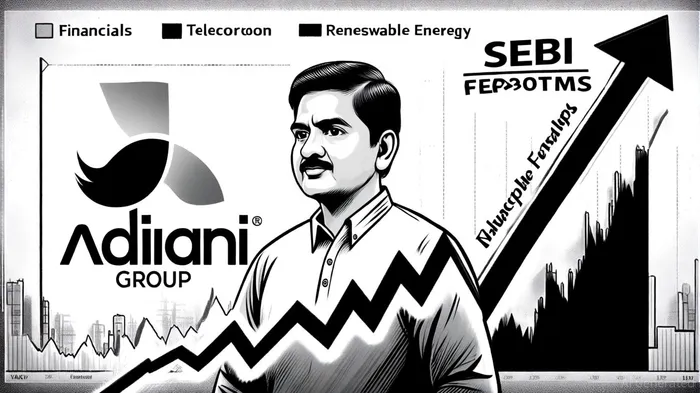
The Adani-Hindenburg crisis of early 2023 exposed critical vulnerabilities in India's equity market oversight, triggering a seismic shift in regulatory frameworks and investor behavior. In response, the Securities and Exchange Board of India (SEBI) and the Supreme Court implemented sweeping reforms to enhance transparency, investor protection, and market integrity. These changes, coupled with evolving macroeconomic dynamics, have reshaped valuation metrics and sectoral opportunities in Indian equities. For investors, understanding the interplay between regulatory risk and valuation dynamics is key to strategic positioning in this emerging market.
Regulatory Reforms and Market Integrity
The Adani-Hindenburg saga underscored systemic gaps in India's securities market, particularly in short-selling practices and corporate governance. In October 2023, SEBI introduced a democratized short-selling framework, extending access to all investors while imposing stricter disclosure requirements[1]. Institutional investors must now disclose short positions upfront, while retail investors report at the end of the trading day. The framework also banned institutional day trading and mandated a securities lending and borrowing scheme to improve market efficiency[1]. These measures aimed to curb manipulative practices and restore confidence, as seen in the Adani Group's Rs 46,000 crore market capitalization surge following SEBI's 2025 clean chit[2].
The Supreme Court further emphasized regulatory independence, urging SEBI to separate its quasi-judicial and executive functions to avoid conflicts of interest[3]. Additionally, real-time surveillance systems and enhanced disclosure norms for conglomerates were proposed to align India's market with global standards[3]. While these reforms have bolstered investor trust, they have also introduced compliance burdens, particularly for foreign institutional investors (FIIs), leading to short-term volatility and liquidity concerns[4].
Valuation Dynamics and Sector Re-Rating
The post-Adani regulatory environment has driven significant sectoral re-ratings. From 2023 to mid-2025, institutional capital shifted from high-beta sectors like Auto and Real Estate to Financial Services and Telecom, driven by earnings visibility and operational resilience[5]. Financial Services, including private banks and non-banking financial companies (NBFCs), became a cornerstone of portfolios, supported by stable gross non-performing assets (GNPAs) (<3.1%) and credit growth of ~14.5% YoY[5]. Telecom operators like Bharti Airtel gained traction due to 5G deployment and rising average revenue per user (ARPU), with sector return on capital employed (ROCE) expanding to 14%[5].
Meanwhile, the MSCIMSCI-- India Index traded at a valuation premium to emerging markets (EM), with most sectors at forward price-to-earnings (P/E) ratios above historical medians as of 2023[6]. However, sectors like IT and Pharmaceuticals faced valuation corrections due to global demand softening and regulatory scrutiny. For instance, IT firms saw mid-cap re-ratings driven by cost arbitrage and generative AI (GenAI) capabilities, though earnings growth lagged compared to earlier highs[5].
Strategic Investment Opportunities
Post-Adani reforms have created a landscape where thematic and sector-specific opportunities dominate. Analysts highlight value buys in renewable energy, telecommunications, and manufacturing, with firms like Adani Energy Solutions and Belrise Industries showing strong fundamentals[7]. Infrastructure and consumption-driven sectors, including Birla Corporation and Larsen & Toubro, benefit from India's $5 trillion GDP trajectory and rising domestic demand[8].
Financial Services remain a critical overweight in portfolios, supported by low GNPA levels and improved current account savings ratios (CASA). Telecom's structural re-rating is underpinned by ARPU growth and capex efficiency, while services sectors like hospitality and logistics recover with improving EBITDA margins[9]. For long-term positioning, investors should prioritize sectors aligned with India's structural reforms, such as digital transformation, green energy, and consumption-led growth[10].
Risks and Considerations
Despite the reforms, regulatory overreach and compliance costs remain risks. FIIs have expressed concerns over stringent disclosure norms, which could deter foreign inflows[4]. Additionally, global monetary policy shifts and geopolitical tensions may impact liquidity, particularly for sectors reliant on external capital. Investors must balance these risks with India's macroeconomic stability—3-5% inflation and a projected third-largest equity market by 2025[8].
Conclusion
The Adani crisis catalyzed a regulatory overhaul that has redefined India's equity market. While short-term volatility persists, the long-term outlook for strategic investors remains positive, particularly in sectors with operational visibility and thematic alignment. By leveraging SEBI's enhanced transparency measures and focusing on fundamentals, investors can navigate regulatory risks while capitalizing on India's structural growth drivers. As the market evolves, a diversified approach—spanning large-cap stability and mid-cap innovation—will be essential to harness the opportunities in this dynamic emerging market.







Comentarios
Aún no hay comentarios