
Regulatory Risk and Political Lobbying in Crypto: Assessing the Long-Term Viability of Blockchain Firms Post-FTX
The collapse of FTX in late 2022 exposed systemic vulnerabilities in the crypto industry, triggering a global regulatory reckoning. By 2025, jurisdictions from the U.S. to Asia have implemented stricter frameworks, while political lobbying has reshaped the industry's trajectory. This analysis evaluates how these forces-regulatory clarity, compliance burdens, and political influence-are determining the long-term viability of blockchain firms.
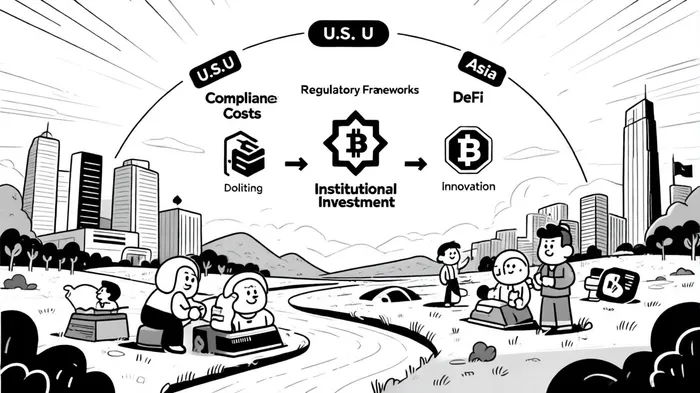
Regulatory Clarity: A Double-Edged Sword
Post-FTX, regulatory frameworks have evolved from ambiguity to structured oversight. In the U.S., the Trump administration's pro-crypto agenda-marked by the nomination of Paul Atkins as SEC chair and the passage of the GENIUS Act-has positioned the country as a "crypto capital of the planet"[1]. The SEC and CFTC's joint green light for spot crypto trading in September 2025[3] and the approval of generic listing standards for ETPs[2] have provided much-needed clarity, attracting institutional investors. However, compliance costs remain a hurdle. For example, Bittrex was fined $24 million in 2022 for BSA violations[4], illustrating the risks of inadequate compliance infrastructure.
In the EU, the Markets in Crypto-Assets (MiCA) regulation, fully implemented by 2025, mandates licensing for 53 crypto firms, including 14 stablecoin issuers[5]. While this fosters transparency, it also raises operational costs, particularly for smaller firms. The EBA and ESMA's 2025 report on DeFi highlights residual risks like MEV and cybersecurity, underscoring the need for ongoing regulatory adaptation[5].
Asia has emerged as a regulatory innovator. Singapore's 30 Major Payment Institution licenses and Hong Kong's 14 virtual asset trading licenses[6] have created hubs for institutional adoption. Japan's approval of the first yen-pegged stablecoin (JPYC) and South Korea's Digital Asset Basic Act (DABA) further demonstrate a balanced approach to innovation and compliance[6].
Political Lobbying: Shaping the Regulatory Landscape
Political lobbying has become a critical lever for crypto firms. In the U.S., the industry spent $133 million in 2024 to influence elections, including defeating Senate Banking Committee chair Sherrod Brown, a crypto skeptic[7]. Pro-crypto Super PACs like Fairshake spent $141 million to elect allies, directly altering legislative priorities[7]. This spending coincided with Trump's pivot to crypto advocacy, including plans for a national BitcoinBTC-- reserve[7].
In the EU, lobbying groups like the European Crypto Initiative and INATBA have pushed for policies supporting decentralized technologies[8]. Meanwhile, Asia's lobbying efforts vary: China's controlled blockchain integration via the Digital Yuan contrasts with Singapore's pro-innovation stance under the Payment Services Act[8].
Case Studies: Adaptation and Survival
Blockchain firms have adapted to regulatory shifts in diverse ways:
- Coinbase leveraged lobbying to secure compliance under MiCA in Luxembourg and contributed to the GENIUS Act's passage[1].
- Chainalysis thrived by providing AML tools, capitalizing on regulators' demand for transparency[1].
- DeFi platforms face existential challenges due to their decentralized nature. While the U.S. and EU adopt consultative approaches, Asian jurisdictions are testing sandbox models to integrate DeFi[3].
Conversely, smaller firms struggle with compliance costs. For instance, FTX's offshore relocation to avoid U.S. restrictions highlights the risks of regulatory fragmentation[1].
Investment Trends and Institutional Adoption
Regulatory clarity has spurred institutional interest. By 2025, 83% of institutional investors plan to increase crypto allocations[9], driven by the legalization of spot ETFs and tokenized assets. The crypto asset management market, valued at $2 billion in 2024, is projected to grow at 4% CAGR to $2.5 billion by 2030[9]. Traditional hedge funds now allocate 47% to digital assets, up from 29% in 2023[9].
However, regulatory divergence poses challenges. For example, the EU's MiCA and China's restrictive policies create cross-border enforcement complexities[6].
Conclusion: Navigating the New Normal
The post-FTX era has redefined the crypto industry's viability. While regulatory clarity and political lobbying have fostered innovation, they also impose significant compliance burdens. Firms that prioritize robust governance, like BlackRock and JPMorgan, are outpacing smaller players[3]. For investors, the key lies in balancing exposure to regulated, institutional-grade assets with cautious optimismOP-- toward DeFi's evolving regulatory integration.
As the U.S. aims to become a "bitcoin superpower" and Asia solidifies its regulatory leadership, the long-term success of blockchain firms will hinge on their ability to adapt to a world where innovation and compliance coexist.





Comentarios
Aún no hay comentarios