
Regulatory Risk in Pharma Supply Chains: The FDA's Dilemma with Sun Pharma and Investor Sentiment
The pharmaceutical supply chain has long been a double-edged sword for investors: a sector brimming with growth potential but shadowed by regulatory scrutiny. Nowhere is this tension more evident than in the case of Sun Pharmaceutical Industries, a global generic drug giant whose repeated FDA violations and selective exemptions have sparked a crisis of confidence. As the FDA grapples with balancing public health needs against corporate accountability, investors must navigate a minefield of regulatory risks that could ripple across the entire generic drug market.
The FDA’s Reluctant Enforcement: A Pattern of Leniency
Sun Pharma’s Halol facility in India has been a recurring thorn in the FDA’s side. A June 2025 inspection revealed “leaks allowing dirty water into sterile areas” and “mold contamination,” compounding a history of violations dating back to 2014 [4]. Despite these findings, the FDA delayed imposing a full import ban until December 2022—seven years after its first major warning. Even then, the agency exempted over a dozen drugs from the banned facility, allowing them to continue flowing into U.S. markets [1]. This pattern of delayed action and selective exemptions raises a critical question: Is the FDA prioritizing corporate convenience over patient safety?
The June 2025 inspection appears to have broken this cycle. The FDA concluded that the Halol plant’s deficiencies were “severe enough to justify maintaining the import ban,” signaling a shift toward stricter enforcement [4]. Yet the agency’s past leniency has left a stain on its credibility. As one industry analyst put it, “The FDA’s reputation as a gatekeeper is eroding when it’s seen as a rubber stamp for companies that cut corners” [1].
Investor Sentiment: A Tug-of-War Between Hope and Distrust
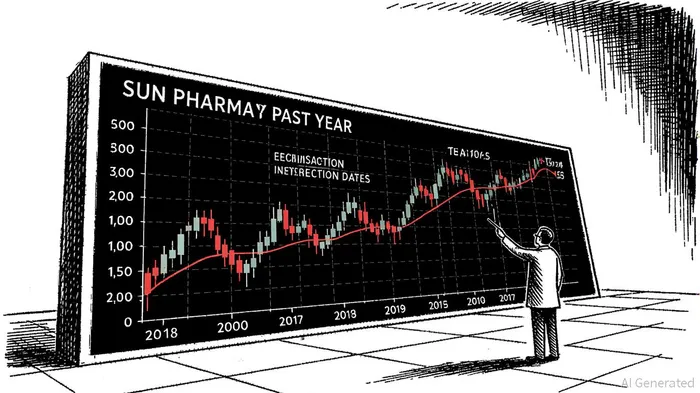
Sun Pharma’s stock has mirrored this regulatory tug-of-war. Over the past month, , driven by weak earnings, concerns over compliance costs, and the looming threat of U.S. tariffs on Indian exports [4]. Yet there’s a silver lining: The FDA’s planned lifting of the ban on Sun Pharma’s Mohali plant—a facility acquired from Ranbaxy in 2015—has injected some optimism. .
However, the broader market remains wary. Financial institutionsFISI-- like Goldman SachsGS-- have downgraded Sun Pharma’s risk profile, citing “persistent quality control issues and the FDA’s inconsistent enforcement” [4]. The company’s recent acquisition of Checkpoint Therapeutics—a move into oncology—has done little to assuage these concerns. While innovative drugs like Unloxcyt (cosibelimab-ipdl) offer growth avenues, they also divert attention from the core compliance challenges that continue to haunt the firm [2].
The Bigger Picture: A Systemic Risk for the Generic Drug Market
Sun Pharma’s struggles are not an isolated incident. . , with over 650 FDA-approved facilities operating in the country [1]. This reliance on Indian manufacturing has created a paradox: The U.S. depends on India for affordable medicines, yet the FDA’s inspections have repeatedly flagged quality issues. For example, Glenmark Pharmaceuticals—a Sun Pharma peer—has also faced FDA warnings for GMP violations [3].
The FDA’s exemptions for non-compliant manufacturers like Sun Pharma highlight a systemic flaw. By allowing certain drugs from banned facilities to enter the U.S., the agency risks undermining public trust in generic medications. As ProPublica noted in a 2024 investigation, “The FDA’s exemptions are a gamble: They prioritize short-term access over long-term safety, and the public pays the price when contaminated drugs reach patients” [1].
What’s Next for Investors?
For investors, the key takeaway is clear: Regulatory risk in the pharmaceutical supply chain is no longer an abstract concept—it’s a tangible threat to portfolio stability. Here’s how to navigate it:
- Monitor FDA Enforcement Trends: The June 2025 inspection suggests the FDA may be tightening its grip. Watch for follow-up actions at other Indian facilities, such as those operated by Cipla or Dr. Reddy’s.
- Assess Company-Specific Compliance Efforts: Sun Pharma claims to have completed Corrective and Preventive Action (CAPA) at the Halol plant [3]. Investors should scrutinize the timeline and effectiveness of these measures.
- Diversify Exposure: Avoid overconcentration in firms reliant on a single FDA-exempted facility. Instead, favor companies with redundant manufacturing sites and robust quality control systems.
Conclusion
The FDA’s handling of Sun Pharma underscores a broader challenge: How to balance the need for affordable drugs with the imperative of safety. For now, the agency’s exemptions appear to be a stopgap solution that masks deeper systemic issues. Investors must remain vigilant, recognizing that regulatory risk is not just a compliance issue—it’s a market-moving force. As the pharmaceutical industry becomes increasingly globalized, the line between corporate accountability and public health will only grow thinner.
Source:
[1] The FDA's Gamble on America's Drugs [https://www.propublica.org/article/fda-drug-loophole-sun-pharma]
[2] Sun Pharma Agrees to Acquire Checkpoint Therapeutics [https://www.pharmtech.com/view/sun-pharma-acquire-checkpoint-therapeutics]
[3] Sun Pharma says working towards full regulatory resolution at 3 plants facing USFDA action [https://m.economictimes.com/industry/healthcare/biotech/pharmaceuticals/sun-pharma-says-working-towards-full-regulatory-resolution-at-3-plants-facing-usfda-action/articleshow/122305341.cms]
[4] FDA Inspection Finds Leaks and Mold at Sun Pharma Halol Facility [https://insights.citeline.com/generics-bulletin/policy-and-regulation/fda-inspection-finds-leaks-and-mold-at-sun-pharma-halol-facility-XKQXY4PMPJBQFH2YUKJEF2VLTU/]







Comentarios
Aún no hay comentarios