
Regulatory Risk in NFTs: Legal Turbulence and the Path to Market Maturation
The NFT and digital asset markets have entered a pivotal phase, where regulatory scrutiny is reshaping investor behavior, market dynamics, and the very definition of ownership. Over the past two years, legal rulings by the U.S. Securities and Exchange Commission (SEC), the Federal Trade Commission (FTC), and international bodies have created a volatile landscape. While enforcement actions have stifled innovation in some corners, they've also catalyzed a push for clarity-forcing the industry to confront its identity and mature in the process.
The SEC's Enforcement-First Approach: A Double-Edged Sword
The SEC has weaponized the Howey Test to classify certain NFTs as securities, triggering a wave of enforcement actions. In 2023, the agency's landmark case against Impact Theory-a media company selling NFTs for content access-set a precedent, as detailed in an SEC press release. This approach extended to Flyfish Club, a restaurant NFT project, and OpenSea, the largest NFT marketplace, which received a Wells Notice in August 2024 for allegedly operating an unregistered securities exchange, according to a NatLaw Review article.
While these actions signal regulatory authority, they've also created a "regulation by enforcement" vacuum. Critics argue the SEC's lack of explicit guidance has left market participants guessing, stifling innovation and investor trust, as noted in a Reuters report. For instance, OpenSea's creation of a legal defense fund to support creators facing SEC notices highlights the industry's defensive posture, as described in the NatLaw Review article.
Legal Challenges and the Fight for Clarity
The NFT community has pushed back. In July 2024, artists Jonathan Mann and Brian Frye sued the SEC, seeking a declaratory judgment that their NFTs are not securities. However, U.S. District Judge Greg Guidry dismissed the case in September 2025, calling the claims "speculative," according to the Reuters report. Meanwhile, OpenSea users filed a class-action lawsuit alleging the platform facilitates unregistered securities, a claim discussed in the NatLaw Review article. These legal battles underscore the tension between regulatory overreach and the need for a coherent framework.
Legislative Breakthroughs: The NFT Act and Beyond
Amid the chaos, legislative efforts have emerged as a lifeline. The New Frontiers in Technology Act (NFT Act), introduced in September 2024, seeks to exclude digital art, collectibles, and certain NFTs from securities classification, per the NatLaw Review article. If passed, the bill could redefine the industry's relationship with regulators, shifting from enforcement to structured clarity. Early signals from the incoming Trump administration also suggest a pivot: reclassifying meme coins and NFTs as collectibles and appointing pro-crypto figures like David Sacks and Paul Atkins to key roles, as reported by Reuters.
Global Harmonization and Investor Sentiment
Internationally, the UK's High Court recognized NFTs as legal property in 2025, offering a degree of certainty, according to a Goettelman Law review. Meanwhile, the Financial Action Task Force (FATF) continues to push for global standards on virtual assets, though compliance remains uneven, a point also covered in the Goettelman Law review. These developments hint at a gradual shift toward harmonization, which could reduce cross-border friction and attract institutional investors.
However, investor confidence remains fragile. A 2025 Chainalysis survey found that 62% of NFT investors view regulatory uncertainty as a top risk. The SEC's enforcement-first strategy has already driven some projects underground, while the NFT Act's potential passage could stabilize the market.
The Road Ahead: Balancing Risk and Opportunity
The NFT market's maturation hinges on balancing regulatory oversight with innovation. For investors, this means:
1. Due Diligence: Prioritize projects with clear utility and minimal securities-like features.
2. Hedging Against Uncertainty: Diversify portfolios across jurisdictions with emerging clarity (e.g., the UK).
3. Advocacy: Support legislative efforts like the NFT Act to reduce ambiguity.
Conclusion
The NFT space stands at a crossroads. Regulatory risk, while daunting, is not insurmountable. As the SEC's enforcement actions clash with legislative and international efforts, the market is being forced to evolve-prioritizing transparency, utility, and compliance. For investors, the challenge lies in navigating this turbulence while positioning for a future where NFTs are not just speculative assets but foundational elements of a digital economy.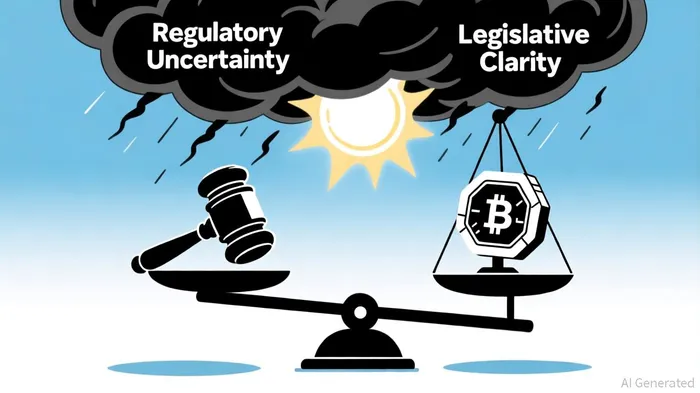







Comentarios
Aún no hay comentarios