
Regulatory Risk in Digital Advertising: DOJ's Antitrust Actions Against Google and Ad Tech Stock Implications
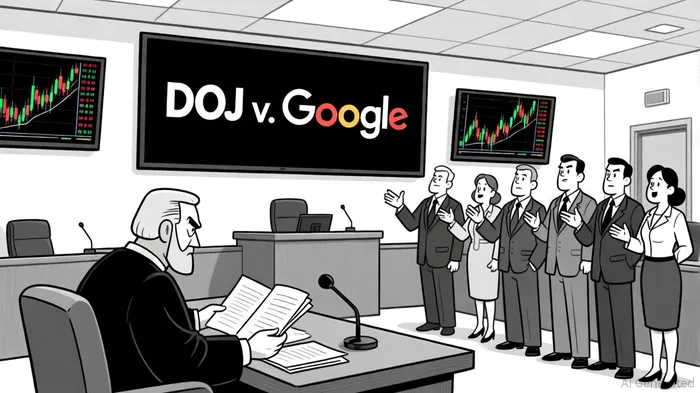
The U.S. Department of Justice's (DOJ) antitrust actions against GoogleGOOGL-- have become a defining regulatory saga of the digital age, with profound implications for the advertising technology sector. As courts deliberate remedies for Google's alleged monopolies in search and ad tech markets, investors are recalibrating their strategies to account for shifting competitive dynamics and regulatory risks. This analysis examines the evolving legal landscape, market reactions, and strategic positioning of ad tech competitors to assess the long-term implications for the sector.
Legal Developments: A Nuanced Outcome for Google
In September 2025, a federal court imposed remedies on Google for its dominance in general search and search advertising but avoided the most severe penalties, such as a forced breakup of the company. The court prohibited Google from enforcing exclusive contracts that set its search engine as the default on devices and mandated data sharing with “Qualified Competitors”[3]. These measures aim to foster competition while preserving Google's innovation incentives. Separately, in the ad tech case, the court ruled that Google monopolized publisher ad servers and ad exchanges but not advertiser-side tools, rejecting the DOJ's push for a structural breakup[6]. Google has contested these remedies, advocating for interoperability solutions instead of divestitures[4].
The outcomes reflect a judicial balancing act: addressing anticompetitive practices without destabilizing the digital advertising ecosystem. As one analyst noted, “The rulings signal a preference for targeted interventions over sweeping structural changes, which could limit immediate disruption to Google's business model”[5].
Market Reactions: Relief and Caution
The market responded favorably to the September 2025 rulings, with Alphabet's shares surging 9.14% as the threat of a breakup receded[1]. Apple also benefited, with its stock rising 3.81%, as the court allowed Google to maintain payments to device manufacturers for preloading its search engine[1]. In the ad tech space, competitors like The Trade DeskTTD-- and PubMatic saw stock gains of 7.7% and 11.9%, respectively, following the April 2025 ad tech ruling[3]. These moves underscore investor optimism about a more competitive landscape if Google's dominance is curtailed.
However, analysts remain cautious. Wedbush analysts raised their price target for Alphabet to $245, noting that even a divestiture of Google Ad Manager would account for less than 8% of its revenue[5]. They emphasized that the “worst-case scenario has been averted,” with Google's AI and cloud divisions offering growth buffers[1].
Strategic Implications for Ad Tech Competitors
The DOJ's actions have created both opportunities and risks for ad tech firms. PubMatic, for instance, has filed its own lawsuit against Google, seeking to restore fair competition in digital advertising[1]. The company's proactive legal stance aligns with its recent financial performance, including strong growth in omnichannel video advertising[3]. Similarly, The Trade Desk has capitalized on regulatory scrutiny, though it faces its own challenges, including lawsuits over privacy violations[2].
The potential for structural remedies—such as the sale of Google's ad exchange—could accelerate market share gains for these competitors. However, the complexity of Google's integrated ad tech stack complicates divestitures without unintended consequences for publishers and advertisers[6]. As one industry observer noted, “Regulators are navigating a minefield of technical and economic dependencies”[4].
Broader Regulatory Trends and Investment Considerations
The Google cases are part of a broader DOJ strategy to rein in Big Tech, with parallel antitrust actions against Meta, Apple, and Amazon[6]. These efforts signal a regulatory shift toward digital markets, where traditional antitrust frameworks are being adapted to address network effects and data-driven monopolies. For investors, this environment demands a nuanced approach:
- Short-Term Stability: Google's avoidance of a breakup and its focus on interoperability solutions suggest limited near-term disruption to its ad revenue streams.
- Long-Term Uncertainty: Structural remedies in the ad tech case could reshape market dynamics, benefiting competitors but also creating integration challenges.
- Regulatory Contagion: Stricter enforcement against Google may prompt similar actions against other tech giants, amplifying regulatory risk across the sector.
Conclusion
The DOJ's antitrust actions against Google represent a pivotal moment for digital advertising. While the immediate market reaction has favored Google and its allies, the long-term trajectory hinges on the effectiveness of remedies in fostering competition. For ad tech stocks, the path forward is fraught with both opportunity and uncertainty. Investors must weigh the potential for a more competitive landscape against the risks of regulatory overreach and operational disruptions. As courts finalize remedies and appeals unfold, the sector's evolution will serve as a litmus test for the viability of antitrust enforcement in the digital era.





Comentarios
Aún no hay comentarios