
Regulatory Risk in Crypto-Powered Prediction Markets: A Growing Threat to Platform Scalability and Profitability?
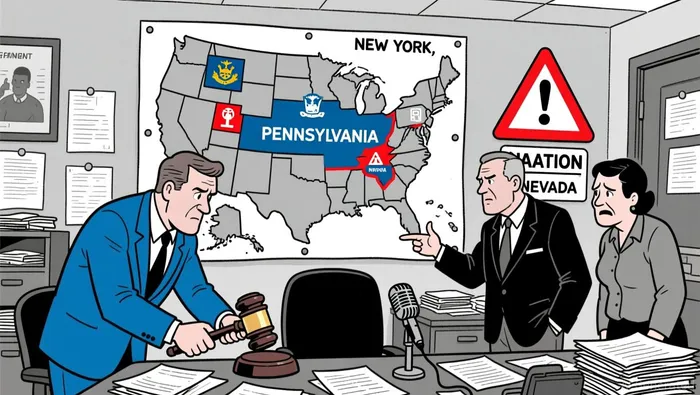
The rise of crypto-powered prediction markets has introduced a novel financial instrument, enabling users to speculate on future events with blockchain-based contracts. Platforms like Kalshi and Polymarket, operating under CFTC oversight as Designated Contract Markets (DCMs), have positioned themselves as pioneers in this space. However, 2025 has revealed a critical vulnerability: the escalating regulatory scrutiny at the state level. As states like New York, Pennsylvania, and Nevada impose legal constraints, the long-term viability of these platforms hinges on their ability to navigate a fragmented and increasingly hostile regulatory environment.
State-Level Regulatory Trends: A Fragmented Landscape
While Tennessee has not yet enacted specific measures against prediction markets, broader U.S. state-level trends suggest a growing appetite for intervention. New York's Assembly Bill 9251, the ORACLE Act, exemplifies this shift. Introduced in November 2025, the bill proposes a statutory framework that defines prediction markets as speculative platforms requiring age restrictions (minimum 21), responsible gaming measures, and prohibitions on markets tied to athletic, political, or death-related events. The legislation also grants the New York Attorney General broad enforcement authority, signaling a regulatory approach that prioritizes consumer protection over innovation.
Pennsylvania's December 2025 informational hearing further underscores this trend. The Pennsylvania House Gaming Oversight Committee examined how prediction markets intersect with existing gaming laws, with regulators highlighting similarities to sports wagering while emphasizing gaps in consumer safeguards. Though no immediate legislation followed, the hearing reflects a broader pattern: states are increasingly treating prediction markets as a regulatory gray area that demands intervention.
Meanwhile, a coalition of states-including Arizona, Illinois, Maryland, Nevada, New Jersey, and Ohio-has taken direct action. These jurisdictions sent cease-and-desist letters to platforms like Kalshi and Crypto.com, asserting that prediction markets functionally resemble sports betting and thus require state gaming licenses. Kalshi has secured preliminary injunctions in some cases but faced defeats in Maryland and Nevada, where courts allowed state regulators to enforce restrictions. This patchwork of enforcement actions creates operational uncertainty, forcing platforms to allocate resources to compliance battles rather than scaling their user bases.
Kalshi's CFTC Approval vs. State-Level Pushback
Kalshi's status as a CFTC-regulated DCM has provided a degree of federal legitimacy. The CFTC's 2023 approval clarified that event contracts can operate within U.S. regulatory boundaries if structured appropriately. However, state-level actions have exposed the limitations of this federal framework. For instance, Massachusetts sued Kalshi in 2025, arguing that its platform offers betting opportunities without a state gaming license. Similarly, Nevada's federal court rejected Kalshi's motion for a stay, enabling state regulators to enforce cease-and-desist orders. These cases highlight a critical tension: while federal regulators may tolerate prediction markets under specific conditions, states are free to impose their own definitions of "gaming" and "betting," creating a jurisdictional quagmire.
SEC Enforcement Shifts and Market Implications
The Securities and Exchange Commission's evolving priorities under Chairman Paul Atkins have also reshaped the regulatory landscape. In 2025, the SEC shifted focus away from registration cases and toward prosecuting fraudulent activities such as insider trading. While this approach may reduce immediate enforcement risks for compliant platforms, it does little to address the operational challenges posed by state-level fragmentation. For prediction markets, the absence of federal preemption means that state regulators retain primary authority to define and restrict their operations.
Investment Implications: Scalability and Profitability at Risk
The dual regulatory burden-federal oversight and state-level crackdowns-poses significant risks to the scalability and profitability of CFTC-regulated platforms. First, operational fragmentation increases compliance costs. Platforms must navigate a labyrinth of state-specific rules, from age restrictions to licensing requirements, which could deter expansion into key markets. Second, the threat of cease-and-desist orders or injunctions creates reputational and financial instability. For example, Kalshi's legal defeats in Nevada and Maryland have forced it to suspend operations in those states, limiting its addressable market. Third, consumer adoption may stagnate if platforms are unable to offer seamless access across jurisdictions.
Investors must also consider the long-term viability of prediction markets in a regulatory environment that prioritizes caution over innovation. If states continue to treat these platforms as extensions of traditional gaming, the result could be a de facto moratorium on new entrants or a consolidation of market share among firms with deep legal resources.
Conclusion: A Tenuous Balance
Crypto-powered prediction markets represent a compelling innovation, but their future depends on resolving the tension between federal and state regulatory frameworks. While the CFTC's approval provides a foundation, the lack of federal preemption leaves platforms vulnerable to state-level interventions. For investors, the key question is whether these platforms can adapt to a fragmented regulatory landscape without sacrificing scalability or profitability. As 2025 has shown, the answer may lie not in technological innovation alone, but in the ability to influence policy and secure a coherent legal framework. Until then, regulatory risk remains a looming threat to the sector's long-term potential.







Comentarios
Aún no hay comentarios