
Regulatory Risk and AI Innovation: The Case of DeepSeek
The global AI landscape in 2025 is defined by a paradox: unprecedented innovation coexisting with escalating regulatory scrutiny. At the center of this tension is DeepSeek, a Chinese AI startup that has disrupted traditional cost structures in AI development while facing mounting geopolitical and legal challenges. For strategic investors, the case of DeepSeek offers a critical lens through which to evaluate the interplay between technological advancement and regulatory risk in the AI sector.
DeepSeek's Business Model and Market Position
DeepSeek's hybrid business model-combining open-source access with AI-as-a-Service (AIaaS) and enterprise licensing-has positioned it as a formidable competitor to Western AI giants. By prioritizing cost efficiency, , , while delivering comparable performance. This cost advantage has driven rapid adoption, particularly in emerging markets. As of Q3 2025, , , .
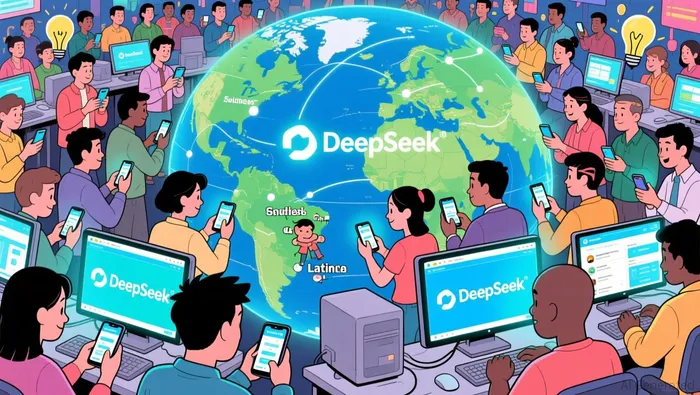 The company's revenue streams are diversified across API subscriptions, on-premise deployments, and model fine-tuning services. Its tiered API pricing, significantly lower than competitors, has attracted developers and small enterprises, while enterprise clients value its on-premise solutions for data privacy compliance. Meanwhile, the open-source release of its models has democratized AI access, fostering global innovation but also sparking debates about security and governance.
Regulatory Challenges and Geopolitical Tensions
Despite its commercial success, DeepSeek faces a growing web of regulatory restrictions. Governments in the U.S., South Korea, Italy, and the EU have imposed bans or restrictions on its use in public-sector operations, citing concerns over data privacy, national security, and potential ties to the Chinese government. For instance, South Korea's Personal Information Protection Commission () found that DeepSeek had transferred user data-including AI prompts and device metadata-to a Chinese cloud provider without consent, leading to app store removals. Similarly, the European Union's enforcement body blocked DeepSeek's R1 model in Italy due to inadequate privacy disclosures.
Cybersecurity vulnerabilities further complicate its position. Independent research has shown that DeepSeek's open-source design allows users to bypass safety guardrails, . models. These risks are compounded by its data storage policies, which place user data under Chinese jurisdiction-a factor that has drawn scrutiny from the U.S. Department of Defense, NASA, and state governments like Texas and New York.
Investment Implications: Balancing Opportunity and Risk
DeepSeek's emergence has reshaped AI market dynamics. Its cost-efficient models have in January 2025 following its announcement. However, the broader AI market remains resilient, with the global AI in finance sector projected to grow . This growth underscores the transformative potential of AI, even as regulatory headwinds persist.
For investors, the key lies in navigating the duality of DeepSeek's value proposition. On one hand, its architectural innovations challenge the dominance of brute-force scaling, offering a blueprint for cost-effective AI development. On the other, its regulatory exposure highlights the need for diversified portfolios and rigorous due diligence. Legal experts warn that litigation risks-such as potential intellectual property disputes over distillation techniques-could further destabilize the sector.
Strategic Recommendations for Investors
To mitigate regulatory risks while capitalizing on AI innovation, investors should adopt a multi-pronged strategy:
1. Diversify Exposure: Avoid over-reliance on single AI platforms by investing in a mix of proprietary and open-source solutions.
2. Prioritize Compliance: Scrutinize data governance practices, particularly for AI tools developed in jurisdictions with opaque regulatory frameworks.
3. Hedge Against Volatility: Allocate capital to AI infrastructure (e.g., semiconductors) and cybersecurity firms, which are less susceptible to direct regulatory bans.
As the DeepSeek case illustrates, regulatory scrutiny is unlikely to abate in 2025. However, for investors with a long-term horizon, the AI sector's resilience and transformative potential remain compelling. The challenge lies in aligning strategic investments with the evolving interplay of innovation, regulation, and geopolitical dynamics.







Comentarios
Aún no hay comentarios