
Regulatory Pressure on Financial Institutions: Implications for Bank Stock Valuation Under FCCPC's 48-Hour Rule
The Federal Competition and Consumer Protection Commission (FCCPC) and the Central Bank of Nigeria (CBN) have introduced a transformative regulatory framework mandating banks to refund failed ATM transactions within 48 hours. This policy, outlined in the CBN's draft guidelines, aims to resolve long-standing consumer grievances and rebuild trust in Nigeria's financial ecosystem. However, the implications for bank stock valuations are complex, hinging on the interplay between operational efficiency, risk management, and investor sentiment.
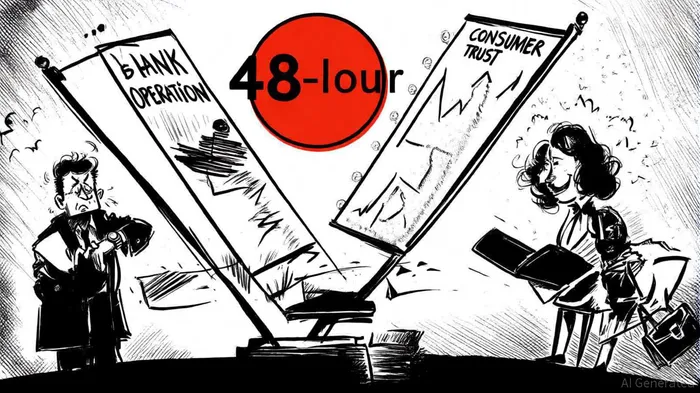
Operational Efficiency: A Double-Edged Sword
The 48-hour rule demands immediate action from banks, particularly for "on-us" transactions (instant refunds) and "not-on-us" transactions (48-hour window). According to a report by Punch Newspapers, banks must now invest in advanced reconciliation systems, real-time transaction monitoring, and staff training to meet these deadlines. For smaller institutions, these upgrades could strain already tight budgets. The FCCPC's Consumer Complaints Data Report highlights that over 3,000 banking-related complaints were recorded between March and August 2025, with ₦10 billion recovered for consumers, according to Arise TV. While automation and AI-driven solutions may mitigate some costs, the initial capital outlay and ongoing maintenance could erode profit margins.
Larger banks, with existing infrastructure, may adapt more swiftly, but even they face challenges. For instance, the FCCPC's collaboration with the CBN to enforce penalties for non-compliance introduces a layer of financial risk. A Premium Times analysis notes that non-compliant banks could face fines or reputational damage, further pressuring operational budgets.
Risk Management: Balancing Compliance and Consumer Trust
The rule's primary goal is to reduce consumer dissatisfaction, a critical risk factor for banks. By addressing issues like delayed refunds and unauthorized deductions, the FCCPC aims to align the sector with the Federal Competition and Consumer Protection Act (FCCPA) 2018, which mandates fair dealings and transparency, as reported by The Issues Magazine. This alignment could lower litigation risks and enhance customer retention.
However, the regulatory burden itself introduces new risks. The Cable underscores that banks must now allocate resources to monitor compliance and address potential violations, diverting attention from core operations. For example, the FCCPC's threat to penalize service disruptions-such as online banking outages-adds pressure to maintain uninterrupted digital services, a costly endeavor for institutions with legacy systems, according to Vanguard.
Stock Valuation Implications: Short-Term Pain, Long-Term Gain?
The immediate impact on stock valuations is likely negative. Increased operational and compliance costs could reduce earnings per share (EPS), a key driver of stock prices. A Nairametrics analysis suggests that banks may see a 5–10% rise in operating expenses in 2025 due to the new rules. This could deter short-term investors, particularly in a market where Nigerian banks raised N1.7 trillion in FY 2024 but now face tighter margins, according to Business Day.
Yet, the long-term outlook is more nuanced. Enhanced consumer trust, a cornerstone of the FCCPC's strategy, could drive higher transaction volumes and customer loyalty. A report highlighted by Legit.ng notes that banks with strong compliance records, such as Guaranty Trust Holding Company (GTCO), saw their market capitalizations surge by 4.24% in October 2024 amid investor confidence in regulatory alignment. If the 48-hour rule succeeds in reducing complaints, it may position compliant banks as industry leaders, attracting institutional investors prioritizing ESG (Environmental, Social, and Governance) criteria.
Investor Sentiment and Market Reactions
Market reactions to regulatory changes are often mixed. While the FCCPC's endorsement of the 48-hour rule has been praised as a "timely and long-awaited correction" by Punch Newspapers, analysts warn of volatility. A study by The Financial Analyst notes that regulatory reforms can initially depress stock prices but lead to stabilization once compliance is achieved. For Nigerian banks, the key will be demonstrating that the costs of compliance are offset by gains in market share and customer trust.
Conclusion: Navigating the New Normal
The FCCPC's 48-hour resolution rule represents a pivotal shift in Nigeria's financial landscape. While operational costs and compliance risks are immediate concerns, the long-term benefits of a more transparent and efficient banking sector could outweigh these challenges. For investors, the key is to differentiate between banks that can adapt swiftly and those likely to struggle. As the FCCPC and CBN enforce the policy, the market will likely reward institutions that balance regulatory demands with innovation, ensuring both profitability and consumer satisfaction.







Comentarios
Aún no hay comentarios