
Regulatory Overreach and the Unintended Consequences: How Blocking Amazon's iRobot Deal Undermined U.S. Robotics Leadership
The tech sector thrives on mergers and acquisitions (M&A), a dynamic engine of innovation and scale. Yet, when regulators overstep, they risk stifling the very ecosystems they aim to protect. The failed Amazon-iRobot acquisition, blocked in early 2024, serves as a cautionary tale of how regulatory zeal can backfire, accelerating industry decline and ceding ground to foreign competitors. For investors, this case underscores the delicate balance between antitrust enforcement and fostering innovation.
The FTC's Rationale and Immediate Fallout
The Federal Trade Commission (FTC) blocked the $1.65 billion Amazon-iRobot deal, citing concerns that AmazonAMZN-- would leverage its dominance to suppress competition by favoring its own products over rivals. European regulators echoed these worries, fearing Amazon could manipulate its marketplace to marginalize competitors. While these concerns were framed as consumer protections, the fallout was stark: iRobotIRBT--, already struggling against heavily subsidized Chinese rivals like Ecovacs and Roborock, lost a critical lifeline. Without Amazon's capital and ecosystem integration, iRobot's financial woes deepened, culminating in a Chapter 11 bankruptcy filing in late 2025 according to The Los Angeles Times.
The Broader Impact on U.S. Robotics Leadership
The U.S. robotics industry, once a global leader, now faces a precarious future. Chinese firms now control nearly 70% of the global robot vacuum market, a sector where iRobot had pioneered innovation with its Roomba line. The blocked merger removed a potential counterweight to China's aggressive expansion. Instead of scaling through strategic partnerships, iRobot was forced to sell its assets to its Chinese supplier, Shenzhen PICEA Robotics. This shift not only ceded market share but also raised alarms about the long-term viability of American innovation in robotics according to Project DISCO.
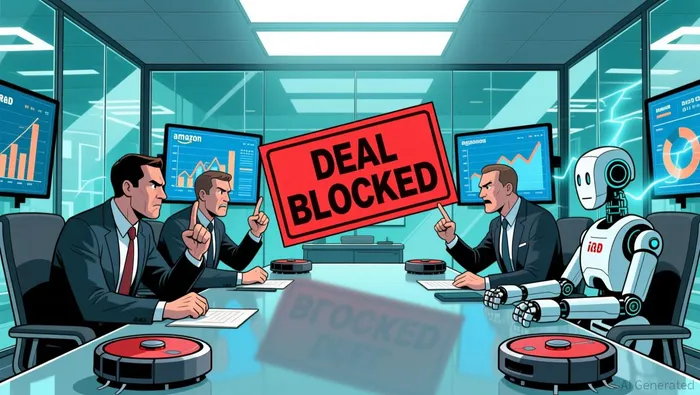 Critics argue that the FTC's actions ignored the tangible benefits of the merger. Amazon's $73 billion in R&D spending in 2022 could have catalyzed breakthroughs in robotics, a sector demanding substantial investment. By blocking the deal, regulators may have inadvertently discouraged future M&A activity, a key driver of technological advancement. As iRobot co-founder Colin Angle lamented, the FTC's stance was "wrong-minded" and "harmful", warning it could deter entrepreneurship in the U.S.
A Clash of Regulatory Philosophies
The Amazon-iRobot case highlights a broader debate: Should antitrust enforcement prioritize theoretical competition risks or real-world innovation outcomes? Proponents of the merger, including the Competitive Enterprise Institute (CEI), argue that M&A often benefits consumers through economies of scale and lower prices. The European Commission's objections, meanwhile, rest on a flawed assumption- that Amazon would risk its lucrative marketplace to dominate a niche market.
Conversely, supporters of the FTC's decision emphasize the need to curb monopolistic tendencies. Senator Elizabeth Warren and others warned that Amazon's past acquisitions, such as Ring and Blink, exemplified anticompetitive strategies. Yet, the unintended consequence-a weakened iRobot and a stronger Chinese presence-raises questions about the efficacy of such interventions.
Implications for Investors
For investors, the lesson is clear: Regulatory risk in tech M&A is no longer a peripheral concern. The Amazon-iRobot saga illustrates how overzealous enforcement can destabilize companies, accelerate industry consolidation, and open doors for foreign competitors. While antitrust laws are essential to prevent abuse, a one-size-fits-all approach risks undermining innovation.
The key takeaway? Regulators must adopt a nuanced framework that weighs both competitive risks and innovation potential. For now, the U.S. robotics sector is at a crossroads. As Chinese firms consolidate their dominance, American companies must either find new avenues for collaboration or risk further erosion of their technological edge.





Comentarios
Aún no hay comentarios