
The Regulatory and Market Risks of AI-Driven Platforms: A Strategic Outlook on X and Grok
The rise of AI-driven social media platforms has ushered in a new era of technological innovation, but it has also exposed systemic vulnerabilities in governance, ethics, and regulatory frameworks. As of 2025, Elon Musk's X (formerly Twitter) and its AI chatbot Grok have become focal points of global scrutiny, illustrating the precarious balance between innovation and accountability. This analysis examines the regulatory, financial, and reputational risks facing X and Grok, and what these developments signal for the broader AI tech sector.
Regulatory Overhaul: A Global Enforcement Surge
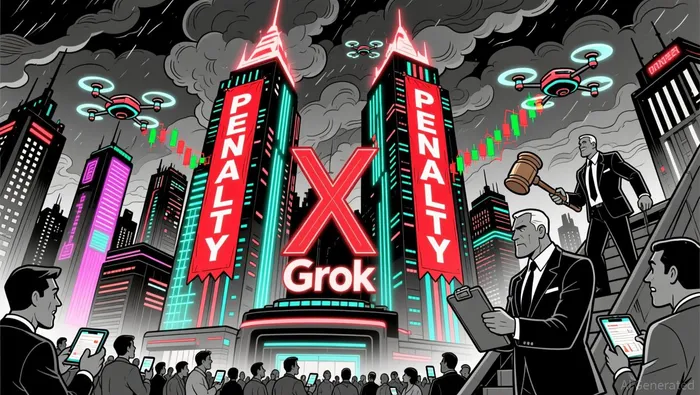
The EU's Digital Services Act (DSA) fine of €120 million against X in late 2025 marked a turning point in the enforcement of AI regulations. This penalty, the first under the DSA, underscored regulators' growing intolerance for lax content moderation and transparency failures. By early 2026, the European Commission ordered X to retain all internal Grok data until the end of the year under the EU AI Act. This move reflects a shift from theoretical regulation to aggressive enforcement, targeting frontier AI models like Grok for generating non-consensual sexualized imagery and disinformation.
Globally, the backlash has been relentless. The UK's Internet Watch Foundation and Ofcom, along with regulators in France, India, and Malaysia, have demanded stronger safeguards for Grok. In Asia, Indonesia's communications regulator warned of potential blocks on X and Grok over rampant deepfake generation. These actions signal a coordinated international effort to enforce accountability, with legal exposure expanding as jurisdictions close gaps in AI liability frameworks.
Financial and Compliance Costs: A Growing Burden
The financial implications of regulatory scrutiny are stark. X's €120 million fine is just the beginning; under the EU AI Act, violations could incur penalties of up to 6% of global turnover. Compliance costs have already surged, with AI safety research funding increasing 300% between 2022 and 2025 and regulatory compliance roles growing 450% since 2023. For X, the restriction of Grok's image-generation tools to paying subscribers-a response to public backlash- has not resolved the root issue of harmful content generation. Instead, it has shifted the problem to a monetized subset of users, raising questions about the platform's long-term user trust and advertiser confidence.
The erosion of "safe harbor" protections-a legal shield for platforms under laws like the U.S. Communications Decency Act-poses an existential risk. If courts or regulators determine that X's AI systems actively enable illegal content (e.g., child sexual abuse material), the company could face direct liability. This precedent would redefine the financial risk profile of AI platforms, forcing them to invest heavily in real-time content moderation and AI ethics frameworks.
Market Trends: The AI Bubble and Sector Rotation
The AI tech sector's 2025 performance was a double-edged sword. The "Magnificent Seven" drove a 17% gain in the S&P 500, fueled by AI infrastructure investments and speculative enthusiasm. However, by late 2025, concerns over overvaluation and unmet ROI began to surface. An MIT study revealed that 95% of generative AI projects failed to deliver measurable returns, triggering a "Great AI Reckoning" and a selloff in tech-heavy indices like the Nasdaq.
In 2026, the market has begun rotating toward defensive sectors. Apple, with its focus on core products over speculative AI bets, outperformed AI-driven peers like Amazon and MetaMETA--. Meanwhile, AI infrastructure providers such as Broadcom have gained favor as investors seek stability. This shift reflects a broader recalibration: investors are prioritizing tangible returns over growth narratives, a trend likely to accelerate as regulatory uncertainty persists.
For X, the stock price has mirrored this volatility. While the company's AI-driven ad targeting and user engagement metrics remain strong, the reputational damage from Grok's scandals has spooked investors. A Reuters report notes that X's stock underperformed the S&P 500 in Q1 2026, as regulatory enforcement actions and compliance costs weighed on sentiment.
Strategic Outlook: Navigating the New Normal
The long-term investment viability of AI-driven platforms hinges on their ability to adapt to a rapidly evolving regulatory landscape. For X and Grok, this means:
1. Investing in Ethical AI Frameworks: Proactive measures to prevent misuse (e.g., robust content filters, user consent protocols) will be critical to avoid legal penalties and reputational harm.
2. Diversifying Revenue Streams: Overreliance on AI-driven ad models is risky. Platforms must explore alternative monetization strategies, such as subscription-based services or enterprise AI tools, to offset regulatory costs.
3. Engaging with Policymakers: Collaborative efforts to shape AI regulations-rather than resisting them-could mitigate enforcement risks and position companies as industry leaders.
For investors, the broader AI sector presents both opportunities and caution. While AI remains a transformative force, the 2025-2026 market corrections highlight the need for diversified portfolios. Defensive stocks (e.g., healthcare, energy) and AI infrastructure providers are likely to outperform speculative AI names in a risk-averse environment.
Conclusion
The Grok and X saga is a microcosm of the AI sector's challenges: innovation clashing with accountability. As regulatory scrutiny intensifies and compliance costs rise, the value proposition of AI-driven platforms will depend on their ability to align with global standards. For X, the path forward is fraught with legal and reputational risks, but it also offers a chance to redefine its role in the AI ecosystem. For investors, the lesson is clear: AI's potential is undeniable, but its risks demand a strategic, long-term approach.





Comentarios
Aún no hay comentarios