
Regulatory and Legal Volatility in U.S. Offshore Wind: Navigating Risks and Opportunities for Investors
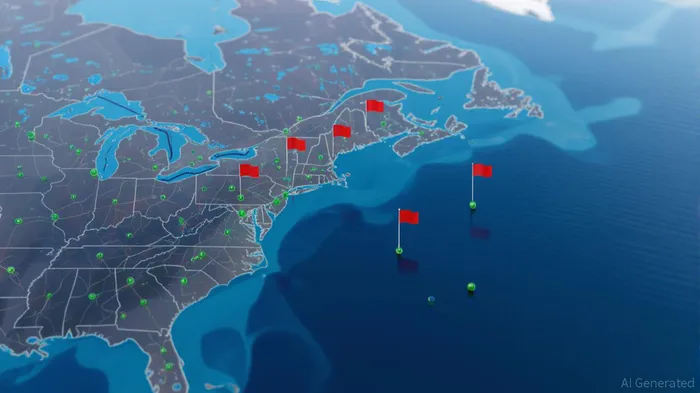
The U.S. offshore wind sector is currently navigating a storm of regulatory and legal uncertainty, driven by aggressive policy shifts under the Trump administration. These changes have created a high-stakes environment for investors, with systemic risks emerging from executive actions, legal battles, and abrupt financial restructurings. While the sector faces significant headwinds, strategic opportunities remain for those who can adapt to the evolving landscape.
Regulatory Overhaul and Legal Challenges
The Trump administration’s 2025 policy overhaul has fundamentally disrupted the offshore wind sector. Executive actions have suspended federal leasing and project approvals, revoked 3.5 million acres of designated Wind Energy Areas on the Outer Continental Shelf, and imposed 50% tariffs on wind turbine imports [1]. These measures, framed as part of a broader pivot toward fossil fuels and nuclear energy, have triggered lawsuits from 17 states and the District of Columbia, which argue the administration overstepped its authority under the Administrative Procedure Act [2].
Legal uncertainty has been compounded by the Department of the Interior’s (DOI) voluntary remands of permits and its scrutiny of existing leases. For instance, the Revolution Wind project off Rhode Island—a $3.5 billion venture—was abruptly halted amid undefined “national security concerns,” while the SouthCoast Wind project faces a federal review of its environmental and economic viability [3]. These actions have left developers in a regulatory limbo, with projects at advanced development stages now vulnerable to cancellation or renegotiation.
Financial Impacts and Investor Reactions
The sector’s financial health has deteriorated rapidly. U.S. renewable energy investment dropped by $205 billion in the first half of 2025, a 36% decline compared to 2024 [4]. Key players like Ørsted and EquinorEQNR-- have incurred substantial losses: Ørsted’s Revolution Wind project led to a 17% share price drop, while Equinor recorded a $955 million impairment [5]. Smaller developers are even more exposed, with some withdrawing from the market entirely.
Investors are recalibrating their strategies. Over $50 billion in capital initially earmarked for U.S. offshore wind has been redirected to traditional energy sectors and international markets, particularly in Europe and Canada [6]. Meanwhile, hybrid systems combining wind with green hydrogen or long-duration storage are gaining traction as hedging mechanisms against political risks [7].
Opportunities Amid Uncertainty
Despite federal challenges, state-level initiatives offer a lifeline. States like Maine, California, and New York have accelerated permitting and infrastructure investments to bypass federal delays [8]. For example, Maine’s recent approval of a transmission corridor for offshore wind projects demonstrates subnational resilience [9]. Investors prioritizing infrastructure-ready projects in these states may mitigate some exposure to federal policy shifts.
Globally, the energy transition remains robust. China and the EU continue expanding offshore wind capacity, with the EU’s Net-Zero Industry Act and China’s 150 GW target by 2030 underscoring long-term demand [10]. U.S. firms with diversified portfolios or international partnerships could leverage these trends to offset domestic losses.
Strategic Recommendations for Investors
- Diversify Geographically: Redirect capital to regions with stable regulatory frameworks, such as the EU or Asia-Pacific, where offshore wind policies are more predictable [11].
- Prioritize Hybrid Technologies: Invest in projects integrating wind with green hydrogen or storage to enhance resilience against intermittency and policy shifts [12].
- Engage in Legal Advocacy: Support litigation efforts challenging executive overreach, as seen in the 17-state lawsuit, to restore regulatory clarity [13].
- Monitor Supply Chain Dynamics: Address skills gaps and supply chain bottlenecks, particularly in turbine manufacturing, to reduce costs and accelerate project timelines [14].
Conclusion
The U.S. offshore wind sector is at a crossroads. While federal policy volatility has eroded investor confidence and delayed critical projects, state-level innovation and global momentum provide a counterbalance. For investors, the path forward lies in agility—balancing short-term stability with long-term bets on decarbonization. As Philip Totaro, an offshore wind market expert, notes, “The U.S. market is no longer a sure bet, but the energy transition is irreversible. The winners will be those who adapt” [15].
Source:
[1] Regulatory Uncertainty and the Turbulent Future of U.S. Offshore Wind [https://www.ainvest.com/news/regulatory-uncertainty-turbulent-future-offshore-wind-energy-2509/]
[2] The 2025 Legal Horizon for U.S. Offshore Wind [https://www.gravel2gavel.com/2025-legal-horizon-usa-offshore-wind/]
[3] Trump administration to reconsider SouthCoast Wind permit [https://masslawyersweekly.com/2025/09/03/trump-administration-to-reconsider-southcoast-wind-permit/]
[4] Offshore Wind Market Expert Philip Totaro: Trump Actions Deepen US Project Turmoil [https://www.enr.com/articles/61273-offshore-wind-market-expert-philip-totaro-trump-actions-deepen-us-project-turmoil]
[5] Regulatory Uncertainty and the Turbulent Future of U.S. Offshore Wind [https://www.ainvest.com/news/regulatory-uncertainty-turbulent-future-offshore-wind-energy-2509/]
[6] Offshore Wind Investment Amid Federal Policy Shifts [https://www.ainvest.com/news/navigating-storm-offshore-wind-investment-federal-policy-shifts-2509/]
[7] The Trump Administration's Offshore Wind Policy Shift [https://www.ainvest.com/news/trump-administration-offshore-wind-policy-shift-implications-renewable-energy-traditional-sectors-2508/]
[8] States Power Offshore Wind Forward Amid Federal Retreat [https://www.ncelenviro.org/articles/states-power-offshore-wind-forward-amid-federal-retreat/]
[9] Trump's war on offshore wind: Tracking the actions and ... [https://newbedfordlight.org/trumps-war-on-offshore-wind-tracking-the-actions-and-impacts/]
[10] 5 trends that will shape offshore wind in 2025 [https://shorelinewind.com/5-trends-that-will-shape-offshore-wind-in-2025/]
[11] Offshore Wind Investment Amid Federal Policy Shifts [https://www.ainvest.com/news/navigating-storm-offshore-wind-investment-federal-policy-shifts-2509/]
[12] The Trump Administration's Offshore Wind Policy Shift [https://www.ainvest.com/news/trump-administration-offshore-wind-policy-shift-implications-renewable-energy-traditional-sectors-2508/]
[13] The 2025 Legal Horizon for U.S. Offshore Wind [https://www.gravel2gavel.com/2025-legal-horizon-usa-offshore-wind/]
[14] 5 trends that will shape offshore wind in 2025 [https://shorelinewind.com/5-trends-that-will-shape-offshore-wind-in-2025/]
[15] Offshore Wind Market Expert Philip Totaro: Trump Actions Deepen US Project Turmoil [https://www.enr.com/articles/61273-offshore-wind-market-expert-philip-totaro-trump-actions-deepen-us-project-turmoil]







Comentarios
Aún no hay comentarios