
Regulatory and Legal Risks in the Aerospace Sector: Investor Protection and Corporate Governance in the Wake of Firefly Aerospace's Turbulent 2025
The aerospace sector in 2025 is navigating a regulatory and legal landscape marked by heightened scrutiny, shifting enforcement priorities, and growing investor skepticism. At the center of this turbulence is Firefly AerospaceFLY-- Inc. (NASDAQ: FLY), whose recent financial disclosures, technical setbacks, and ongoing securities investigations exemplify the risks of weak corporate governance and inadequate investor protection. As the Pomerantz Law Firm and other legal entities probe potential misconduct by Firefly's leadership, the case underscores broader vulnerabilities in the aerospace industry-and the urgent need for investors to reassess their exposure to companies operating in this high-stakes environment.
Firefly Aerospace: A Case Study in Governance and Disclosure Failures
Firefly's 2025 initial public offering (IPO) raised $868.5 million by pricing 19.3 million shares at $45.00 apiece, according to an investor alert by the Pomerantz Law Firm. However, the company's subsequent financial performance has been disastrous. Its Q2 2025 results revealed a net loss of $80.3 million (or $5.78 per share) and revenue of $15.55 million-26.2% below the same period in 2024, a fact noted in the same investor alert. These figures, coupled with a technical failure during testing of its Alpha Flight 7 rocket on September 29, 2025, triggered a 43% cumulative drop in Firefly's stock price within two weeks, according to a Third News report.
The Pomerantz Law Firm's investigation, launched in response to these events, alleges that FireflyFLY-- and its executives may have violated federal securities laws by either misrepresenting material information or failing to disclose critical risks to investors. Such allegations are not isolated. Multiple law firms, including Robbins Geller Rudman & Dowd LLP and Kessler Topaz Meltzer & Check, have joined the inquiry, signaling a coordinated effort to hold the company accountable for its governance shortcomings, as detailed in a PR Newswire alert.
Sector-Wide Risks: Cybersecurity, FCA Enforcement, and ESG Shifts
Firefly's struggles reflect systemic challenges facing the aerospace and defense (A&D) sector in 2025. Regulatory shifts, including the freezing of Biden-era diversity, equity, and inclusion (DEI) mandates and the revocation of Executive Order 11246, have created uncertainty around hiring practices and affirmative action compliance for government contractors, as explained in a Morgan Lewis report. Simultaneously, the Department of Justice (DOJ) has intensified its use of the False Claims Act (FCA), recovering $93 million in settlements in 2024 alone, a point the Morgan Lewis analysis also highlights. This enforcement focus on cybersecurity and supply chain integrity-particularly for companies using foreign-made components-has raised the stakes for aerospace firms to maintain rigorous compliance protocols, as noted in a Corporate Affairs analysis.
For Firefly, these trends are particularly relevant. The rocket testing failure in September 2025 not only damaged investor confidence but also exposed potential lapses in technical oversight and risk disclosure. If the Pomerantz investigation uncovers evidence that Firefly's leadership downplayed or concealed such risks, the company could face severe penalties under the FCA and broader reputational damage.
Investor Protection in a New Era: SEC Arbitration Rules and Shareholder Rights
The regulatory environment for investors has also evolved in 2025. On September 17, 2025, the Securities and Exchange Commission (SEC) announced a policy allowing public companies to include mandatory arbitration provisions in their corporate documents without regulatory delays, as described in a Harvard Law post. While this move aims to streamline dispute resolution, it has sparked debate over whether it undermines shareholder rights by limiting access to courts. For companies like Firefly, which are already under legal fire, such provisions could further insulate executives from accountability while leaving investors with fewer avenues to seek redress. That policy thus adds another layer of complexity to the Pomerantz investigation. If Firefly's bylaws now include mandatory arbitration clauses, affected shareholders may face procedural hurdles in pursuing claims, even as they seek to hold the company's leadership accountable for alleged misconduct.
Lessons for Investors: Due Diligence and Risk Mitigation
The Firefly case serves as a cautionary tale for investors in the aerospace sector. Key takeaways include:
1. Scrutinize Earnings and Technical Milestones: Sudden declines in revenue or operational setbacks (e.g., rocket failures) should trigger deeper due diligence into a company's governance practices and risk disclosures.
2. Monitor Regulatory Trends: Shifts in DEI policies, cybersecurity enforcement, and FCA priorities can significantly impact aerospace firms, particularly those reliant on government contracts.
3. Assess Legal Exposure: Companies under investigation for securities fraud often face prolonged stock price declines and reputational harm. Investors should evaluate the potential for class-action lawsuits and their financial implications.
For Firefly, the path forward is fraught. If the Pomerantz investigation confirms allegations of misconduct, the company could face not only legal penalties but also a loss of trust from investors and government partners. Meanwhile, the broader aerospace sector must adapt to a regulatory environment that demands greater transparency, robust compliance frameworks, and a renewed focus on investor protection.
As the SEC and DOJ continue to reshape the legal landscape, one thing is clear: in 2025, corporate governance and regulatory compliance are no longer optional-they are existential imperatives. 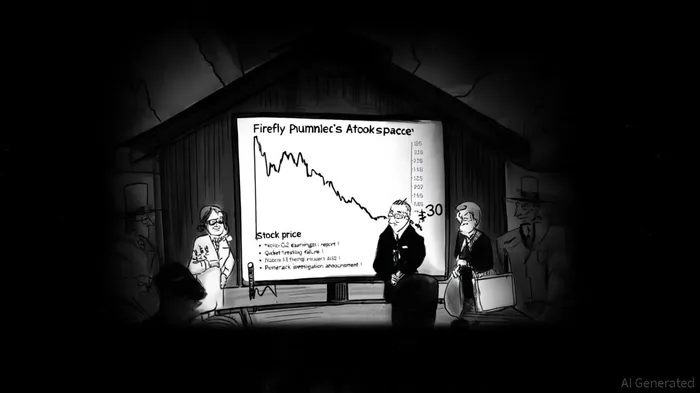







Comentarios
Aún no hay comentarios