
Regulatory Leadership and the Rise of MiCA-Compliant Stablecoins: Europe's Strategic Edge in Digital Asset Adoption
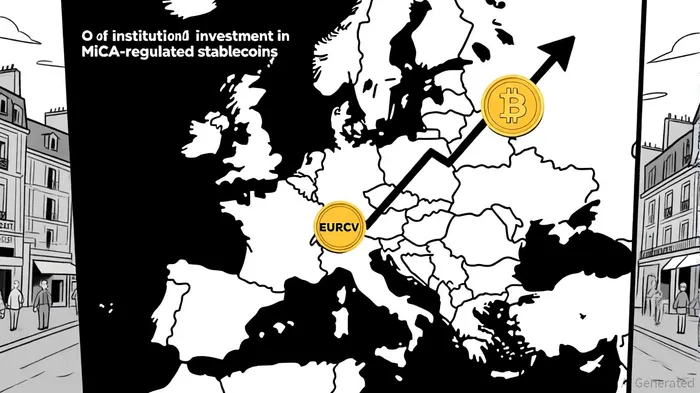
The European Union's Markets in Crypto-Assets (MiCA) regulation, which came into full force in December 2024, has emerged as a cornerstone of global crypto governance, fostering a regulatory environment that balances innovation with investor protection. By harmonizing rules across 27 member states, MiCA has positioned Europe as a leader in legitimizing digital assets, particularly stablecoins. This regulatory clarity has catalyzed institutional adoption, as evidenced by the strategic partnership between Société Générale-FORGE and Bullish Europe to launch the first MiCA-licensed U.S. dollar-pegged stablecoin, USD CoinVertible (USDCV).
MiCA as a Catalyst for Institutional Confidence
MiCA's comprehensive framework, which includes mandatory whitepapers, licensing requirements, and strict reserve transparency for stablecoins, has directly addressed institutional investors' concerns about volatility and fraud. According to a report by CoinLaw, institutional participation in MiCA-regulated initial coin offerings (ICOs) surged to 42% in 2025, up from 18% in 2023, while fraudulent ICOs dropped by 60% under the new regime[1]. This shift reflects a broader trend: 96% of EU financial institutions now view MiCA as a critical step toward market stability[2].
The EUR CoinVertible (EURCV), launched by Société Générale-FORGE in June 2025, and its U.S. dollar counterpart, USDCV, exemplify how traditional financial institutions are leveraging MiCA to bridge legacy systems with blockchain-based markets. Both stablecoins are fully backed by cash or high-quality collateral, with USDCV's reserves custodied by the Bank of New York Mellon[3]. Marco Bodewein, CEO of Bullish Europe, emphasized that the listing of USDCV on its BaFin-regulated platform expands access to “institutional-grade digital assets,” reinforcing the exchange's role as a hub for compliant trading[4].
Strategic Partnerships and Market Integration
The collaboration between Société Générale-FORGE and Bullish Europe underscores the EU's ability to merge traditional finance with digital innovation. Jean-Marc Stenger, CEO of SG-FORGE, noted that the partnership aims to “pave the way for broader adoption of regulated stablecoins” by enhancing liquidity and trust[5]. This aligns with MiCA's passporting system, which allows compliant issuers to operate across the EU without redundant licensing, creating a unified market for cross-border transactions.
Data from the World Economic Forum highlights that MiCA's reserve requirements and redemption rights—mirrored in the U.S. GENIUS Act—have standardized stablecoin issuance, reducing systemic risks[6]. However, Europe's approach remains more flexible. Unlike the U.S., which prohibits interest payments on stablecoins and mandates federal charters for large issuers, MiCA permits stablecoins to function as payment methods without transaction limits, potentially attracting more issuers[7].
Global Regulatory Leadership and Competitive Advantages
While the U.S. and Asia grapple with fragmented frameworks, Europe's MiCA-driven coherence is setting a global benchmark. The GENIUS Act, signed into law in July 2025, shares MiCA's focus on 1:1 reserve backing but adds layers of federal oversight, such as requiring large stablecoin issuers to be federally chartered[8]. In contrast, jurisdictions like Singapore and the UAE are adopting “MiCA-equivalent” standards to attract cross-border compliance, signaling Europe's influence on global norms[9].
The impact on institutional investment is profound. With MiCA, European stablecoins now account for 75% of cross-border crypto transactions, and institutional lending activity in the EU has grown by 45% year-over-year[10]. This contrasts sharply with Asia's patchwork regulations, where compliance complexities hinder large-scale adoption.
Looking Ahead: A Model for Global Adoption
As the EU implements MiCA, the launch of USDCV and EURCV represents more than a product—it signals a paradigm shift. By prioritizing regulatory clarity, Europe is not only attracting institutional capital but also setting standards that other regions may follow. For investors, this means a more secure, liquid, and scalable digital asset ecosystem, where stablecoins serve as a bridge between traditional finance and Web3.







Comentarios
Aún no hay comentarios