
Regulatory Headwinds and Onchain Derivatives: The Ripple Effect of KYC/AML on Stablecoin-Driven Markets
The 2025 regulatory landscape for stablecoins and derivatives markets has undergone a seismic shift, driven by the U.S. GENIUS Act, the CLARITY Act, and complementary global frameworks like the EU's MiCA. These developments have notNOT-- only redefined compliance obligations but also reshaped the utility of digital assets like XRPXRP--. As Know-Your-Customer (KYC) and Anti-Money Laundering (AML) requirements tighten, the derivatives market is recalibrating, with XRP emerging as a critical bridge asset in a compliance-first era.
Regulatory Clarity and the New Compliance Paradigm
The GENIUS Act, signed into law in July 2025, established a federal framework for stablecoins, mandating 1:1 reserve backing, public disclosures, and robust AML/KYC programs[1]. This act classified stablecoin issuers as financial institutions under the Bank Secrecy Act, aligning them with traditional banking regulations[2]. Complementing this, the OCC's Interpretive Letter IL 1183 removed prior restrictions on banks engaging in crypto activities, enabling broader institutional participation[3]. These changes have forced stablecoin platforms to adopt advanced compliance tools, including blockchain analytics and AI-driven monitoring systems, to meet risk-based AML standards[4].
Globally, the EU's MiCA and Asia's regulatory frameworks have mirrored these trends, creating a synchronized push toward institutional-grade oversight[5]. For derivatives markets, this means heightened scrutiny of on-chain transactions, with platforms now required to implement real-time monitoring and automated sanctions checks[6]. The result is a market structure where liquidity is increasingly concentrated among compliant participants, favoring assets with built-in regulatory infrastructure.
XRP's Strategic Positioning: Credentials and Compliance
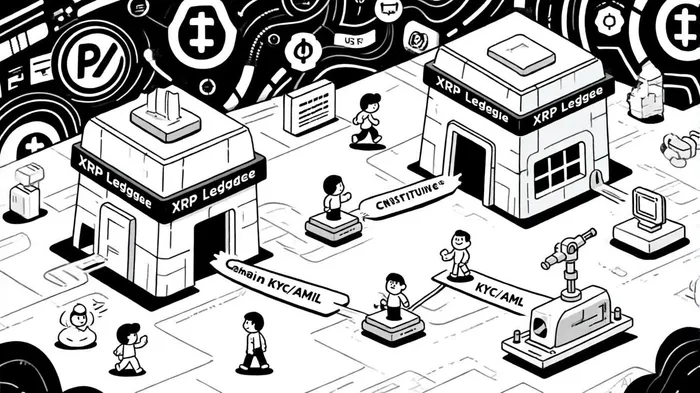
The XRP Ledger's activation of the Credentials amendment on September 4, 2025, marked a pivotal moment in decentralized compliance[7]. This update introduced on-chain KYC/AML verification, allowing trusted issuers to create verifiable credentials for users without exposing sensitive data[8]. By leveraging W3C Verifiable Credentials standards, the XRP Ledger enables institutions to automate compliance checks during transactions, reducing overhead by 60% compared to legacy systems[9].
This innovation aligns with the GENIUS Act's requirements, positioning XRP as a compliance-friendly asset. Ripple's RLUSD stablecoin, which operates on the XRP Ledger and uses XRP for network fees, has further solidified XRP's role in cross-border settlements and liquidity solutions[10]. Analysts note that XRP's utility as a “neutral bridge asset” is amplified in this environment, as its speed and low cost make it ideal for corridors requiring rapid, trustless transfers[11].
Derivatives Markets: Liquidity, Structure, and Institutional Adoption
The impact of KYC/AML regulations on derivatives markets is multifaceted. Centralized exchanges now require 92% of platforms to be fully compliant, altering liquidity dynamics as users undergo rigorous onboarding[12]. In decentralized finance (DeFi), the FATF Travel Rule's enforcement has forced platforms to adopt real-time reporting for high-value transactions, reducing pseudonymity and attracting institutional capital[13].
XRP's integration into derivatives platforms is evident in its growing institutional adoption. The REX-Osprey XRP ETF (XRPR), launched in Q2 2025, accumulated $33.57 million in assets within days, signaling renewed confidence[14]. Meanwhile, RLUSD's inclusion in tokenized funds like BlackRock's BUIDL and VanEck's VBLL has expanded XRP's utility in on-chain liquidity provision[15]. These developments are supported by technical upgrades to the XRP Ledger, including batch transactions and token escrow, which enhance scalability and regulatory readiness[16].
Quantifying the Ripple Effect
Market data underscores XRP's evolving role. Post-GENIUS Act, XRP's price surged 400% year-to-date, outpacing BitcoinBTC-- and Ethereum[17]. The XRP Ledger's Q2 2025 report noted a price increase to $2.24 and a 50% rise in RLUSD's market cap, driven by institutional demand[18]. Additionally, the Credentials amendment's 82.86% validator approval rate highlights strong community support for its compliance-focused features[19].
However, challenges remain. Cross-border compliance complexities and rapid regulatory shifts require continuous adaptation. For XRP, the key lies in its ability to balance privacy with compliance, a feat the Credentials amendment achieves by enabling decentralized identity management without centralized oversight[20].
Conclusion: A New Era for XRP and Derivatives
The convergence of regulatory clarity and technological innovation is redefining stablecoin-driven derivatives markets. XRP's Credentials amendment and RLUSD's institutional adoption position it as a linchpin in this new ecosystem, where compliance is no longer a barrier but a competitive advantage. As the tokenized asset market grows—projected to represent 10% of global assets by 2030—XRP's role in bridging traditional and digital finance will only intensify[21]. For investors, the message is clear: in a world of tightening compliance, XRP's adaptability and regulatory alignment make it a strategic asset.






Comentarios
Aún no hay comentarios