
The Regulatory Harmonization of Crypto Markets: A Catalyst for U.S. Market Leadership and Institutional Inflows
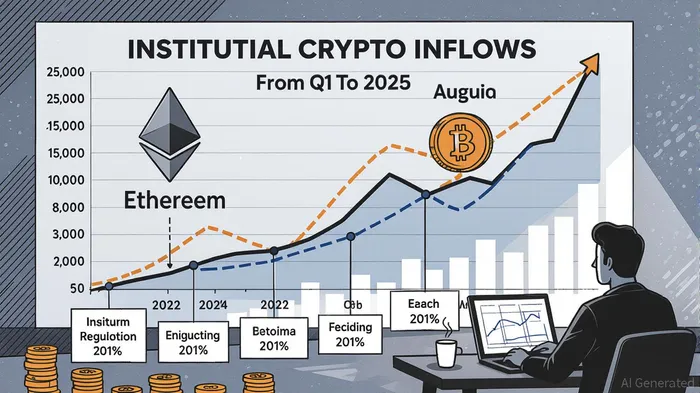
The U.S. crypto market is undergoing a seismic shift as the Securities and Exchange Commission (SEC) and Commodity Futures Trading Commission (CFTC) collaborate to harmonize regulatory frameworks. This alignment, crystallized in September 2025 through joint statements and legislative initiatives, has unlocked institutional-grade trading infrastructure, positioning the U.S. as a global leader in digital assetDAAQ-- innovation. By addressing long-standing ambiguities around product definitions, custody rules, and market oversight, the SEC and CFTC have created a fertile ground for institutional participation, driving unprecedented inflows and reshaping the competitive landscape.
Regulatory Clarity as a Foundation for Institutional Frameworks
The September 2025 joint staff statement from the SEC and CFTC marked a pivotal moment, explicitly permitting registered exchanges to facilitate leveraged, margined, or financed spot retail commodity transactions involving digital assets [1]. This guidance, issued by the SEC’s Division of Trading and Markets and the CFTC’s Division of Market Oversight, clarified that current law does not prohibit such activities—a critical clarification for exchanges like NYSE and Nasdaq seeking to list BitcoinBTC-- and EthereumETH-- spot products [2]. By emphasizing transparency in transaction data and streamlining clearinghouse-custodian partnerships, the agencies have laid the groundwork for robust, institutional-grade trading environments [1].
This regulatory clarity is further reinforced by initiatives like the SEC’s Project Crypto and the CFTC’s Crypto Sprint, which aim to modernize securities laws and expand oversight of crypto derivatives [2]. For instance, Project Crypto includes the development of exemptions for airdrops and DeFi service providers, while the CFTC’s focus on portfolio margining could reduce capital inefficiencies by allowing cross-platform exposure netting [2]. These efforts align with the broader goals of the Digital Asset Market Clarity Act of 2025, which seeks to classify digital assets into distinct categories—security tokens, commodity tokens, and commercial/consumer use tokens—each with tailored regulatory oversight [3].
Market Growth and Institutional Inflows: A Quantitative Surge
The impact of these regulatory developments is evident in the explosive growth of institutional crypto inflows. In August 2025 alone, global crypto investment products recorded $4.37 billion in net inflows, with Ethereum-focused funds attracting $3.95 billion—a stark contrast to Bitcoin’s $301 million in net outflows [4]. This reallocation reflects institutional confidence in Ethereum’s post-merge economics and DeFi yield opportunities, as well as the growing appeal of spot ETFs. For example, Ethereum ETFs saw a record $1 billion in inflows during the month, driven by the SEC’s approval of structured products and the CFTC’s expanded commodity oversight [5].
Bitcoin’s institutional adoption remains strong, albeit more consolidated. Spot Bitcoin ETFs, led by issuers like BlackRockBLK-- and Fidelity, have amassed $50 billion in assets under management (AUM) by mid-2025, with projections suggesting total AUM could exceed $80 billion by year-end [6]. These figures underscore the normalization of crypto as a core institutional asset, with pension funds, family offices, and corporate treasuries allocating capital for long-term appreciation and operational use cases [6].
Compliance Cost Reductions and Innovation Incentives
A critical enabler of this institutional shift is the reduction in compliance costs, particularly through the SEC’s SAB 122. By replacing the onerous requirements of SAB 121—which forced banks to classify customer-held crypto as liabilities—SAB 122 allows institutions to recognize liabilities only for actual risk exposure, such as fraud or cybersecurity breaches [7]. This change aligns crypto custody with traditional accounting standards (FASB ASC 450-20 and IAS 37), reducing reserve capital requirements and enabling banks like JPMorganJPM-- and CitigroupC-- to launch custody services [7].
The cumulative effect of these reforms is a 28% reduction in compliance costs for small to mid-sized crypto firms, with average annual expenses dropping from $620,000 in 2024 to $450,000 in 2025 [8]. This cost efficiency has spurred innovation, including the development of “super apps” that integrate traditional and tokenized securities under a unified regulatory framework [2]. Additionally, the SEC and CFTC’s planned regulatory sandbox will allow firms to test novel business models under controlled conditions, further accelerating adoption [3].
U.S. Market Leadership and Global Implications
The U.S. regulatory approach contrasts sharply with more cautious strategies in jurisdictions like the UK, where fragmented oversight has stifled institutional participation. By positioning itself as a technology-neutral, pro-innovation hub, the U.S. has attracted $35.5 billion in year-to-date crypto inflows in 2025 [4]. This momentum is amplified by the President’s Working Group on Digital Asset Markets, which advocates for expanding the CFTC’s authority over non-security digital assets and establishing a Joint Advisory Committee to coordinate SEC-CFTC efforts [3].
The global ripple effects are already visible. The EU’s MiCA regulation, for instance, has adopted a similar risk-based framework for stablecoins and custody, while Asian markets are accelerating their own crypto-friendly policies [6]. This regulatory leadership not only solidifies the U.S.’s dominance in digital finance but also ensures that innovation remains anchored to a stable, transparent, and investor-protected ecosystem.
Conclusion
The SEC-CFTC collaboration has transformed the U.S. crypto market into a bastion of institutional-grade infrastructure, driven by regulatory clarity, cost efficiency, and strategic innovation. As institutional inflows surge and global competitors recalibrate their frameworks, the U.S. is not merely adapting to the crypto revolution—it is leading it. For investors, this represents a unique opportunity to capitalize on a maturing asset class, underpinned by a regulatory environment that balances growth with accountability.
Source:
[1] SEC and CFTC Staff Issue Joint Statement on Digital Asset Commodity Transactions [https://www.troutmanfinancialservices.com/2025/09/sec-and-cftc-staff-issue-joint-statement-on-digital-asset-commodity-transactions/]
[2] SEC and CFTC Launch Crypto Initiatives to Revamp Regulations and Promote Innovation [https://www.fintechanddigitalassets.com/2025/08/sec-and-cftc-launch-crypto-initiatives-to-revamp-regulations-and-promote-innovation/]
[3] President's Working Group on Digital Asset Markets Releases Report [https://www.eversheds-sutherland.com/en/united-states/insights/presidents-working-group-on-digital-asset-markets-releases-its-report-strengthening]
[4] US leads $2.48 billion crypto inflow as Ethereum outshines Bitcoin [https://cryptoslate.com/us-leads-2-48-billion-crypto-inflow-as-ethereum-outshines-bitcoin-in-august/]
[5] SEC, CFTC seek to 'harmonize' on DeFi, perps contracts [https://www.coinglass.com/news/689539]
[6] Institutional Crypto Adoption & Regulation: Q2 2025 Trends [https://pinnacledigest.com/blog/institutional-crypto-adoption-regulation-q2-2025-trends-analysis]
[7] SAB 122: The key that unlocks institutional crypto custody [https://blog.cryptio.co/sab-122-the-key-that-unlocks-institutional-crypto-custody]
[8] Institutional Crypto Risk Management Statistics 2025 [https://coinlaw.io/institutional-crypto-risk-management-statistics/]







Comentarios
Aún no hay comentarios