
Regulatory Fragmentation in the EU Crypto Market: Implications for Cross-Border Investment and Fintech Valuations
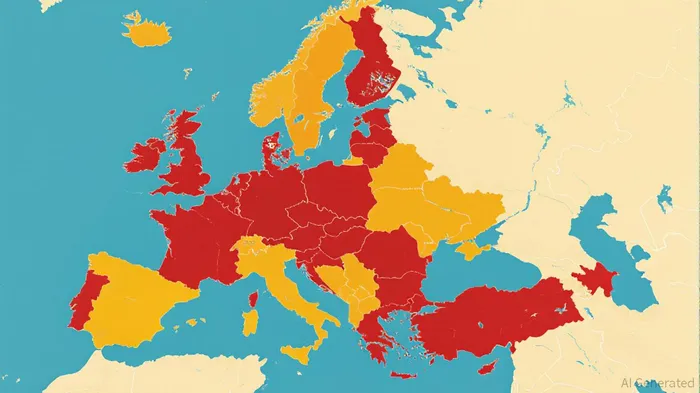
The European Union's Markets in Crypto-Assets (MiCA) regulation, fully enforced by December 2024, was designed to harmonize crypto rules across 27 member states, fostering cross-border investment and fintech scalability. However, persistent regulatory fragmentation—driven by divergent enforcement practices and national policy priorities—has created both opportunities and challenges for market participants. This analysis examines how these dynamics are reshaping cross-border investment flows and fintech valuations in 2025.
Cross-Border Investment: Progress and Persistent Barriers
MiCA's passporting system, which allows licensed crypto service providers (CASPs) to operate across the EU with a single authorization, initially spurred a 60% surge in cross-border crypto transaction volumes in 2025, with stablecoins accounting for 40% of all cross-border payments[2]. Transaction fees fell by 30%, and institutional investment in compliant crypto assets rose sharply[2]. However, regulatory arbitrage risks have emerged as some member states, including France, Austria, and Italy, advocate for stricter oversight to address cybersecurity and transparency gaps[1]. These nations have hinted at suspending passporting privileges for firms operating in jurisdictions perceived to have lax enforcement, potentially delaying cross-border expansion for CASPs[1].
For example, France's AMF (Autorité des Marchés Financiers) has imposed stricter consumer protection rules, while Lithuania enforced MiCA standards immediately in late 2024 but later extended a five-month grandfathering period for legacy firms[5]. Such disparities create operational complexity for fintechs, which must navigate conflicting timelines and compliance priorities. A CASP operating in both Lithuania and France, for instance, must adhere to the stricter Lithuanian timeline, increasing costs and reducing agility[5].
Fintech Valuations: Compliance Costs and Market Consolidation
MiCA's impact on fintech valuations is twofold: it has boosted investor confidence while imposing compliance burdens that disproportionately affect smaller firms. Institutional investors have responded positively, with 32% increasing crypto holdings post-MiCA[2]. Regulated exchanges have seen a 45% rise in institutional investments compared to non-compliant platforms[2], while non-compliant exchanges lost 40% of EU-based users[2]. This shift has driven a 35% growth in European crypto hedge funds[2].
However, compliance costs—such as 1:1 reserve backing for stablecoins, mandatory whitepaper disclosures, and advanced AML infrastructure—have strained smaller firms. Over 65% of EU-based crypto businesses achieved MiCA compliance by early 2025, but compliance rates varied widely: Germany, France, and the Netherlands reached 90%, while Greece and Portugal lagged at 50-60%[1]. Smaller startups in countries like Estonia and Lithuania saw a 42% drop in new crypto company registrations as stricter rules deterred non-compliant entrants[2]. This has accelerated industry consolidation, with larger firms acquiring smaller players to offset compliance costs[1].
Valuation multiples for MiCA-compliant fintechs have also diverged. Institutional investments in compliant platforms surged by 45% compared to non-compliant ones[2], while non-compliant firms faced penalties of up to €15 million or 3% of annual revenue[2]. The result is a bifurcated market: compliant firms benefit from higher trust and funding, while non-compliant ones struggle to attract capital.
Geopolitical and Structural Challenges
Beyond MiCA, broader geoeconomic fragmentation—such as U.S. regulatory pullbacks and EU-CBDC vs. U.S.-blockchain policy divergences—threatens to further complicate cross-border flows[2]. The EU's preference for Central Bank Digital Currencies (CBDCs) contrasts with the U.S. administration's pro-blockchain stance, potentially fragmenting transatlantic markets[2]. Meanwhile, MiCA's exclusion of DeFi and NFTs from its core framework has left regulatory gaps, creating uncertainty for innovators in these sectors[3].
Strategic Implications for Investors
For investors, the key takeaway is that MiCA has created a more structured, transparent crypto market but at the cost of operational complexity. Fintechs in early-adopting jurisdictions like Malta, the Netherlands, and Luxembourg are better positioned to scale, while those in fragmented markets may require strategic partnerships or regulatory lobbying to navigate divergent enforcement. Cross-border investment opportunities remain robust, but firms must prioritize compliance agility and geographic diversification to mitigate risks from passporting restrictions and national policy shifts.







Comentarios
Aún no hay comentarios