
Regulatory Crossroads: Senate Democrats' Crypto Framework and the Future of DeFi Investment Risks
The U.S. cryptocurrency market is at a pivotal juncture, with Senate Democrats' newly leaked regulatory framework sparking intense debate over its potential to reshape decentralized finance (DeFi). According to a report by CoinCentral, the framework outlines a seven-pillar approach to close regulatory gaps, enhance investor protections, and address DeFi-related risks. While the proposal aims to clarify jurisdictional boundaries-assigning the Commodity Futures Trading Commission (CFTC) oversight of non-security digital assets and the Securities and Exchange Commission (SEC) authority over security tokens-it introduces provisions that critics argue could stifle innovation and drive DeFi development overseas, the report says.
Key Provisions and Their Implications for DeFi
The framework's most contentious element is its treatment of DeFi platforms. It mandates that entities profiting from the "front-end" of DeFi protocols register as brokers with the SEC or CFTC, subjecting them to anti-money laundering (AML) and sanctions enforcement under the Bank Secrecy Act, according to the CoinCentral analysis. While the proposal does not explicitly extend these requirements to protocol-level developers, it grants the Treasury Department broad discretion to identify and regulate actors deemed responsible for DeFi activity, such as those who "design, deploy, operate, or profit from a DeFi front-end," the report adds.
This ambiguity has raised alarms among industry leaders. Summer Mersinger of the Blockchain Association warned that the language would "effectively ban" DeFi in the U.S., forcing innovation to jurisdictions with more favorable regulatory climates, the CoinCentral piece notes. Jake Chervinsky, a former SEC attorney, criticized the framework as a "government takeover of an entire industry," arguing it undermines bipartisan progress and could derail negotiations with Republican-led proposals like the Clarity Act, as reported by Cointelegraph.
Heightened Scrutiny and Ethical Constraints
Beyond operational requirements, the framework introduces ethics provisions that prohibit elected officials and their families from profiting from crypto projects while in office, the CoinCentral analysis states. These measures, framed as anti-corruption safeguards, are explicitly aimed at addressing concerns over President Trump's crypto ventures, according to CryptoNews. However, critics argue they risk politicizing DeFi by creating a "restricted list" of protocols deemed too risky, potentially stifling competition and innovation, as Cointelegraph coverage highlights.
The framework also mandates that digital asset platforms register as financial institutions, subjecting them to AML and sanctions enforcement. While this aligns with broader efforts to combat illicit finance, it raises compliance burdens for DeFi platforms, which rely on decentralized governance models. As noted by The Block, the proposal's emphasis on stricter enforcement and slower legislative timelines contrasts sharply with the Republican approach, which prioritizes market clarity and innovation-friendly safeguards.
Investor Strategies in a Shifting Landscape
For investors, the regulatory uncertainty presents both risks and opportunities. The framework's potential to fragment the DeFi ecosystem-by driving development overseas or creating a "chilling effect" on U.S.-based projects-could lead to short-term volatility in DeFi token valuations, the CoinCentral report warns. However, it may also accelerate adoption of compliance-focused protocols and cross-border arbitrage strategies.
Investors should consider the following strategies:
1. Geographic Diversification: Allocate capital to DeFi projects in jurisdictions with clearer regulatory frameworks, such as Singapore or Switzerland, where innovation is less constrained.
2. Support Compliant Protocols: Prioritize investments in DeFi platforms proactively engaging with regulators, such as those adopting transparent governance models or integrating AML tools.
3. Hedge Against Regulatory Shifts: Use derivatives or stablecoins to hedge against potential liquidity crunches in DeFi markets, particularly if bipartisan negotiations fail to produce a unified framework, a CryptoNews analysis suggests.
Conclusion
The Senate Democrats' framework underscores the growing tension between regulatory oversight and technological innovation in the crypto space. While its proponents argue it is necessary to protect investors and prevent corruption, its critics warn it risks stifling the very innovation that DeFi represents. As negotiations with Republicans intensify, investors must remain agile, balancing caution with strategic opportunities in a market poised for transformation.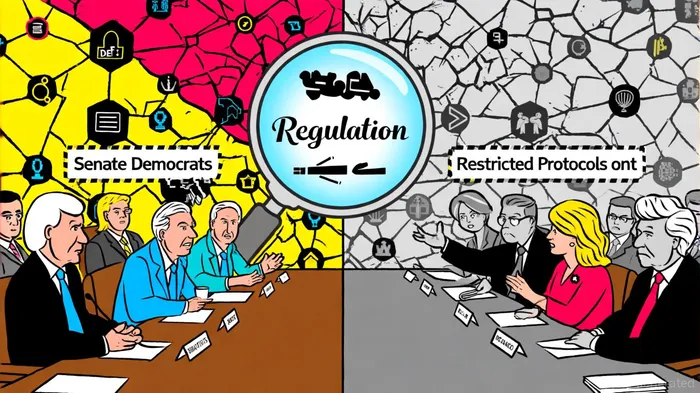







Comentarios
Aún no hay comentarios