
Regulatory Crossroads: Evaluating the Long-Term Resilience of Canada's Big Banks
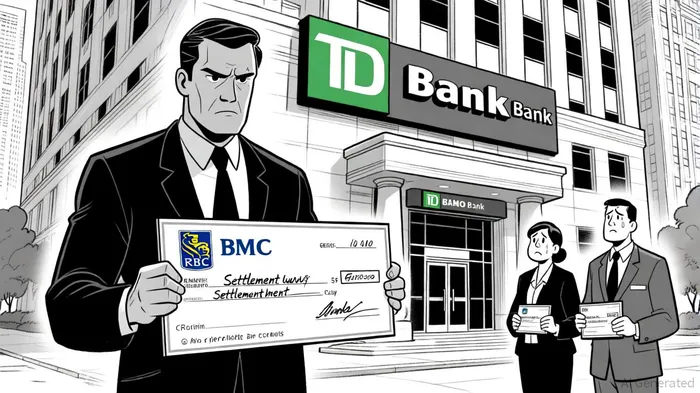
The Canadian banking sector, long celebrated for its stability, now faces a pivotal test of resilience amid escalating regulatory and litigation risks. At the center of this storm is Toronto-Dominion BankTD-- (TD), which has become a cautionary tale of systemic compliance failures. In 2025, TD agreed to a historic $3.09 billion anti-money laundering (AML) settlement with U.S. regulators, marking one of the largest penalties ever imposed for financial crime oversight lapses [5]. This settlement, coupled with a $434 billion asset cap and the appointment of an independent compliance monitor, underscores the high stakes of modern banking regulation [1]. For investors, the question is no longer whether Canadian banks can navigate regulatory scrutiny—but how they will adapt to an increasingly punitive and complex environment.
TD Bank: A Case Study in Regulatory Overreach
TD's AML scandal reveals a systemic breakdown in risk management. According to a report by The Banker, the bank failed to report suspicious transactions linked to international drug trafficking, with $671 million laundered through its systems [5]. The Office of the Comptroller of the Currency (OCC) responded with unprecedented severity, imposing an asset cap that restricts TD's ability to expand its U.S. operations—a critical market for its growth ambitions [1]. This regulatory clampdown has already translated into financial strain: TD anticipates a $225 million annual reduction in pre-tax net interest income, forcing a strategic pivot toward its core Canadian market [1].
The fallout extends beyond financial metrics. TD's leadership has undergone a dramatic overhaul, with the CEO and several board members exiting amid shareholder pressure. While the bank has pledged a “cultural reset” focused on accountability, the narrow re-election of Alan MacGibbon as chair highlights lingering governance concerns [4]. For investors, this signals a fragile recovery path—one where trust in management and regulatory compliance must be rebuilt from the ground up.
RBC and BMO: Navigating a Tightening Regulatory Landscape
While TD's challenges are exceptional in scale, its peers are not immune to regulatory pressures. Royal Bank of Canada (RBC) and Bank of Montreal (BMO) have faced their own compliance hurdles in 2025. RBC settled allegations of supervisory lapses involving trade confirmation errors for $769,000, attributed to coding flaws and inadequate oversight systems [3]. BMO, meanwhile, paid $40.7 million to the U.S. Securities and Exchange Commission (SEC) for misleading sales practices in mortgage-backed bonds, including flawed risk disclosures [4].
These penalties, though smaller than TD's, reflect a broader trend: regulators are tightening scrutiny of operational and supervisory practices. According to OSFI's 2025 Annual Risk Outlook, Canadian banks must now integrate climate risk management and operational resilience into their core strategies, with new guidelines like B-15 and E-21 setting higher compliance benchmarks [2]. RBC and BMO have responded proactively. RBC, for instance, has embedded climate risk into its net-zero emissions strategy, while BMO has emphasized risk management as a strategic pillar, aligning with industry trends identified in a 2024 Oliver Wyman CRO survey [2].
Industry-Wide Shifts: From Compliance to Resilience
The regulatory environment for Canadian banks is evolving rapidly. As noted in PwC's Next in Canadian Banking 2025 report, institutions must now balance growth with adaptive risk frameworks, particularly in the face of geopolitical uncertainties and AI-driven threats [1]. The Office of the Superintendent of Financial Institutions (OSFI) has also signaled a shift toward proactive oversight, with plans to issue a Corporate Governance and Accountability Guideline later in 2025 [3].
For TD, the path to resilience hinges on its ability to rebuild trust and innovate within constraints. The bank's pivot to digital mortgage platforms and fee-based services in Canada is a strategic response to its U.S. growth limitations [1]. However, its asset cap and compliance costs may hinder long-term competitiveness. In contrast, RBC and BMO's emphasis on risk integration and governance appears to position them better for sustained resilience, though their smaller penalties suggest they are not entirely free of vulnerabilities.
Conclusion: Investing in Resilience
The 2025 regulatory landscape underscores a critical divergence in the resilience of Canada's big banks. TD's unprecedented penalties and operational restrictions highlight the existential risks of compliance failures, while RBC and BMO demonstrate the value of embedding risk management into strategic decision-making. For investors, the lesson is clear: long-term resilience in banking now depends not just on financial strength, but on the ability to adapt to regulatory expectations, technological disruptions, and evolving risk profiles. As OSFI and global regulators continue to raise the bar, the banks that thrive will be those that treat compliance not as a cost center—but as a competitive advantage.







Comentarios
Aún no hay comentarios