
Regulatory Crossroads: China's Qualcomm Probe Signals a New Era in Tech M&A Enforcement
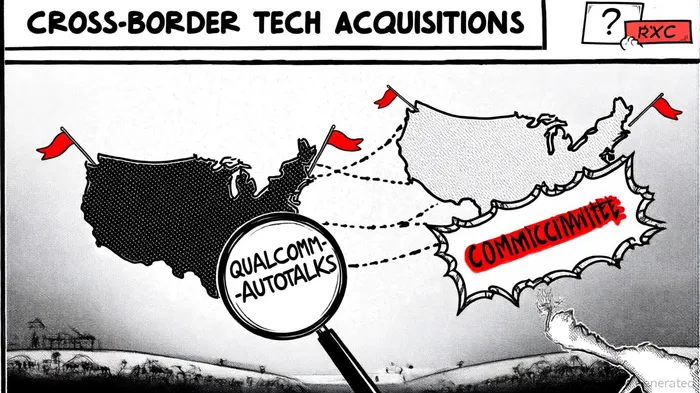
In October 2025, China's State Administration for Market Regulation (SAMR) launched an antitrust investigation into Qualcomm's acquisition of Israeli V2X chipmaker Autotalks, marking a pivotal moment in the scrutiny of cross-border technology deals. According to a Reuters report, the probe alleges that QualcommQCOM-- failed to notify Chinese regulators of the $80–90 million acquisition, a procedural violation under China's Anti-Monopoly Law (AML). This case, while centered on a single transaction, reflects a broader shift in China's regulatory approach to foreign tech investments-particularly in strategic sectors like autonomous vehicles.
A Strategic Move Under Scrutiny
Qualcomm's acquisition of Autotalks, finalized in June 2025, was designed to integrate the latter's 5G-V2X chipsets into Qualcomm's Snapdragon Digital Chassis platform, strengthening its foothold in the autonomous vehicle supply chain, as described in a CorpDev analysis. However, the deal-originally valued at $350–400 million in 2023-was devalued due to prolonged regulatory delays and shifting market dynamics, according to Security Online. The Chinese investigation now threatens to unravel these strategic gains. As stated by Lexology, failure to file a mandatory "operator concentration declaration" could result in fines up to 10% of Qualcomm's previous-year sales in China, a market critical to its revenue.
China's Regulatory Tightrope
The probe aligns with China's 2025 AML updates, which raised global and domestic turnover thresholds for merger notifications. For instance, the Regulations on Filing Thresholds for Concentration of Undertakings now require mandatory filings if combined worldwide turnover exceeds RMB 12 billion (~$1.66 billion) and Chinese turnover of at least two companies exceeds RMB 800 million (~$110 million), as noted in a Gibson Dunn review. These thresholds, while seemingly higher, are tailored to target high-stakes tech mergers, particularly in semiconductors and automotive technology.
The Horizontal Merger Review Guidelines, effective December 2024, further sharpened the focus on anticompetitive risks in the automobile and tech sectors. By scrutinizing Qualcomm's acquisition, China is signaling its intent to enforce these rules rigorously, even for deals completed after the regulatory updates. This approach mirrors past actions, such as the 2023 investigation into NVIDIA's acquisition of Mellanox, where China leveraged antitrust mechanisms to assert control over critical technology flows, as reported by Invezz.
Geopolitical Undercurrents and Market Implications
The timing of the Qualcomm probe is no coincidence. As Invezz noted, the investigation emerged ahead of high-level U.S.-China diplomatic engagements, suggesting a strategic use of regulatory tools to influence trade negotiations. This aligns with broader U.S.-China tensions over intellectual property and tech dominance, where cross-border acquisitions are increasingly viewed as battlegrounds for economic leverage.
For investors, the implications are twofold. First, the risk of post-completion penalties-such as fines or forced divestitures-has become a material concern. Qualcomm's shares fell over 4% in pre-market trading following the announcement, illustrating market sensitivity to regulatory overhangs, as previously reported. Second, the case underscores the need for robust compliance frameworks in cross-border deals. Companies must now navigate not only pre-transaction filings but also the possibility of retroactive investigations, particularly in sectors deemed strategically vital.
A New Era of Enforcement?
The Qualcomm-Autotalks case is emblematic of a new phase in global tech M&A. China's enforcement of AML rules is no longer confined to domestic players; it now actively targets foreign firms in high-tech sectors. This trend is mirrored in the U.S. and EU, where regulators have also raised concerns about Qualcomm's dominance in V2X technology, as coverage at Security Online highlighted. For the autonomous vehicle industry, which relies on global supply chains, this fragmented regulatory landscape increases transaction costs and delays innovation.
Investors must now factor in a dual risk: the immediate financial penalties from non-compliance and the long-term reputational damage from regulatory scrutiny. As China's SAMR continues to refine its tools-such as the SEP Guidelines and Internet Regulation Provisions-the emphasis on proactive reporting and transparency will only intensify, consistent with the perspectives set out in the Gibson Dunn review.
Conclusion
Qualcomm's Autotalks acquisition, once a strategic pivot in the V2X space, now serves as a cautionary tale for cross-border tech M&A. China's antitrust probe highlights the growing complexity of regulatory compliance in an era where geopolitical tensions and technological competition intersect. For investors, the lesson is clear: in the autonomous vehicle supply chain and beyond, due diligence must extend beyond financial metrics to include a rigorous assessment of regulatory landscapes-and the political forces that shape them.





Comentarios
Aún no hay comentarios