
Regulatory-Compliant Stablecoins and Institutional Adoption: How MiCA Compliance and Cross-Chain Innovation Position USDC as a Superior Institutional-Grade Stablecoin
MiCA Compliance: A Regulatory Milestone for Institutional Trust
The EU's MiCA framework, which came into effect in June 2024, represents the most stringent and comprehensive regulatory regime for crypto assets to date. Compliance with MiCA is no longer optional for institutions operating in Europe-it is a prerequisite. According to Circle's One Year of MiCA, the stablecoin issuer became the first major global stablecoin provider to achieve full MiCA compliance on its implementation date, operating as an EU Electronic Money Institution (EMI) licensed in France. This milestone is critical for institutional adoption, as it signals to banks, asset managers, and fintechs that USDC adheres to the same rigorous standards as traditional financial instruments.
Circle's compliance extends beyond mere legal adherence. The company has leveraged its EMI license to expand EURC, its euro-pegged stablecoin, as a complementary asset within Europe's digital financial infrastructure, as the Circle report notes. This dual-currency approach notNOT-- only diversifies USDC's utility but also underscores Circle's commitment to global regulatory alignment-a priority for institutions navigating cross-border operations. As MiCA compliance becomes a de facto standard, USDC's early-mover advantage strengthens its appeal to institutional clients seeking stable, regulated digital assets.
Cross-Chain Innovation: Scaling Utility and Accessibility
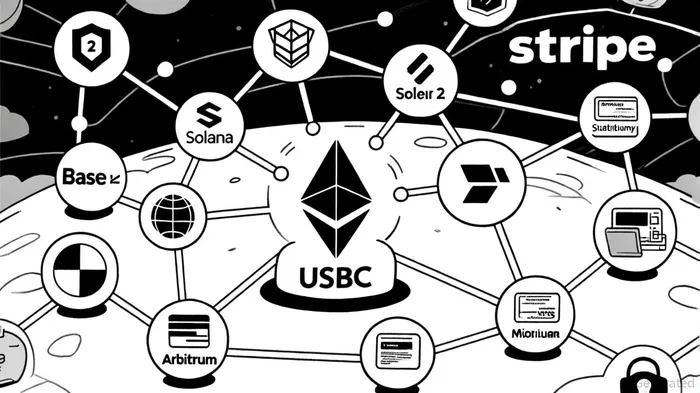
While regulatory compliance builds trust, technological innovation drives adoption. In 2025, USDC has demonstrated significant progress in cross-chain capabilities, , including EthereumETH--, SolanaSOL--, and Layer 2 solutions like Base and ArbitrumARB--, according to a Coinotag report. These advancements address two critical pain points for institutions: scalability and cost efficiency.
Circle's integration of Layer 2 networks has enabled faster on-chain transactions at lower fees, making USDC a viable medium for high-volume, real-time settlements. For example, the Arc blockchain network, launched by Circle, is designed to facilitate large-scale on-chain financial flows. Its public testnet has already attracted over 100 financial institutions and tech firms, signaling strong institutional interest in leveraging USDC for programmable money and automated settlements, as discussed in a Coingape article.
Beyond technical upgrades, Circle has also prioritized cultural and strategic partnerships to broaden USDC's appeal. The appointment of Grammy-winning artist as Global Culture Advisor, for instance, aims to make stablecoins more accessible in emerging markets by promoting use cases like cross-border payments and microbusiness growth, as Coingape reported. While this initiative may seem unconventional, it aligns with broader efforts to bridge the gap between institutional infrastructure and grassroots adoption-a critical step for stablecoins to achieve mass utility.
Institutional Adoption: From Compliance to Real-World Integration
The true test of a stablecoin's institutional-grade status lies in its adoption by major financial players. Zerohash, a stablecoin infrastructure firm, has emerged as a key enabler in this space. Securing a MiCA license in 2025, Zerohash now supports institutions like Morgan Stanley, Franklin Templeton, and Stripe in leveraging stablecoins for regulated blockchain-based payments, as detailed in The Coinrise article. Mastercard, which is reportedly in advanced acquisition talks with Zerohash, has already expanded USDC settlements in the Eastern Europe, Middle East, and Africa (EEMEA) region, the article also noted. This partnership highlights how MiCA compliance is becoming a linchpin for institutional integration, with USDC serving as the preferred stablecoin for cross-border and on-chain transactions.
The synergy between regulatory alignment and cross-chain innovation is evident in USDC's trajectory. By 2025, the stablecoin's role has evolved from a speculative asset to a foundational component of institutional-grade financial infrastructure. Its ability to operate seamlessly across multiple blockchains, coupled with MiCA compliance, addresses the dual demands of scalability and regulatory safety-two pillars of institutional confidence.
Conclusion: A New Era for Institutional-Grade Stablecoins
As the crypto ecosystem matures, the distinction between speculative assets and institutional-grade instruments becomes increasingly pronounced. USDC's achievements in 2025-MiCA compliance, cross-chain scalability, and strategic partnerships-position it as a leader in the latter category. For investors, the stablecoin represents not just a hedge against volatility but a bridge to the future of digital finance. With institutions like Mastercard and Zerohash accelerating its adoption, USDC's trajectory suggests that regulatory-compliant stablecoins are no longer on the fringes of finance-they are at its core.





Comentarios
Aún no hay comentarios