
Regulatory Clarity and XRP: Implications for Institutional Adoption
Legal Clarity as a Foundation for Institutional Adoption
The path to institutional adoption for XRP has been significantly shaped by recent legal developments. A landmark 2023 ruling, according to The Reg Review, determined that XRP is not a security under the Howey test and has provided a critical layer of regulatory clarity. This decision, delivered by Judge Analisa Torres, curtailed the SEC's broad interpretation of digital assets as securities and allowed programmatic sales of XRP to retail investors to proceed without registration requirements. The ruling has since become a cornerstone for institutional confidence, reducing compliance risks for firms integrating XRP into their portfolios or payment systems.
Data from Ripple's ecosystem further illustrates this shift. The company now boasts over 300 institutional partners, including central banks like the European Central Bank. Ripple's acquisition of GTreasury in 2025, WRAL Markets reports, aimed at embedding XRP into corporate treasury systems and highlights the token's growing utility for liquidity management and cross-border payments. These moves align with the assertion of Federal Reserve economist David Andolfatto that Ripple's protocol can "co-exist with the U.S. payment system," functioning as a currency-agnostic platform that complements traditional financial infrastructure.
Enforcement Actions and Market Dynamics
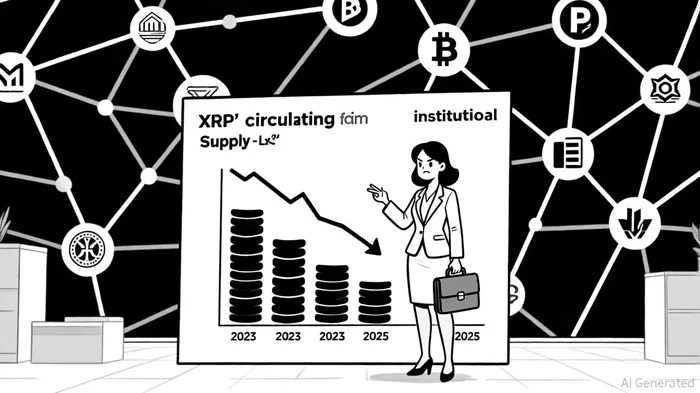
The recent seizure of XRP by the DEA, while part of a $54.7 million digital asset crackdown, has introduced volatility into the market. However, experts argue that such enforcement actions may inadvertently accelerate the token's institutional adoption. As XRP's circulating supply dwindles-currently at 59.98 billion out of 100 billion-increased institutional accumulation is reducing liquidity, potentially driving scarcity and price appreciation, according to InvestingHaven. For instance, Evernorth, a newly established XRP-focused treasury firm, has acquired 261 million XRP tokens as part of a $1 billion strategy to offer regulated exposure through a Nasdaq listing in 2026.
The market has responded with mixed short-term movements, including a 6% surge on October 20, 2025, followed by retracement. Yet, the broader trend remains upward, with XRP's price surpassing $2.54 in October 2025, supported by increased trading volumes and the launch of regulated financial products, according to Coinotag. The CME Group's introduction of XRP options in 2025, building on its successful XRP futures, has provided institutional investors with sophisticated hedging tools, further embedding the token into traditional finance ecosystems, Coinotag reports.
Institutional Infrastructure and Regulatory Momentum
The institutional adoption of XRP has been bolstered by strategic infrastructure developments. Ripple's acquisition of Hidden Road, rebranded as Ripple Prime, has created a multi-asset prime brokerage platform that bridges traditional finance and crypto. The platform now supports over 100 institutional clients and has seen a threefold increase in activity since April 2025, according to Coinotag. This expansion is critical for XRP's long-term viability, as it enables institutional clients to access the token through regulated, diversified portfolios that include derivatives, forex, and fixed income.
The launch of the REX-Osprey XRP ETF in September 2025, which surpassed $100 million in assets under management within a month, marks another milestone. This ETF offers a compliant vehicle for investors to gain exposure to XRP without direct custody risks, addressing a key barrier to institutional participation. Meanwhile, the appointment of Mike Selig as CFTC chairman-a vocal XRP advocate-has signaled a regulatory environment more open to crypto innovation. Selig's stance that XRP is a fungible commodity, akin to gold, contrasts with the SEC's historical approach and could pave the way for clearer classification under U.S. law.
Long-Term Viability and Scarcity Dynamics
While enforcement actions like the DEA's seizure may raise concerns about XRP's liquidity, they also highlight the token's evolving role in institutional portfolios. Analysts note that as large investors and corporations accumulate XRP for strategic use-such as Ripple's GTreasury integration-the active market supply will shrink, potentially increasing scarcity-driven value. On-chain data reveals a trend of large XRP transfers to custodial wallets, with institutional holdings now accounting for a significant portion of the token's total supply, as reported by WRAL Markets.
However, the long-term outcome hinges on whether these holdings remain locked or re-enter the market. If institutions continue to use XRP for utility purposes (e.g., cross-border payments) rather than speculative trading, the token's supply dynamics could mirror those of gold-a store of value with limited circulating liquidity. This scenario would align with Ripple's broader vision of XRP as a bridge between blockchain and traditional finance, reducing volatility and enhancing institutional trust, according to a market expert.
Conclusion: A Maturing Ecosystem
The U.S. government's seizure of $7.8 million in XRP, while a short-term disruptor, reflects a broader regulatory landscape in flux. For XRP, the combination of legal clarity, institutional infrastructure, and strategic acquisitions has created a foundation for mainstream adoption. The token's integration into ETFs, derivatives markets, and corporate treasuries signals a shift from speculative trading to utility-driven value. As enforcement actions continue to shape the crypto ecosystem, XRP's ability to navigate regulatory scrutiny while expanding institutional partnerships will be critical to its long-term success.






Comentarios
Aún no hay comentarios