
Regulatory Clarity and Institutional Onslaught: How XRP and Solana ETFs Could Reshape Crypto Markets
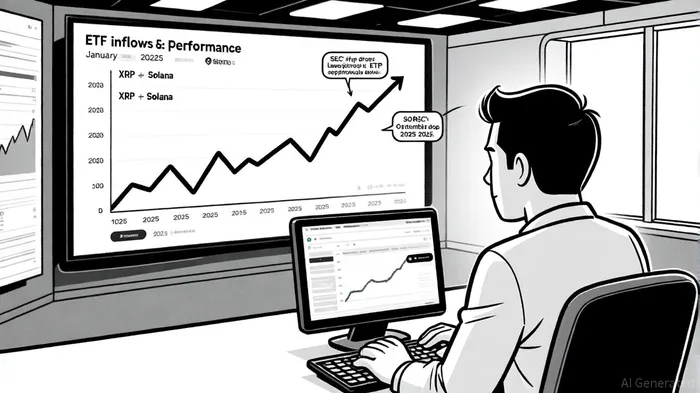
The U.S. Securities and Exchange Commission (SEC) has long been a pivotal gatekeeper for cryptocurrency innovation, and its evolving stance on exchange-traded funds (ETFs) is now poised to redefine the institutional investment landscape for altcoins like XRPXRP-- and SolanaSOL--. With over 90 crypto ETF applications pending and a backlog-driven timeline extension pushing key decisions into October 2025, the regulatory environment is shifting toward a more structured framework. According to a report by Coin Edition, the SEC is preparing a standardized rule to reduce the approval process for spot crypto ETFs from 240 days to 75 days, signaling a potential acceleration in market access for tokens like XRP and Solana [1]. This regulatory pivot, coupled with the precedent set by Bitcoin's ETF-driven price surge, could unlock a flood of institutional capital into these altcoins, catalyzing a new era of crypto adoption.
The SEC's Evolving Stance: From Hesitation to Streamlined Approval
The SEC's cautious approach to crypto ETFs has historically been rooted in concerns over market manipulation, custody solutions, and investor protections. However, the agency's recent actions suggest a strategic shift. For instance, BlackRock's Solana ETF application now faces a decision on October 30, 2025, while Franklin Templeton's XRP ETF has been extended to November 14, 2025 [2]. These delays, though frustrating for market participants, reflect the SEC's effort to balance regulatory rigor with the growing demand for crypto products.
A critical development is the SEC's proposed 75-day approval rule, which aims to streamline the process for ETFs that meet specific criteria, such as active futures trading and robust custody frameworks [3]. This rule, if implemented, could fast-track approvals for tokens like Solana and XRP, which already have institutional-grade infrastructure. As stated by Reuters, the rule change is part of a broader effort to “accelerate the maturation of the crypto market while safeguarding investors” [4].
Bitcoin's ETF Precedent: A Blueprint for Altcoin Adoption
The approval of BitcoinBTC-- ETFs in 2025 offers a compelling blueprint for how institutional demand can reshape crypto markets. Data from Sky Bitcoins reveals that Bitcoin's price surged 162% post-approval, reaching $119,000, while ETF inflows exceeded $14.8 billion [5]. This influx of capital not only stabilized Bitcoin's volatility but also transformed it into a legitimate treasury asset for corporations and investment funds. BlackRock's iShares Bitcoin Trust (IBIT), with over $51 billion in assets under management, exemplifies how institutional validation can drive mainstream adoption [5].
For XRP and Solana, the Bitcoin ETF model suggests a similar trajectory. XRP's price has already surged from sub-$0.50 to over $3.60 in 2025, driven by the launch of products like the ProShares Ultra XRP ETF (UXRP) and the Teucrium XRP ETF, which now manages $397 million in assets [6]. Meanwhile, Solana's institutional appeal is evident in the accumulation of 3% of its circulating supply by firms like Galaxy Digital and Pantera Capital, mirroring pre-Bitcoin ETF patterns [7].
XRP's Institutional Breakthrough: From Legal Uncertainty to ETF Momentum
XRP's path to institutional adoption has been uniquely challenging due to the SEC's prolonged lawsuit against Ripple. However, the agency's recent decision to drop the case has created a “regulatory vacuum” that asset managers are swiftly filling. The REX-Osprey Spot XRP ETF, approved in September 2025 after a 75-day review, is a testament to this shift [8]. Analysts project that sustained inflows into spot XRP ETFs could push the token to $6–$7 by year-end and $8–$10 by 2026 [8].
The Teucrium XRP ETF's success further underscores the demand for regulated exposure. With assets under management (AUM) growing to $397 million by July 2025, the fund has become a cornerstone of XRP's institutional narrative [6]. Canadian ETFs like Purpose and 3iQ have also contributed to XRP's liquidity, leveraging low fee structures to attract global investors [6].
Solana's Institutional Hype: A High-Speed Blockchain's ETF Play
Solana's technological advantages—its high-speed blockchain and scalability—have made it a favorite among institutional investors. According to Financial Content, firms like Forward Industries and Pantera Capital have accumulated 17.11 million SOLSOL-- tokens (3% of the circulating supply) since April 2025, positioning themselves for an ETF-driven price surge [9]. Analysts predict that a U.S. spot Solana ETF could attract $3–6 billion in inflows, potentially driving the price to $250–$300 or even $750–$1,000 in bullish scenarios [9].
The SEC's 99% approval probability for Solana ETFs by October 2025 [10] further amplifies this optimism. If approved, these products would not only enhance liquidity but also integrate Solana into traditional finance (TradFi) ecosystems, fostering adoption in DeFi and cross-border payments [9].
Risks and the Road Ahead
While the outlook for XRP and Solana ETFs is bullish, risks remain. Regulatory shifts, such as the SEC's potential reversal on the 75-day rule, could delay approvals. Additionally, Solana's network centralization and XRP's ongoing legal scrutiny (though reduced) pose challenges. However, the growing institutional appetite and the SEC's streamlined approach suggest that these hurdles are manageable.
Conclusion: A New Dawn for Altcoin ETFs
The SEC's regulatory clarity, combined with the institutional momentum behind XRP and Solana, is creating a perfect storm for price appreciation and market adoption. As Bitcoin's ETF success demonstrates, institutional validation can transform volatile assets into stable, mainstream investments. For XRP and Solana, the October 2025 decision deadlines represent not just regulatory milestones but potential inflection points for their trajectories. Investors who recognize this shift may find themselves at the forefront of a crypto revolution.





Comentarios
Aún no hay comentarios