
Regulatory Clarity in Crypto Prediction Markets: The Long-Term Implications of Coinbase's Legal Battles for U.S. Innovation and Investment
The U.S. crypto industry stands at a pivotal crossroads, where legal battles over regulatory clarity are shaping the future of innovation and investment. At the center of this storm is CoinbaseCOIN--, whose strategic litigation against the SEC and state governments has become a litmus test for the viability of crypto prediction markets. As the company navigates a fragmented regulatory landscape, its legal outcomes will determine whether these markets evolve into mainstream financial tools or remain niche, speculative experiments.
The SEC Dispute: A Case of Equitable Estoppel and Regulatory Whiplash
Coinbase's legal action against the SEC, rooted in equitable estoppel, underscores the industry's frustration with inconsistent enforcement. The company argued that the SEC's silence during its 2021 IPO implicitly validated its operations, creating a reliance that the agency now seeks to undermine according to reports. While the case was dismissed in February 2025, the broader regulatory environment has shifted under SEC Chair Paul Atkins, who has prioritized structured rulemaking over enforcement-heavy tactics. This shift includes no-action letters for DePIN tokens and state trust custody arrangements, signaling a more pragmatic approach as detailed in Goodwin's analysis. 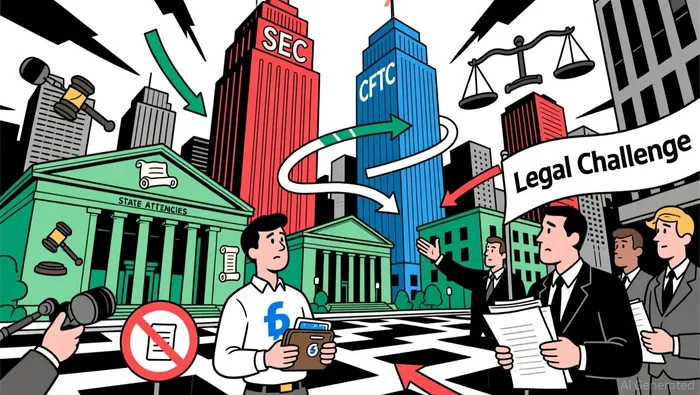 Critics argue that the dismissal of Coinbase's case reflects a lack of clarity rather than a solution, leaving firms to rely on legal doctrines to challenge regulatory ambiguity as the Chicago Business Law Review notes.
State vs. Federal Jurisdiction: The Prediction Market Frontlines
Coinbase's expansion into prediction markets has ignited a jurisdictional war with states like Connecticut, Michigan, and Illinois, which classify these products as gambling under state law. The company contends that the CFTC has exclusive oversight, a claim it is testing in court according to Seeking Alpha. This conflict mirrors broader tensions between federal and state regulators, with the CFTC recently allowing Polymarket to operate nationwide while states issue cease-and-desist orders. A federal judge's temporary block of Connecticut's enforcement against Kalshi highlights the uncertainty, as outcomes vary by state as reported by Pymnts. For Coinbase, a favorable ruling could cement the CFTC's authority and create a unified regulatory framework, while state victories would fragment the market, stifling innovation as Bitcoin World reports.
Innovation and Investment: A Double-Edged Sword
The legal outcomes will directly influence investment flows into prediction markets. Platforms like Kalshi have attracted $11 billion in venture capital and institutional backing, with global trading volumes surpassing $28 billion in 2025 according to KPMG's analysis. However, regulatory uncertainty remains a barrier. Traditional financial institutions are cautiously evaluating how to integrate event contracts into brokerage accounts, wary of surveillance challenges and market integrity risks. Meanwhile, Coinbase's partnership with Kalshi to launch prediction markets on its app-alongside stock trading-signals a strategic bet on user adoption as The Information reports. Yet, analysts warn of "cannibalization" risks, where prediction markets could divert funds from crypto trading, potentially limiting Coinbase's revenue growth.
The Trump Era: Pro-Crypto Policies and Legislative Stalemates
Coinbase holds an edge in the U.S. crypto race even as rivals make public listings reshape the landscape. The Trump administration's pro-crypto stance has accelerated regulatory clarity, with the SEC rescinding stringent accounting guidance and dismissing lawsuits against Coinbase and Binance as Reuters reports. This shift has bolstered industry optimism, but legislative progress remains stalled. A House bill to define token status has failed to gain Senate traction due to disagreements over anti-money-laundering provisions and DeFi oversight as Reuters notes. While this delay prolongs uncertainty, it also creates a window for innovation as firms like Coinbase push boundaries through litigation and product diversification according to Reuters.
Long-Term Implications: A Tipping Point for the Industry
The resolution of Coinbase's legal battles will set a precedent for how prediction markets-and by extension, the broader crypto ecosystem-are regulated. A federal victory would likely spur investment, as seen in Polymarket's nationwide approval as reported by Pymnts, while state-level fragmentation could deter institutional participation. For investors, the key lies in monitoring court rulings and legislative developments. A unified regulatory framework under the CFTC would reduce compliance costs and attract capital, whereas a patchwork of state laws could fragment the market, favoring nimble startups over incumbents like Coinbase as Bitcoin World reports.
Conclusion: Navigating the Regulatory Maze
As Coinbase's legal saga unfolds, the U.S. crypto industry faces a critical juncture. The outcome of its battles with the SEC and state governments will not only define the future of prediction markets but also shape the broader regulatory landscape for digital assets. For investors, the path forward requires a nuanced understanding of these legal dynamics. Those who position themselves to capitalize on a federal regulatory framework-while hedging against state-level risks-stand to benefit from the next wave of crypto innovation.





Comentarios
Aún no hay comentarios