
Regulatory Clarity and Crypto Market Infrastructure: How Bipartisan Support for a Crypto Market Structure Bill Signals Institutional Readiness and Investment Opportunity
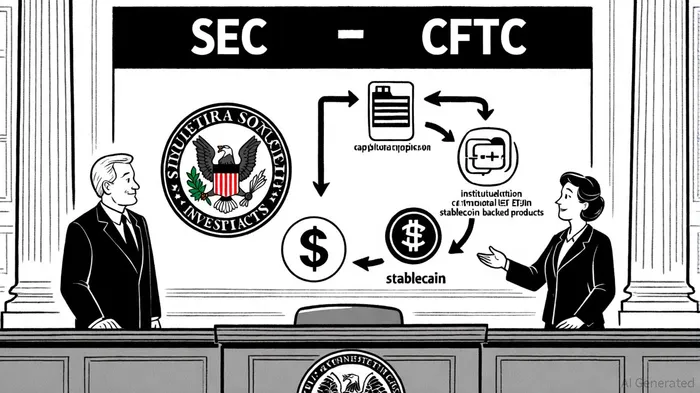
The U.S. crypto market is undergoing a transformative shift as bipartisan legislative efforts converge to establish a clear regulatory framework. With the House passing the Digital Asset Market Clarity Act (CLARITY Act) in July 2025 and the Senate advancing the Responsible Financial Innovation Act (RFIA), the sector is witnessing unprecedented alignment between policymakers, regulators, and market participants. These bills aim to resolve jurisdictional conflicts between the SEC and CFTC, define digital asset categories, and create a structured environment for innovation. For institutional investors, this regulatory clarity is a green light to deepen their participation in crypto markets, unlocking new opportunities in ETFs, stablecoins, and tokenized assets.
Legislative Foundations: CLARITY and RFIA
The CLARITY Act, passed by the House with bipartisan support (294–134), establishes a three-tiered classification system for digital assets: digital commodities (e.g., BitcoinBTC-- and Ethereum), investment contract assets (e.g., tokens sold for capital appreciation), and permitted payment stablecoins[1]. By assigning the CFTC exclusive oversight of digital commodity spot markets and the SEC authority over investment contracts, the bill eliminates regulatory ambiguity that has long hindered institutional adoption[2]. For example, the CFTC's jurisdiction over Bitcoin and EthereumETH-- ensures a consistent regulatory approach for exchanges and brokers, while the SEC's focus on investment contracts aligns with existing securities laws[3].
Meanwhile, the Senate's RFIA takes a broader approach, emphasizing the SEC's role in regulating ancillary assets—intangible assets linked to securities transactions—and introducing safeguards like anti-money laundering (AML) requirements and a "Micro-Innovation Sandbox" for experimental projects[4]. Unlike the CLARITY Act's decentralized commodity framework, the RFIA grants the SEC broader authority, reflecting Senate Democrats' emphasis on investor protection and consumer safeguards[5].
Institutional Readiness: A Surge in Capital Allocation
Regulatory clarity has directly spurred institutional interest. A 2025 survey by CoinbaseCOIN-- and EY-Parthenon revealed that 75% of institutional investors plan to increase crypto allocations, with 59% targeting over 5% of their total assets under management (AUM) in digital assets[6]. This shift is driven by the CLARITY Act's structured framework, which reduces legal and compliance risks. For instance, the Act's safe harbors for token offerings and preemption of state securities laws have encouraged firms like BlackRock and Fidelity to expand their crypto product suites[7].
Concrete examples of institutional adoption include the SEC's recent approval of Bitwise Asset Management's Bitcoin and Ethereum ETF, which tracks the two largest cryptocurrencies in an 83:17 market cap-weighted ratio[8]. This ETF, now cleared for Form 19b-4, marks a milestone in mainstream acceptance, with Bitwise also exploring a Dogecoin ETF to capitalize on growing demand for memeMEME-- tokens[8].
Market Infrastructure: Stablecoins and CBDCs in the Spotlight
The CLARITY Act and the GENIUS Act (a companion bill for stablecoins) are reshaping market infrastructure. The GENIUS Act mandates that stablecoins be backed 1:1 by U.S. dollars or short-term Treasuries, enforced by a Stablecoin Certification Review Committee[9]. This has spurred major banks like JPMorgan and Citi to explore regulated stablecoin issuance, treating them as part of their core financial infrastructure[10].
Conversely, the Anti-CBDC Act, passed by the House along party lines, prohibits the Federal Reserve from issuing a consumer-facing central bank digital currency (CBDC) without congressional approval[11]. This aligns with Bitcoin's decentralized ethos and preserves space for private innovation, as seen in the rise of tokenized deposit frameworks and DeFi protocols.
Investment Opportunities: From ETFs to Tokenized Assets
The legislative landscape is creating fertile ground for new investment vehicles. The CLARITY Act's structured classification system has already enabled the launch of in-kind creation and redemption mechanisms for crypto ETPs, reducing liquidity risks for institutional investors[12]. Meanwhile, the RFIA's emphasis on AML and risk disclosure is fostering trust in tokenized real-world assets (RWAs), such as real estate and art, which are now being securitized on blockchain platforms[13].
For example, Circle's recent IPO—backed by the GENIUS Act's stablecoin framework—demonstrated the potential for crypto-native companies to attract institutional capital. The company's regulated stablecoin, USDCUSDC--, now serves as a bridge between traditional finance and decentralized markets, with a market cap exceeding $50 billion[14].
Conclusion: A New Era for Crypto Markets
The bipartisan push for a crypto market structure bill signals a pivotal moment in the sector's evolution. By resolving regulatory conflicts and fostering innovation, the CLARITY Act and RFIA are laying the groundwork for institutional capital to flow into digital assets with confidence. As stablecoins gain legitimacy and ETFs become mainstream, the U.S. is positioning itself as a global leader in crypto infrastructure. For investors, this is not just regulatory clarity—it's a call to action.





Comentarios
Aún no hay comentarios