
Regulatory Clarity as a Catalyst: How Engagement with Policymakers Shapes Crypto Investment Opportunities
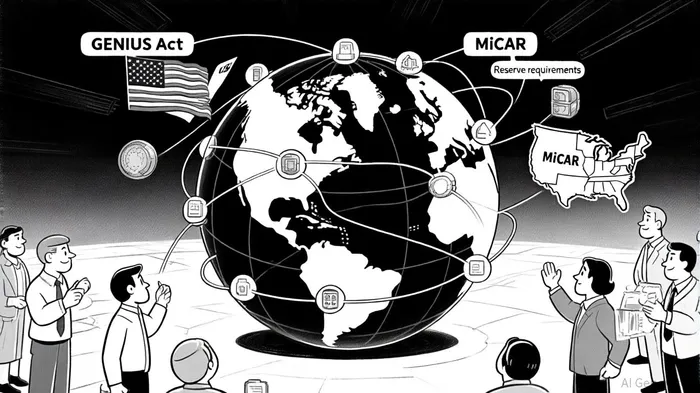
The crypto industry's evolution in 2025 has been defined by a pivotal shift: regulatory clarity emerging as a catalyst for institutional adoption and market growth. This transformation is not accidental but the result of deliberate, strategic alignment between industry leaders and policymakers. From the U.S. GENIUS Act to the EU's MiCAR framework, the collaboration between regulators and crypto innovators has redefined the landscape, unlocking new investment opportunities while addressing systemic risks.
U.S. Regulatory Innovation: The GENIUS and CLARITY Acts
The U.S. has emerged as a leader in structuring a regulatory environment that balances innovation with investor protection. The GENIUS Act, signed into law by President Trump on July 18, 2025, established a federal framework for stablecoins, requiring 100% reserve backing in U.S. dollars or short-term government assets[1]. This act, supported by bipartisan lawmakers and crypto firms like Ondo Finance and Bitpanda, has legitimized stablecoins as a cornerstone of digital finance[2]. By mandating monthly audits and AML/KYC compliance, the GENIUS Act has reduced uncertainty for institutional investors, enabling major banks like JPMorganJPM-- and Bank of AmericaBAC-- to explore stablecoin-based cross-border payment systems[3].
Complementing this, the CLARITY Act passed the House in July 2025 with bipartisan support, aiming to clarify jurisdictional boundaries between the SEC and CFTC[1]. Industry groups, including the Blockchain Association and CoinbaseCOIN--, lobbied aggressively for the bill, arguing that regulatory ambiguity was driving talent and capital to jurisdictions like Singapore[4]. Brian Armstrong, CEO of Coinbase, described the CLARITY Act as a “freight train” for U.S. crypto leadership, emphasizing its role in preventing regulatory arbitrage[4].
EU's MiCAR Framework: Harmonization and Investor Protection
While the U.S. prioritizes innovation, the EU's Markets in Crypto-Assets Regulation (MiCAR), effective December 30, 2024, focuses on harmonization and stability. MiCAR imposes stringent reserve requirements on stablecoin issuers, mandates passporting rights for crypto asset service providers (CASPs), and introduces a licensing regime for e-money tokens (EMTs) and asset-referenced tokens (ARTs)[5]. This framework has spurred a 47% increase in registered Virtual Asset Service Providers (VASPs) in the EU by Q1 2025[6], while institutional investors boosted crypto holdings by 32% post-implementation[6].
Notably, MiCAR's alignment with U.S. stablecoin regulations—such as 1:1 reserve backing—has created a bridge for cross-border compliance. However, the EU's emphasis on ex ante regulation contrasts with the U.S.'s modular approach, creating operational challenges for global firms. For example, tokens classified as “payment stablecoins” under the GENIUS Act may face restrictions in the EU if deemed “asset-referenced tokens” under MiCAR[7].
Investment Trends: IPOs and Market Expansion
Regulatory clarity has directly fueled investment growth. In the U.S., the GENIUS Act catalyzed a $2 billion crypto IPO wave in 2025, with firms like Bullish, CircleCRCL--, and Gemini going public[8]. These listings were enabled by the act's disclosure rules and reserve segregation standards, which provided underwriters and institutional investors with measurable compliance benchmarks[8]. Infrastructure players, such as custody firms and settlement networks, dominated the IPO surge due to their recurring revenue models and transparency[8].
In the EU, the crypto market is projected to reach €1.8 trillion by year-end 2025, driven by MiCAR-compliant firms and increased institutional participation[6]. The EU's focus on investor protection has also attracted fintech giants like PayPalPYPL-- and Binance to expand their services under the new framework[2].
Strategic Implications and Future Outlook
The U.S. and EU regulatory models reflect divergent philosophies: the U.S. prioritizes innovation and dollar-backed stablecoin dominance, while the EU emphasizes stability and monetary sovereignty[7]. This divergence creates both opportunities and challenges. For instance, the U.S. strategy of “cryptomercantilism”—promoting dollar-backed stablecoins globally—risks undermining weaker currencies in emerging markets[7]. Conversely, the EU's strict prudential requirements may limit the entry of non-EU stablecoins, reinforcing the dollar's dominance[7].
Investors must navigate these dynamics by aligning with firms that bridge regulatory gaps. Ondo Finance, for example, has leveraged its regulatory engagement—appointing former SEC official Peter Curley to lead global affairs—to expand tokenized U.S. Treasuries and stablecoin offerings[2]. Similarly, Coinbase's lobbying efforts for the CLARITY Act highlight the importance of proactive industry-policymaker collaboration[4].
Conclusion
Regulatory clarity is no longer a barrier but a catalyst for crypto investment. The strategic alignment between industry leaders and regulators—evidenced by the GENIUS Act, CLARITY Act, and MiCAR—has transformed the sector into a legitimate asset class. As the U.S. and EU continue to shape global standards, investors who prioritize compliance, innovation, and cross-border adaptability will thrive in this evolving landscape.





Comentarios
Aún no hay comentarios