
The Regulatory Clampdown on Privacy Coins and Its Impact on Crypto Portfolio Strategy
The global regulatory landscape for cryptocurrencies is undergoing a seismic shift, with privacy coins-once celebrated for their anonymity-now facing unprecedented scrutiny. Dubai's recent ban on privacy-focused assets like MoneroXMR-- (XMR) and ZcashZEC-- (ZEC) underscores a broader trend where regulators are prioritizing transparency over decentralization. For investors, this marks a critical inflection point: portfolios must now be restructured to mitigate regulatory risk while navigating a post-anonymity crypto ecosystem.
Dubai's Ban: A Harbinger of Global Enforcement
Dubai's regulatory actions, effective January 12, 2026, represent one of the most stringent crackdowns on privacy coins to date. The Dubai Financial Services Authority (DFSA) and Dubai International Financial Centre (DIFC) prohibited all trading, promotion, and fund management activities involving privacy tokens on regulated exchanges, citing anti-money laundering (AML) and sanctions compliance risks. While individuals may still hold these assets in private wallets, the ban effectively sidelines privacy coins from institutional and retail markets governed by the DIFC.
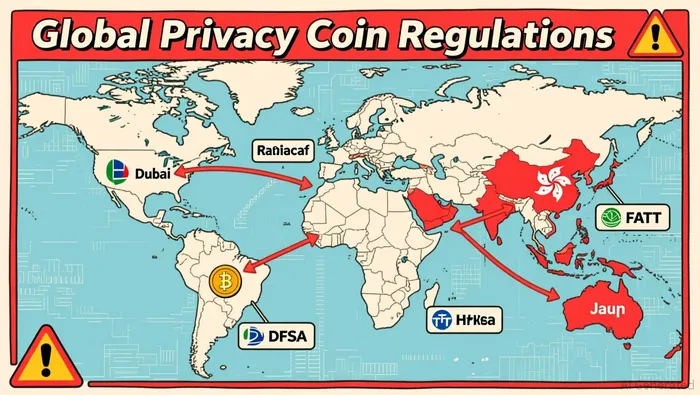
The DFSA's revised Crypto Token Regulatory Framework explicitly aligns with Financial Action Task Force (FATF) guidelines, which mandate full transactional transparency to combat financial crime. This move mirrors global efforts to eliminate anonymity in crypto transactions, a trend that has seen privacy coins excluded from regulated markets in the European Union, Hong Kong, Japan, and South Korea according to reports.
A Global Trend: From Caution to Confrontation
Dubai's actions are not an outlier. The European Union's Markets in Crypto-Assets (MiCA) regulation, enacted in early 2025, has imposed uniform transparency requirements across member states, effectively marginalizing privacy tokens from compliant exchanges. Similarly, Hong Kong has tightened AML and know-your-customer (KYC) rules for exchanges listing privacy coins, while South Korea has moved toward outright restrictions in key segments as noted. Japan, though more cautious, has also increased scrutiny on platforms offering privacy-focused assets according to analysis.
These measures reflect a shared regulatory philosophy: anonymity is incompatible with modern financial oversight. As stated by the DFSA, privacy coins "inherently violate global AML standards by obscuring transaction details and user identities." This rationale has gained traction worldwide, with regulators increasingly viewing privacy tokens as high-risk assets.
Strategic Implications for Investors
For crypto investors, the regulatory clampdown necessitates a recalibration of portfolio strategies. Here are three key considerations:
Hedge Exposure to Privacy Coins
Privacy coins like XMRXMR-- and ZECZEC--, while resilient in price notably surging post-Dubai's ban, face existential regulatory risks. Investors should reduce direct exposure to these assets and instead allocate capital to tokens that align with evolving compliance frameworks. For example, stablecoins backed by fiat reserves-such as USDCUSDC-- and RLUSD- now meet stricter regulatory criteria under Dubai's revised rules.Prioritize Regulated Assets and Platforms
The shift toward compliance demands a focus on assets and exchanges that adhere to AML/KYC standards. Tokens listed on regulated platforms, particularly those with transparent transaction histories, are better positioned to withstand regulatory scrutiny. Investors should also favor jurisdictions with clear legal frameworks, such as Singapore or Switzerland, which have demonstrated adaptability in balancing innovation and oversight.Adapt to a Post-Anonymity Ecosystem
The era of untraceable transactions is waning. Investors must accept that privacy and regulatory compliance are increasingly at odds. This does not mean abandoning privacy altogether but rather embracing tools that operate within legal boundaries. For instance, layer-2 solutions or privacy-preserving protocols that comply with AML requirements (e.g., zero-knowledge proofs with selective disclosure) may offer a middle ground.
Conclusion: Compliance as a Competitive Advantage
The regulatory crackdown on privacy coins is not merely a policy shift-it is a structural reordering of the crypto market. Investors who fail to adapt risk being left with illiquid or non-compliant assets. Conversely, those who proactively reposition their portfolios toward regulated, transparent tokens will gain a competitive edge in a maturing industry.
As Dubai's actions demonstrate, the future of crypto is not defined by anonymity but by accountability. In this new paradigm, resilience lies not in evading regulation but in embracing it.






Comentarios
Aún no hay comentarios