
Regulating Youth Social Media Use: Investment Opportunities in Digital Safety and Education
The global regulatory landscape for youth social media use is undergoing a seismic shift. From U.S. states like Arkansas and Utah enforcing age verification mandates to the EU setting a default minimum age of 16 for social media access, governments are prioritizing digital safety for minors. These policy changes are not just reshaping user behavior-they are unlocking a multi-billion-dollar market for tech solutions in digital safety, education, and identity verification. For investors, this represents a unique opportunity to capitalize on regulatory tailwinds while addressing critical societal challenges.
Global Regulatory Momentum: A Catalyst for Innovation
The U.S. has been at the forefront of legislative action. Arkansas' Social Media Safety Act (2023) and Utah's Utah Social Media Regulation Act (2025) require platforms to implement age verification and parental consent for users under 18, with penalties for noncompliance. Similarly, Maryland's "Kids Code" prohibits data collection for personalized content targeting minors under 16, mandating high privacy settings by default. These laws are part of a broader trend: by 2025, over 20 U.S. states had enacted or proposed age verification, parental consent, or data restriction measures.
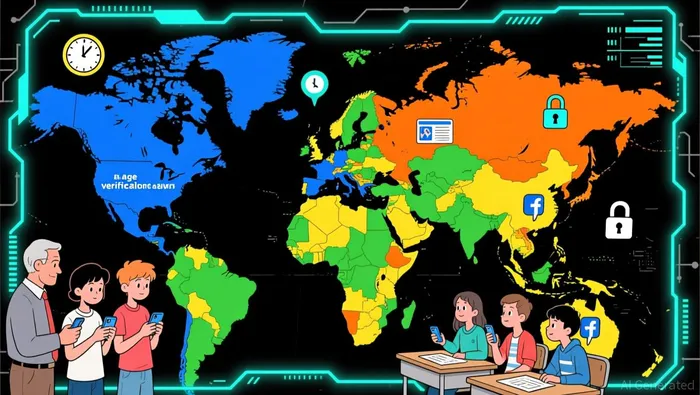
Internationally, the EU has taken a more centralized approach. In November 2025, the European Parliament passed a directive setting a default minimum age of 16 for social media access, with exceptions for ages 13–15 under parental consent. Countries like France, Denmark, and Norway have introduced stricter measures, including bans on social media for under-15s or requiring parental approval for account creation according to sources. Asia is following suit: Malaysia's 2025 mandate bans users under 16 and enforces age verification starting 2026, while Pakistan and Indonesia explore similar frameworks according to reports.
These regulatory shifts are driven by growing concerns over mental health, cyberbullying, and data exploitation. According to a report by the OECD, governments are increasingly viewing social media as a public health issue, with 78% of surveyed countries implementing or proposing age restrictions by 2025.
Market Opportunities: From Age Verification to Digital Literacy
The regulatory push has created three key investment opportunities:
Age Verification and Identity Tech
Platforms must now verify users' ages to comply with laws like the EU's Digital Services Act (DSA) and the U.S. Kids Online Safety Act (KOSA). Startups specializing in AI-powered age estimation, biometric verification, and blockchain-based identity solutions are thriving. For example, Didit, a leader in age verification, offers modular tools that adapt to varying regulatory environments, reducing user drop-off while ensuring compliance. Similarly, k-ID, a kids' gaming safety startup, raised $45 million in 2024 to develop privacy-first solutions for minors.Digital Literacy and Education Tools
As governments mandate digital safety education, startups are filling gaps in curriculum development and platform-specific tools. California's law requiring mental health warning labels on social media platforms for minors and Connecticut's online safety centers highlight the need for educational resources. Companies like CodeFarm AI and SkillSphere are leveraging generative AI to create adaptive learning tools, while platforms like Meta's "Teen Accounts" and TikTok's age-based content filters demonstrate the commercial viability of child-centric features according to analysis.
- Child-Centric Platform Design
Regulatory frameworks like the UK's Online Safety Act (2025) and California's privacy-focused laws are forcing platforms to redesign interfaces to minimize harm. This includes limiting geolocation tracking, reducing addictive design elements, and defaulting to high privacy settings according to experts. Startups that integrate these features into their core offerings-such as those developing AI-driven content moderation tools-are well-positioned to benefit.
Investment Trends and Strategic Sectors
The market is already responding to these shifts. Venture capital is pouring into age verification software, with North America's market projected to grow at a 22% CAGR through 2025. In education tech, companies like SpecterOps and Cybrary have raised $30 million and $4.5 million, respectively, in 2025, reflecting demand for cybersecurity and digital literacy tools.
Investors should focus on sectors where regulatory compliance intersects with user demand:
- AI and Biometrics: Startups using facial recognition or decentralized identity solutions to verify age without compromising privacy.
- SaaS Platforms: Tools that help schools and parents monitor online activity or enforce digital safety policies.
- Global Expansion: Companies adapting to regional regulations, such as EU's DSA or Australia's under-16 ban, to serve multinational markets.
Conclusion: A Golden Age for Digital Safety Innovation
The convergence of regulatory action and technological innovation is creating a fertile ground for investment. As governments worldwide enforce stricter rules on youth social media use, the demand for age verification, digital literacy, and child-centric design will only accelerate. For investors, the key is to identify startups and sectors that align with both regulatory mandates and user needs-those that can scale solutions while maintaining privacy and usability.
The next decade will likely see digital safety become as foundational to tech as cybersecurity is today. The question is not whether to invest, but where-and how quickly-to act.





Comentarios
Aún no hay comentarios