
Regulated Crypto Derivatives in Europe: How Backpack EU is Reshaping the Market Landscape
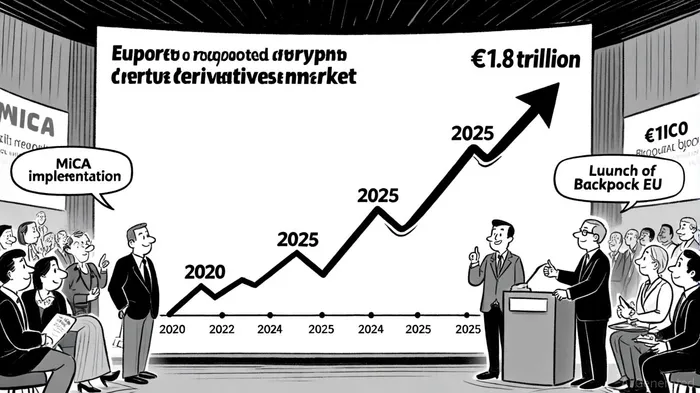
The European crypto derivatives market is undergoing a seismic shift, driven by regulatory clarity and institutional demand. At the forefront of this transformation is Backpack EU, a regulated platform offering perpetual futures under a MiFID II license from the Cyprus Securities and Exchange Commission (CySEC). By addressing the void left by unregulated offshore exchanges, Backpack EU is not only reshaping the European landscape but also positioning itself as a strategic asset for investors seeking exposure to compliant crypto infrastructure.
Regulatory Clarity as a Catalyst for Growth
The Markets in Crypto-Assets (MiCA) and MiFID II frameworks have created a fertile ground for institutional adoption. By Q1 2025, 65% of EU-based crypto businesses had achieved MiCA compliance, signaling a maturing ecosystem [3]. This regulatory clarity has spurred a surge in institutional interest, with derivatives now serving as critical tools for risk management, hedging, and portfolio diversification. For instance, 74% of institutional risk strategies now prioritize cybersecurity, while 62% employ multi-signature wallets and cold storage solutions to mitigate custodial risks [1].
Backpack EU’s launch in June 2025 under a reissued CySEC license underscores this trend. The platform’s commitment to daily proof-of-reserves and compliance with MiFID II standards has restored trust in a market still reeling from the FTX collapse. By acquiring FTX EU and resolving outstanding customer claims, Backpack has transformed a liability into a foundation for trust, a move that aligns with the ECB’s emphasis on financial stability in crypto markets [4].
Strategic Positioning and Market Differentiation
Backpack EU’s offering—over 40 trading pairs with up to 10x leverage—positions it as a direct competitor to unregulated exchanges while catering to both retail and institutional traders. Its integration of traditional payment systems like SEPA and wire transfers further bridges the gap between legacy finance and crypto, a critical factor for institutional onboarding [5].
The platform’s expansion plans highlight its ambition: regulatory efforts in Japan and the U.S. are already underway, with the CEO, Armani Ferrante, framing Backpack as a “trust-first” gateway to global crypto derivatives [1]. This strategy mirrors broader industry trends, where platforms like CME GroupCME-- have reported a 215% year-over-year increase in Micro Ether futures trading, reflecting the growing legitimacy of derivatives as risk tools rather than speculative instruments [2].
Institutional Adoption and Market Projections
Institutional participation in European crypto derivatives is accelerating. By 2025, 78% of global institutional investors had formal crypto risk management frameworks, up from 54% in 2023 [1]. This shift is driven by the recognition of digital assets as a legitimate asset class, with 91% of institutions expressing interest in tokenized assets to prepare for digital financial transformation [2].
The European market’s projected size of €1.8 trillion by 2025 [3] underscores its potential. Derivatives are central to this growth, enabling institutions to hedge long ETF exposure, execute basis trades, and manage volatility in a 24/7 market. Platforms like Backpack EU, which combine regulatory compliance with liquidity access, are uniquely positioned to capture this demand.
Challenges and Risks
Despite the optimism, challenges persist. The ECB’s Financial Stability Review (May 2025) highlights macroeconomic uncertainties, including geopolitical tensions and evolving U.S. trade policies, which could impact crypto platforms’ liquidity and operations [6]. Additionally, the fast-moving nature of the crypto ecosystem requires continuous regulatory adaptation to address volatility and liquidity risks [3].
Conclusion: A Strategic Investment Opportunity
Backpack EU’s emergence as a regulated, trust-focused platform in Europe represents a compelling investment thesis. By aligning with MiCA and MiFID II standards, it addresses institutional demand for compliance while filling a critical gap left by unregulated exchanges. As the European market matures and institutional adoption accelerates, platforms that prioritize regulatory innovation—like Backpack—will likely dominate the next phase of crypto derivatives growth. For investors, this is not just a bet on crypto but on the infrastructure enabling its integration into the global financial system.
Source:
[1] Institutional Crypto Risk Management Statistics 2025 [https://coinlaw.io/institutional-crypto-risk-management-statistics/]
[2] How Institutional Crypto Adoption Is Reshaping Finance [https://www.xbto.com/resources/how-institutions-are-adopting-crypto?619c498a_page=8]
[3] EU MiCA Regulations Statistics 2025 [https://coinlaw.io/eu-mica-regulations-statistics/]
[4] Backpack EU Launches after “Fulfilling Promise” to Refund Former FTX EU Customers [https://www.financemagnates.com/cryptocurrency/backpack-eu-launches-after-fulfilling-promise-to-refund-ex-ftx-customers/]
[5] Backpack EU Goes Live, Offering Regulated Perpetuals Trading for European Traders [https://www.prnewswire.com/news-releases/backpack-eu-goes-live-offering-regulated-perpetuals-trading-for-european-traders-302548842.html]
[6] Financial Stability Review, May 2025 - European Central Bank [https://www.ecb.europa.eu/press/financial-stability-publications/fsr/html/ecb.fsr202505~0cde5244f6.en.html]







Comentarios
Aún no hay comentarios