
Regional Demographic Shifts and Canadian Real Estate: Alberta's Growth vs. Declines in Ontario, B.C., and Quebec
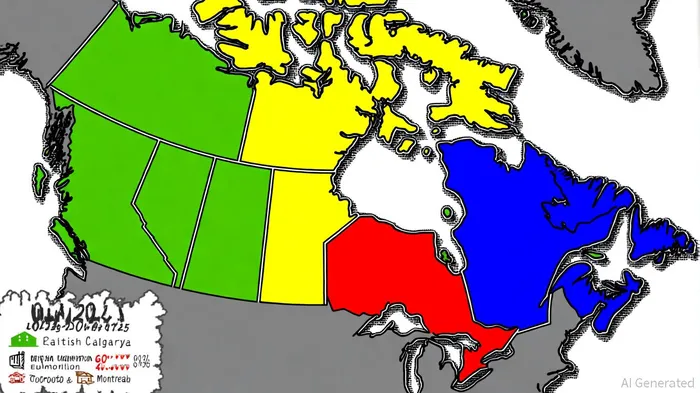
Canada's real estate and economic landscapes are being reshaped by divergent demographic trends. Alberta's population growth in 2025, fueled by interprovincial and international migration, stands in stark contrast to the stagnation or decline seen in Ontario, British Columbia, and Quebec. These shifts are not merely statistical—they are driving profound changes in housing markets, employment dynamics, and investment opportunities.
Alberta: A Magnet for Migration and Economic Momentum
Alberta's population growth in 2025, though slower than its 4.3% surge in 2023, remains robust at 0.4% in the second quarter, driven by a combination of interprovincial migration (6,187 new residents), international immigration (11,538), and natural increase (5,361) [2]. This inflow has directly supported a resilient real estate market. Benchmark home prices in Calgary and Edmonton rose by 6.81% year-over-year in 2024, outpacing the national average [3].
The province's affordability relative to high-cost regions like Ontario and B.C. is a key draw. Alberta's home prices have increased by just 26.3% since 2014—the third-smallest rise in Canada—despite recent acceleration [3]. This, combined with a 7.7% unemployment rate in August 2025 (down from 8.2% in early 2024) [4], has created a virtuous cycle: job growth attracts migrants, who in turn boost demand for housing and infrastructure.
However, supply constraints persist. In Q4 2023, Alberta produced only one housing start for every 4.1 new residents [3], raising concerns about long-term affordability. Federal policies, including GST exemptions for rental developments and the National Housing Strategy, are attempting to bridge this gap [2]. Investors may find opportunities in suburban and secondary markets like Lethbridge and Grande Prairie, where appreciation potential remains untapped [1].
Ontario and B.C.: Population Gains vs. Housing Market Strains
Ontario and British Columbia, despite experiencing population growth, face a paradox: rising populations have not translated into rising home prices. Ontario's benchmark prices fell 4.05% from 2023 to 2024, even as its population grew 3.2% [3]. Similarly, B.C. saw a 3.02% population increase but a 2.45% drop in home prices [3]. Both provinces are losing residents to Alberta, where housing is more affordable [1].
The root cause lies in imbalanced housing supply. Ontario, for instance, had hit only 26% of its 2025 housing target by September, jeopardizing its goal of 1.5 million new homes by 2031 [4]. B.C. has seen a marginal 7.9% rise in building permits but a year-over-year decline in housing starts [5]. Overemphasis on rental construction in both provinces has left ownership housing undersupplied, creating risks for future shortages as population growth stabilizes [1].
Employment trends further complicate the picture. Ontario's unemployment rate stabilized at 7.5% in March 2025 [6], while B.C.'s rate remained at 6.0% in January 2025 [7]. These figures, though stable, fail to offset the outmigration pressures exacerbated by high housing costs.
Quebec: Immigration-Driven Growth and Construction Resilience
Quebec's population growth in 2025, at 0.4%, lags behind Alberta but is bolstered by immigration [8]. The province's labor market showed a 0.4% monthly job increase in April 2025, with an unemployment rate of 6.0% [9]. Unlike Ontario and B.C., Quebec has seen a broad uptick in housing starts across all property types, suggesting better alignment between population growth and supply [3].
However, Quebec's reliance on immigration to offset demographic stagnation mirrors national challenges. Without addressing structural issues in housing affordability and interprovincial migration, its gains may remain fragile.
Investment Implications
For investors, the divergent trajectories of these provinces present clear opportunities and risks. Alberta's real estate market, while constrained by supply, offers strong fundamentals: rising employment, migration-driven demand, and relatively affordable prices. Suburban and secondary markets are particularly attractive.
Conversely, Ontario and B.C. require caution. Overbuilt rental sectors and undersupplied ownership housing could lead to future volatility. Investors in these regions should prioritize assets in areas with infrastructure development or policy tailwinds, such as Toronto's suburban corridors or Vancouver's mixed-use projects.
Quebec's balanced approach to housing construction and immigration offers a middle path, but its slower population growth limits explosive potential.
Conclusion
Canada's demographic shifts are reshaping its economic map. Alberta's growth, driven by migration and economic resilience, positions it as a key hub for real estate and employment. Meanwhile, Ontario, B.C., and Quebec grapple with affordability crises and supply imbalances. For investors, the lesson is clear: align portfolios with regions where demographic momentum and policy support converge.







Comentarios
Aún no hay comentarios