
Regional Bank Rate Cuts and Credit Markets: Navigating Investment Opportunities in 2025
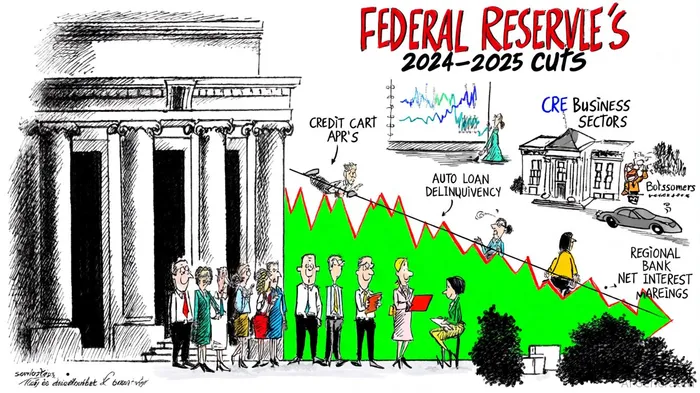
The Federal Reserve's rate cuts in 2024–2025 have reshaped the financial landscape, creating both challenges and opportunities for regional banks and credit markets. As the central bank reduced borrowing costs to combat inflation and stabilize growth, regional institutions—already grappling with narrow margins and commercial real estate (CRE) vulnerabilities—have faced a complex recalibration of risk and reward. For investors, this environment demands a nuanced understanding of how rate cuts influence consumer and business credit dynamics, as well as the strategic positioning of regional financial institutionsFISI-- and consumer credit-related equities.
Consumer Credit Markets: Relief and Trade-offs
The Fed's rate reductions have provided modest relief to borrowers with variable-rate debt. Credit card interest rates, for instance, are expected to decline from an average of 20% to 17–18% over the next year, easing financial pressure on households[1]. Auto loan rates, though largely fixed, may see improved buyer sentiment as refinancing becomes more attractive[3]. However, these benefits are unevenly distributed. Subprime borrowers remain exposed to elevated rates, and mortgage markets—tied to long-term bond yields—have seen limited immediate impact, with 30-year fixed rates hovering near 6.35% as of September 2025[5].
Savers, meanwhile, face headwinds. Regional banks have aggressively cut yields on high-interest savings accounts and certificates of deposit (CDs), with some shortening CD terms to preserve margins[2]. This shift incentivizes investors to diversify into short-term fixed-income instruments, such as U.S. Treasury bills or short-duration bonds, to mitigate erosion of returns[4].
Business Credit Markets: CRE Risks and Strategic Adjustments
The commercial lending landscape remains fraught with challenges, particularly in the CRE sector. Delinquency rates for U.S. CRE loans reached 1.57% in late 2024, with office property loans accounting for a staggering 9.37% of defaults[6]. Regional banks, which historically underwrote CRE loans with lower down payments, now face a perfect storm of falling property values and maturing debt. Approximately $500 billion in CRE mortgages will mature in 2025, with many borrowers struggling to refinance amid tighter lending standards[1].
Yet, the Fed's rate cuts offer a partial lifeline. Lower borrowing costs could ease refinancing for multifamily and industrial sectors, which remain relatively resilient[5]. Banks are also adapting by selling low-yielding securities and reinvesting in higher-yielding assets, a strategy that has reduced unrealized losses and improved liquidity[4]. For example, Wells FargoWFC-- and KeyCorpKEY-- have repositioned portfolios to capitalize on the rate environment, signaling a potential rebound in net interest income for well-capitalized institutions[2].
Investment Opportunities: Regional Banks and Consumer Credit Equities
Regional banks are emerging as compelling long-term investments, albeit with caveats. PNC Financial Services GroupPNC-- and Regions Bank have outperformed the S&P 500 in 2025, with YTD returns of 5.66% and 14.50%, respectively[7]. Analysts attribute this to improved net interest margins and regulatory tailwinds, including relaxed capital requirements for banks like FITBFITB-- and HBAN[3]. Fitch's recent affirmation of stable outlooks for 10 major regional banks further underscores their resilience[8].
For consumer credit-related equities, the focus is on diversification and risk mitigation. High-yield corporate bonds and municipal bonds are gaining traction as low-risk, high-return assets[4]. Additionally, credit risk management firms—such as Experian, FICO, and TransUnion—are leveraging advanced analytics and machine learning to help lenders navigate defaults in a low-rate environment[9]. These tools enable scenario-based stress testing, a critical capability as economic uncertainty persists[2].
Strategic Recommendations
- Regional Banks: Prioritize institutions with strong capital buffers, diversified loan portfolios, and proactive CRE risk management. PNC and Regions Bank exemplify this profile, with earnings rebounds projected to exceed 10% in 2025[3].
- Consumer Credit Equities: Allocate to high-yield bonds and credit risk technology firms. Avoid overexposure to subprime auto loans and office CRE-linked assets[6].
- Diversification: Balance portfolios with short-term fixed-rate instruments (e.g., CDs, Treasuries) to hedge against further rate cuts[4].
Conclusion
The 2024–2025 rate cuts have created a bifurcated credit environment: relief for borrowers, uncertainty for savers, and mixed fortunes for regional banks. While CRE risks persist, strategic investments in well-positioned financial institutions and credit risk management tools offer pathways to capitalize on this evolving landscape. As the Fed projects further cuts in 2026, investors must remain agile, balancing growth opportunities with prudence in an era of shifting monetary policy.





Comentarios
Aún no hay comentarios