
Regional Bank Consolidation: Strategic Growth and Investor Optimism in a Shifting Landscape
Regional Bank Consolidation: Strategic Growth and Investor Optimism in a Shifting Landscape
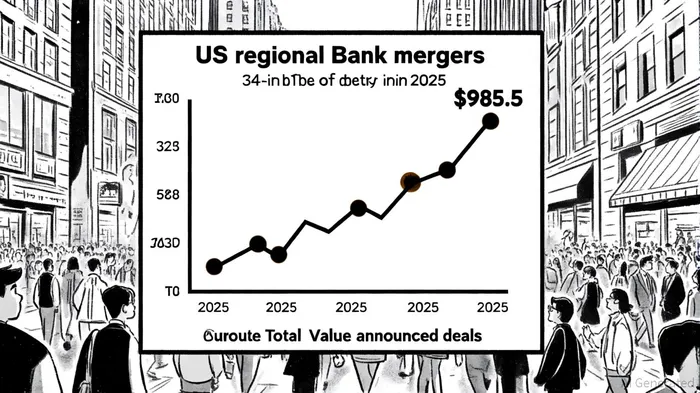
The U.S. regional banking sector is undergoing a transformation driven by a confluence of regulatory, economic, and strategic forces. From 2023 to 2025, mergers and acquisitions (M&A) have surged, with deal volumes and valuations reflecting a sector in motion. A Window Magazine report found the first quarter of 2025 alone saw 34 announced deals, up from 28 in the same period in 2024, with a total value of $985.5 million by February 28. This acceleration is not merely a function of market cycles but a calculated response to a shifting regulatory environment and the imperative for scale in an increasingly competitive financial landscape.
Strategic Drivers of Consolidation
The primary catalyst for this wave of consolidation is the anticipated regulatory easing under the Trump administration, which has signaled a lighter touch on compliance burdens for mid-sized banks, as Reuters reported. This shift has emboldened regional institutions to pursue larger balance sheets, enabling them to invest in technology, expand geographic footprints, and counter the encroachment of fintech disruptors, as the Window Magazine report also notes. For instance, Fifth Third Bancorp's $10.9 billion acquisition of ComericaCMA-- exemplifies the pursuit of scale, combining two regional powerhouses to create a more diversified and resilient entity.
Valuation metrics also underscore the strategic rationale. The average price-to-tangible book value (P/TBV) for regional bank deals in Q1 2025 reached 151%, a significant jump from 117% in Q1 2024, according to the Window Magazine report. This premium reflects investor confidence in the long-term value of consolidation, particularly as banks seek to offset the costs of compliance and digital transformation. Smaller deals, such as Seacoast Banking Corp. of Florida's $109.7 million acquisition of Heartland Bancshares Inc., further illustrate the sector's focus on targeted growth and operational efficiency.
Investor Sentiment and Market Performance
Investor sentiment toward regional bank consolidation has been cautiously optimistic, buoyed by the sector's undervaluation relative to its larger peers. As noted by Wall Street analysts in CNBC, super-regional banks like PNC Financial Services and U.S. Bancorp have outperformed in terms of loan demand and net interest income, even as they trade at a discount to the broader market. This gap presents an attractive opportunity for investors, particularly as regional banks benefit from the repricing of fixed-rate assets to higher interest rates, which enhances net interest margins.
The SPDR S&P Regional Banking ETF (KRE) serves as a barometer of this sentiment. After plummeting over 30% in the wake of the 2023 banking crisis-triggered by the collapses of Silicon Valley Bank and First Republic Bank-the ETF rebounded with a 75% surge from its May 2023 low through July 2025, a trend noted in Reuters reporting. By late 2024, KRE had gained over 36% in a year, driven by reduced competition from failed banks and expectations of rate cuts, as reported by Nasdaq. As of October 2025, the ETF maintained a year-to-date return of 5.14%, with assets under management (AUM) of $3.9 billion, according to BestETF. While it remains 20% below its January 2022 peak, the recovery trajectory suggests a sector regaining its footing.
However, optimism is tempered by risks. Analysts caution that inflationary pressures from tariffs and the potential for prolonged high interest rates could flatten yield curves and compress profit margins, a point highlighted by Filip's Investment Strategies. These headwinds highlight the delicate balance regional banks must strike between growth and stability.
Conclusion
The regional bank consolidation wave is a testament to the sector's adaptability in the face of regulatory, economic, and technological challenges. While strategic growth through M&A offers a path to resilience, investor sentiment remains a double-edged sword-optimistic yet wary. For investors, the key lies in discerning which institutions are best positioned to navigate these dynamics, leveraging scale without sacrificing agility. As the Trump administration's regulatory agenda unfolds and interest rate trajectories crystallize, the next chapter of regional banking will likely be defined by those who can harmonize growth with prudence.





Comentarios
Aún no hay comentarios