
Regional Australia's Golden Harvest: Investing in the $100 Billion Agribusiness Boom
The Australian agribusiness sector is on the brinkBCO-- of a historic milestone: hitting $100 billion by 2030. Driven by soaring commodity prices, a strengthening regional economy, and the tailwinds of falling interest rates, this is no mere projection—it's an investable reality. For those willing to act now, the opportunities are ripe across agriculture, logistics, and rural real estate.
Agricultural Resilience Fuels the $100 Billion Target
Australia's agribusiness sector is firing on all cylinders. Beef, lamb, and dairy prices have propelled the NAB Rural Commodities Index to a 6.1% annual rise in AUD terms, while ABARES forecasts a $91 billion agricultural turnover for 2025–26—the third-highest on record. This isn't just a cyclical upswing; it's a structural shift.
The catalysts are clear: global demand for Australian produce is surging. Premium markets like China, the Middle East, and Japan are hungry for high-quality beef, dairy, and grains. Meanwhile, U.S.-China trade tensions have opened a window for Australian exporters, and a weaker Australian dollar (expected to hit 0.70 vs. the U.S. dollar by year-end) makes our goods more price-competitive.
Regional Property: Outpacing Cities and Attracting Global Capital
While metropolitan property growth has stalled at 2.6%, regional Australia is booming. Median property valuations have soared to $673,373—a 58.7% jump since pre-pandemic levels—and are growing at 5.6% annually. This isn't just a housing story; it's a testament to the region's economic vitality.
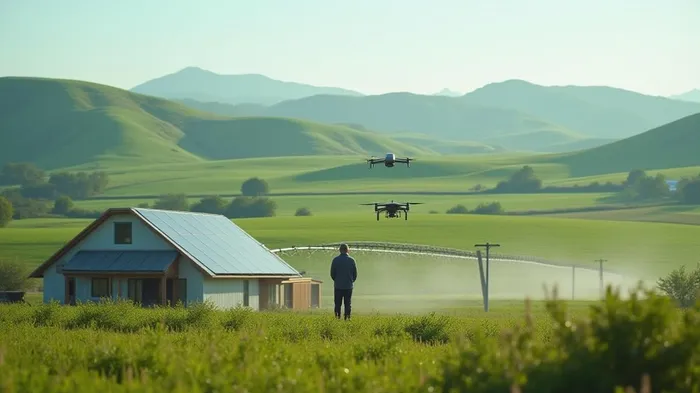
Foreign investors, particularly U.S. buyers, are snapping up land: over 265,000 hectares were sold for $1.2 billion in 2024. The appeal is simple: rural Australia offers both tangible assets and exposure to the agribusiness boom. High-value property segments ($25M+) are primed for further growth as interest rates drop.
The Interest Rate Catalyst: Borrowing Costs Collapse to 3.1% by 2025
The Reserve Bank's pivot toward lower rates is a game-changer. With the cash rate expected to fall to 3.1% by year-end, farmers and investors can lock in historically low borrowing costs. This isn't just about refinancing—it's about unlocking capital for expansion.
For farmers, this means upgrading equipment, scaling operations, or adopting green technologies like precision irrigation systems. For investors, it's a chance to buy undervalued rural land or agribusiness assets while leverage costs are favorable.
Historically, this strategy has paid off. When the RBA cut rates between 2020 and 2025, a buy-and-hold approach to the S&P/ASX 20 Agriculturals Index for 30 days generated an average return of 96%, though investors should note a maximum drawdown of 33%. While the Sharpe ratio of 0.45 suggests moderate risk-adjusted returns, the strong absolute gains underscore the opportunity.
Strategic Investment Playbook: Where to Act Now
- Agriculture-Adjacent Industries: Food and beverage manufacturing is booming, with an 11.9% investment surge as regional producers capitalize on global demand. Invest in companies processing Australian exports—from dairy to wine—to capture added-value opportunities.
- Logistics and Infrastructure: Australia's export boom needs better roads, ports, and storage. Firms specializing in rural logistics or infrastructure development stand to benefit as supply chains are modernized.
- Rural Real Estate: Buy now before valuations climb further. Focus on high-potential regions like Queensland (irrigation-rich) or Victoria (dairy hubs), where land prices are still below their peak potential.
- Green Technology: Sustainability is non-negotiable. Back agritech startups deploying soil sensors, solar-powered irrigation, or carbon sequestration solutions. The Clean Energy Finance Corporation's discounted loans make this accessible even for small investors.
Navigating Risks: Weather, Costs, and Commodity Volatility
No investment is risk-free. Input costs like fertilizers (up 19% year-on-year) and feed grains (trending upward) could squeeze margins. Weather remains a wildcard, but drought resilience programs—funded by the Future Drought Fund—provide a safety net.
Meanwhile, the sector's diversification across commodities and markets mitigates single-point failures. With global demand for Australian produce at an all-time high, the downside is limited.
Conclusion: The Clock Is Ticking—Act Before the Boom Peaks
The pieces are in place: a $100 billion industry is within reach, regional assets are undervalued, and borrowing costs are plummeting. This is a once-in-a-generation opportunity.
Investors who move now will secure stakes in Australia's agricultural renaissance—from land and logistics to the next wave of agritech innovators. The harvest is coming. Don't be left holding empty hands.







Comentarios
Aún no hay comentarios