
Reevaluating Risk Assets in a Decelerating Labor Market: Implications for Equity Markets and Cyclical Sectors
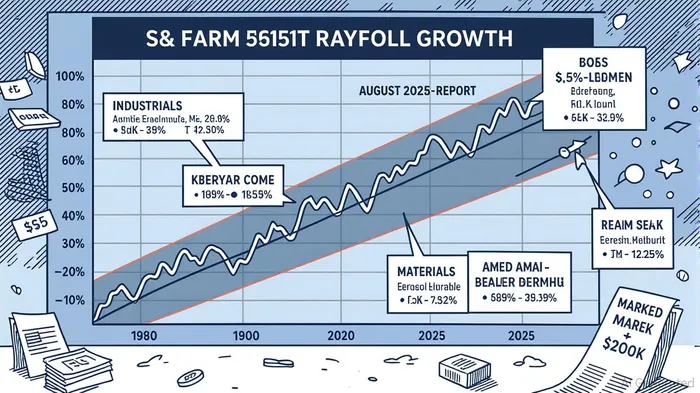
The U.S. labor market has entered a precarious phase, with August 2025's nonfarm payrolls expanding by a mere 22,000 jobs—far below the 75,000 forecast and the weakest print since late 2020. The unemployment rate climbed to 4.3%, the highest since 2021, while youth unemployment surged to 10.5%, nearly double the national average. This data, coupled with downward revisions to prior months, signals a labor market that is not merely cooling but fracturing under the weight of policy uncertainty, global supply chain disruptions, and the lingering effects of Trump-era tariffs.
The equity market's reaction has been swift and severe. The S&P 500 and Nasdaq turned negative in the wake of the report, as investors recalibrated expectations for corporate earnings and Federal Reserve policy. The Fed, now under pressure to respond to a labor market that has lost its momentum, faces a delicate balancing act: cutting rates to stimulate growth risks exacerbating inflationary pressures from tariffs and supply chain bottlenecks. Traders have priced in a 25-basis-point cut in September, with whispers of a 50-basis-point move gaining traction.
Cyclical Sectors: A Tale of Two Realities
Historical patterns offer a sobering perspective. During labor market slowdowns, cyclical sectors like industrials, materials, and consumer discretionary have consistently underperformed, while defensive sectors such as healthcare and consumer staples have acted as safe havens. For instance, the materials sector, which relies heavily on construction and industrial demand, has averaged just 7% returns during economic downturns—well below the 15% average of healthcare and consumer staples. The August 2025 report has amplified these dynamics.
In Q2 2025, industrials and materials lagged despite a broader S&P 500 earnings beat, with energy and materials reporting year-over-year declines due to weak commodity prices and tariff-driven uncertainty. The Russell 2000's surge in August, driven by small-cap outperformance, further underscores a market narrowing in focus, with investors favoring resilient sub-sectors like healthcare over vulnerable ones like utilities and industrials. Consumer discretionary, meanwhile, has shown mixed signals. While the sector outperformed in the pre-pandemic era, recent macroeconomic headwinds—including inflation and shifting consumer behavior—have eroded its appeal.
The Fed's Dilemma and Market Repricing
The Federal Reserve's next move will be pivotal. A 50-basis-point rate cut in September, though speculative, would signal a dramatic shift in policy and likely trigger a rotation into risk assets. However, the Fed's hands are tied by the broader economic context. Tariffs, which have already disrupted global trade flows, are pushing inflation higher, complicating the central bank's mandate. Moreover, the labor market's fragility—evidenced by rising long-term unemployment and a participation rate that remains below pre-pandemic levels—suggests that even a modest rate cut may not be enough to stave off a deeper slowdown.
Reevaluating Risk Assets: A Strategic Shift
For investors, the message is clear: the era of broad-based equity gains is giving way to a more fragmented market. Cyclical sectors, particularly those tied to discretionary spending and industrial activity, face headwinds as labor market weakness persists. Defensive sectors, on the other hand, offer a buffer against volatility. This realignment is not merely tactical but structural.
Consider the materials sector, which has historically rebounded during recovery phases but has struggled to gain traction in a decelerating economy. Similarly, consumer discretionary's reliance on wage growth and consumer confidence makes it vulnerable to prolonged labor market softness. In contrast, healthcare and utilities, with their stable cash flows and low sensitivity to economic cycles, are likely to outperform.
Conclusion: Navigating the Crosscurrents
The August 2025 jobs report is more than a data point—it is a harbinger of a broader economic inflection point. As the labor market slows and policy uncertainties mount, investors must reevaluate their exposure to risk assets. Cyclical sectors, once the bedrock of equity returns, now require a more cautious approach. Defensive allocations, meanwhile, offer a counterbalance to the headwinds. The Fed's next move will shape the immediate outlook, but the long-term trajectory of the labor market—and its implications for equity markets—will depend on whether policymakers can stabilize the economy without fueling inflation.







Comentarios
Aún no hay comentarios