
Redwood Materials' Strategic Shift to Grid-Scale Energy Storage and Its Implications for the Battery Recycling Sector
Strategic Initiatives: Bridging Recycling and Grid-Scale Storage
Redwood Energy, launched in 2025, repurposes used EV batteries-many retaining over 50% of their usable capacity-into modular grid-scale storage systems. These systems address infrastructure gaps, particularly in AI-driven data centers, which are projected to consume 12% of U.S. electricity by 2028. A 12 MW, 63 MWh microgrid deployed for Crusoe's AI infrastructure exemplifies this approach, offering cost savings of 30-50% compared to new lithium-ion systems. With over 1 GWh in deployment pipelines and plans to expand by 5 GWh in 2026, Redwood is positioning itself as a scalable solution for grid resilience and renewable integration.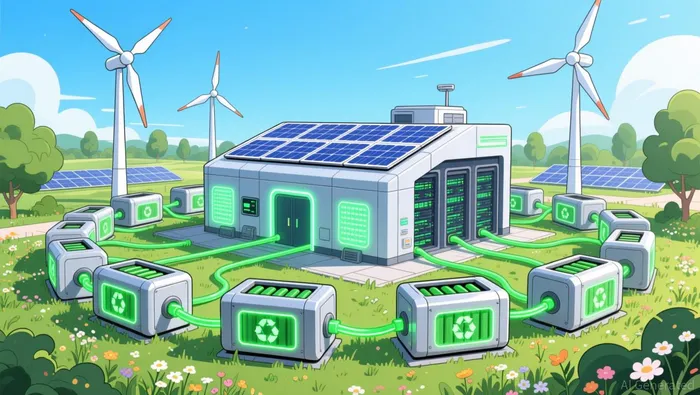
This pivot aligns with broader market trends. The global circular economy in battery recycling is valued at $26.54 billion in 2024 and projected to reach $56.07 billion by 2032, driven by regulatory pressures and resource scarcity. Redwood's hydrometallurgical and reductive calcination technologies recover up to 95% of lithium and cobalt, and nickel from end-of-life batteries, reducing reliance on virgin mining and cutting CO2 emissions by 92% compared to conventional refining.
Financial Resilience Amid Market Volatility
Despite market volatility, Redwood has secured $350 million in Series E funding in October 2025, underscoring investor confidence in its dual-value proposition. While its valuation dipped from $3.7 billion in 2021 to $5-6 billion in 2025, this reflects broader sector-wide uncertainties, including raw material price swings and regulatory shifts. However, Redwood's vertical integration-spanning collection, diagnostics, reuse, and recycling-creates a self-sustaining demand loop. Second-life batteries deployed in grid storage eventually return to Redwood's recycling facilities, ensuring a steady supply of materials for new battery production.
This closed-loop model mitigates exposure to market fluctuations. For instance, by 2030, Redwood aims to produce materials for five million EVs annually, capitalizing on the $410 billion battery value chain. Strategic partnerships with automotive giants like General Motors further solidify its position, while its reductive calciner-the only such facility in North America-processes 40,000 metric tons of live battery feedstock annually, enhancing operational scalability.
Competitive Advantages in the Circular Economy
Redwood's integration of energy storage and recycling creates a unique competitive edge. By extending battery lifecycles through second-life applications, it reduces costs and environmental impact while generating recurring revenue streams. For example, its modular storage systems can be redeployed across AI data centers, grid stabilization projects, and renewable energy sites.
Moreover, Redwood's technological leadership in hydrometallurgy and direct recycling positions it to outpace competitors. Its ability to recover 95% of critical minerals contrasts with industry averages of 50-70%, enabling lower production costs and higher margins. This advantage is amplified by U.S. federal incentives for domestic battery manufacturing, which align with Redwood's expansion plans.
Conclusion: A Justified Investment Thesis?
Redwood's pivot to grid-scale energy storage is not merely a diversification play but a strategic recalibration to address systemic challenges in the energy transition. By creating a closed-loop ecosystem, it transforms battery recycling from a cost center into a revenue-generating asset, stabilizing cash flows amid market volatility. The company's financial resilience, technological edge, and alignment with regulatory tailwinds suggest that its long-term investment thesis remains robust.
However, risks persist. Logistical bottlenecks, such as inconsistent battery designs and collection infrastructure gaps, could delay scalability. Additionally, the success of Redwood Energy hinges on the continued demand for AI-driven energy solutions, which remains speculative. Investors must weigh these factors against the company's demonstrated ability to innovate and adapt-a hallmark of its leadership in the circular economy.
For now, Redwood Materials' dual focus on grid-scale storage and recycling appears well-positioned to capitalize on the energy transition, offering a compelling case for long-term investment despite cyclical market headwinds.







Comentarios
Aún no hay comentarios