
Redwire's ROSA: Pioneering Power for the Lunar Economy and National Security
The race to establish a sustainable human presence on the Moon—and beyond—has entered a new phase, and at its center stands RedwireRDW-- (NASDAQ: RDW), a company quietly cementing its role as a linchpin of deep-space infrastructure. Its Roll-Out Solar Array (ROSA) technology, now a cornerstone of NASA's Artemis program, is not only enabling the next era of lunar exploration but also redefining the economics of space power systems. With its 60kW ROSA breakthrough for the NASA Gateway's Power and Propulsion Element (PPE) and a proven track record on the International Space Station (ISS), Redwire is positioned to dominate the $10 billion+ market for space-based energy solutions.
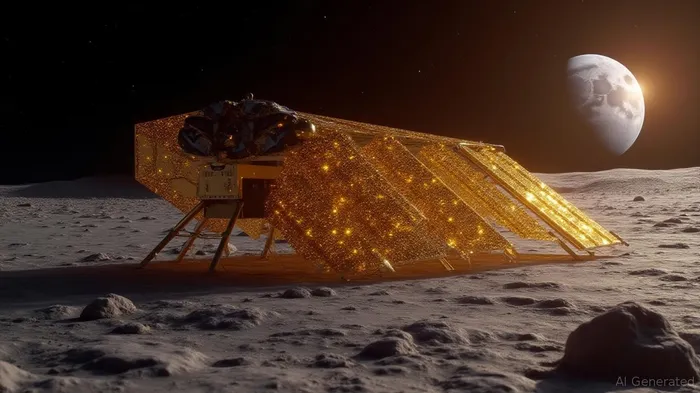
Technological Leadership: ROSA's Unmatched Edge
Redwire's ROSA is far more than a solar array—it's a game-changer for deep-space missions. Unlike rigid panels, ROSA's rollable design reduces mass and stowage volume by up to 40%, enabling higher power generation in compact spaces. For the NASA Gateway, two 30kW ROSA arrays will provide 60kW of continuous power, enough to sustain crewed operations, advanced experiments, and communications across lunar orbit.
This technology has already been battle-tested: ROSA powered NASA's Double Asteroid Redirection Test (DART) mission, which successfully altered an asteroid's trajectory, and eight IROSA wings now generate 160kW of power for the ISS. Redwire's ability to scale ROSA's capabilities—from 30kW to 60kW—demonstrates its engineering prowess, while its reliability record (zero failures in space) builds confidence among customers.
International Partnerships: Building a Global Solar Network
Redwire's partnerships are as strategic as its technology. Its collaboration with Thales Alenia Space (a Franco-Italian aerospace giant) highlights its reach: in July 2024, the companies announced a follow-on order for ROSA wings to power Space Inspire satellites, a commercial telecom constellation. This deal underscores ROSA's versatility—it's now a dual-use asset for both civil exploration and commercial ventures.
The U.S. government is also leaning on Redwire for national security applications. ROSA's compact, high-output design makes it ideal for satellites critical to intelligence, surveillance, and communications. As defense budgets prioritize space-based capabilities, Redwire's tech could underpin next-gen military satellites, creating a recurring revenue stream.
Recurring Revenue Streams: The Moat That Keeps Growing
Redwire's business model is a masterclass in diversification. Its three revenue pillars—NASA-funded exploration, commercial partnerships, and defense contracts—create a “recurring revenue flywheel”:
- NASA Contracts: The $2.3 billion Gateway program ensures steady work through 2028, with ROSA's PPE delivery expected in late 2025 (post-testing).
- Commercial Deals: Thales's order and Astrobotic's Lunar Vertical Solar Array (also ROSA-powered) signal a pipeline of commercial opportunities.
- Defense Work: Contracts like the International Berthing and Docking Mechanism for the Gateway's Lunar I-Hab module highlight Redwire's role in securing critical infrastructure for U.S. allies.
This mix reduces reliance on any single customer, a stark contrast to peers like Maxar or Lockheed MartinLMT--, which face concentration risks.
Investment Catalysts: Near-Term Wins and Long-Term Vision
- Q4 2025 Milestones: Redwire's ROSA arrays for the PPE are nearing test readiness reviews in 2025, with delivery to Maxar (the PPE builder) expected later this year. Success here could drive a re-rating of RDW's valuation.
- Gateway Launch (2028): Once operational, the Gateway will serve as a showcase for ROSA's reliability, spurring demand for similar systems on lunar landers, Mars rovers, and commercial stations.
- Cost Savings for Taxpayers: ROSA's scalability reduces the need for costly mass-specific launches, aligning with NASA's goal to cut deep-space mission costs by 30% by 2030.
The Bottom Line: A Must-Watch Play on the Deep-Space Economy
Redwire's ROSA isn't just a solar array—it's the power backbone of humanity's next frontier. With its blend of technological leadership, global partnerships, and recurring revenue streams, Redwire is uniquely insulated from sector volatility. Investors should watch for:
- Q4 2025 PPE delivery as a near-term catalyst.
- Thales-inspired commercial orders to validate ROSA's commercial viability.
- Defense contracts to solidify its role in national security.
At current valuations, Redwire trades at 15x forward revenue, a discount to peers like Maxar (20x) and SpaceX-backed rivals. With its moat widening and the deep-space economy accelerating, RDWRDW-- is a long-term buy for investors seeking exposure to the next trillion-dollar industry.
In the words of Redwire's CEO: “The Moon is the proving ground for Mars—and ROSA is the engine that will take us there.” For investors, that engine could also power significant returns.





Comentarios
Aún no hay comentarios