
Redistricting and Its Impact on Electoral Dynamics: A New Era for Political and Market Risk
The 2026 midterm elections are shaping up as a pivotal battleground, not just for political power but for the very structure of American democracy. In Texas and California—two of the nation's most populous and politically influential states—partisan redistricting efforts are rewriting electoral maps, reshaping policy priorities, and creating a volatile landscape for investors. These developments underscore a broader trend: the weaponization of redistricting as a tool to entrench political control, with cascading effects on market stability and sector-specific opportunities.
The Redistricting Arms Race: Texas and California as Laboratories of Partisan Strategy
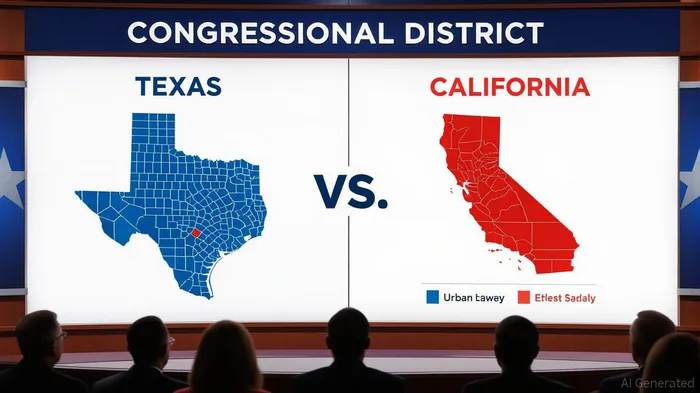
Texas and California have become epicenters of a mid-decade redistricting arms race. In Texas, Republicans have advanced a gerrymandered map designed to secure a 30-8 House majority, consolidating Democratic-leaning urban centers into fewer districts while creating safe GOP seats in rural and suburban areas. This shift could lock in a Republican advantage for decades, altering the state's political identity and amplifying its influence in national elections. Conversely, California Democrats have bypassed the state's independent redistricting commission to propose a map that could expand their House delegation from 43-9 to 48-4, ensuring a firewall against Republican gains.
These moves are not merely about electoral arithmetic; they reflect a strategic recalibration of power. In Texas, the GOP's focus on rural dominance aligns with a policy agenda favoring deregulation, fossil fuels, and reduced federal oversight. California's Democratic push, meanwhile, signals a commitment to renewable energy, healthcare expansion, and antitrust enforcement. The resulting policy divergence creates a fragmented national landscape, where sector-specific opportunities and risks are increasingly tied to regional political dynamics.
Political Stability and the Shadow of Legal Challenges
The redistricting battles in both states have sparked intense legal and political backlash. Texas Democrats' failed walkout and subsequent court challenges argue that the GOP map dilutes minority voting power, while California's shift to partisan redistricting has drawn criticism from moderates and Republicans who view it as a betrayal of nonpartisan principles. These legal uncertainties introduce a layer of volatility, as courts could invalidate maps or delay implementation, creating a fluid electoral environment.
For investors, this instability translates to heightened regulatory and policy risks. Sectors sensitive to legislative shifts—such as energy, healthcare, and technology—face unpredictable outcomes. For example, if Texas's redistricting plan is struck down, the state could see a resurgence of Democratic influence, accelerating clean energy incentives and ESG-aligned policies. Conversely, a successful GOP map would likely prioritize fossil fuels and roll back environmental regulations, favoring traditional energy firms.
Sector-Specific Opportunities and Risks in a Partisan Landscape
The redistricting-driven policy shifts in Texas and California are creating divergent investment opportunities:
- Energy and ESG:
- Texas (GOP-leaning): Deregulation and fossil fuel expansion could boost traditional energy firms like XOM and CVX. However, this stance may clash with ESG investment trends, potentially deterring capital from sustainability-focused funds.
California (Democratic-leaning): Renewables expansion and carbon neutrality goals favor companies like NextEra EnergyNEE-- (NEE) and First SolarFSLR-- (FSLR). A Republican-led Congress, though unlikely, could ease regulatory burdens for tech firms like TeslaTSLA-- (TSLA), but this remains speculative.
Healthcare:
- A GOP-controlled House may oppose federal healthcare expansions, favoring privatization and reduced Medicaid funding. This would benefit private insurers like UnitedHealth GroupUNH-- (UNH) but strain public hospitals.
A Democratic-led Congress could push for universal healthcare or Medicaid expansion, benefiting public-sector providers and companies like Anthem (ANTM).
Technology and Antitrust:
California's Democratic agenda includes aggressive antitrust enforcement, creating headwinds for Big Tech firms like AppleAAPL-- (AAPL) and AmazonAMZN-- (AMZN). Conversely, a Republican-led Congress might roll back Biden-era regulations, easing compliance costs for tech giants.
Defense and Procurement:
- Defense spending remains bipartisan, but GOP priorities lean toward increased contracts and streamlined procurement, favoring Lockheed MartinLMT-- (LMT) and Raytheon (RTX). A Democratic Congress may prioritize non-proliferation and humanitarian efforts, altering the defense sector's focus.
Navigating the New Normal: Investment Strategies for a Fragmented Era
The redistricting-driven political realignment demands a nuanced approach to portfolio construction. Investors should:
- Diversify across sectors to mitigate risks tied to partisan policy swings. For example, balancing energy holdings between traditional (XOM) and renewable (NEE) equities.
- Monitor legal and political developments in key states, as court rulings or voter referendums could invalidate maps and shift policy trajectories.
- Prioritize defensive equities in utilities (e.g., Dominion EnergyD-- (D)) and healthcare (e.g., HumanaHUM-- (HUM)) to hedge against legislative gridlock.
- Engage in ESG alignment where feasible, given the growing influence of sustainability-focused policies in Democratic-leaning states.
Conclusion: A Tectonic Shift in Political and Market Dynamics
The redistricting battles in Texas and California are not isolated events but harbingers of a broader transformation in American politics. As partisan gerrymandering becomes a tool for entrenching power, investors must adapt to a landscape where policy shifts are increasingly localized and unpredictable. The 2026 midterms will test whether these redistricting efforts succeed in reshaping electoral dynamics—and whether markets can navigate the resulting turbulence. For now, agility, diversification, and a keen eye on regional policy trends will be essential for managing risk and capitalizing on opportunity in this new era.







Comentarios
Aún no hay comentarios