
Redefining Smart Contract Dominance: Solana, XRP, and Layer 2 Innovations
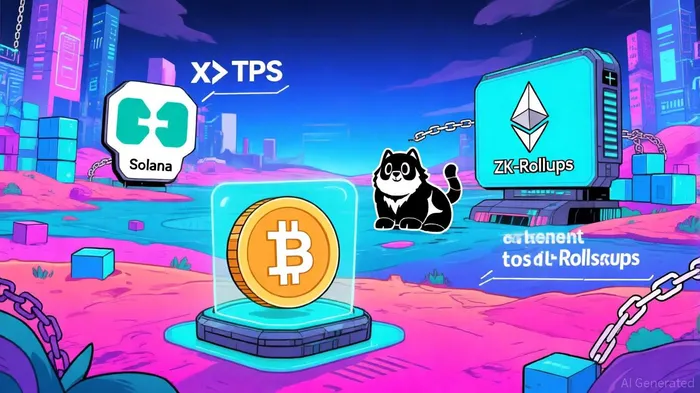
In the post-Ethereum era, the crypto landscape is being reshaped by projects that prioritize scalability, cost efficiency, and regulatory adaptability. SolanaSOL-- (SOL), XRPXRP-- (XRP), and innovative Layer 2 solutions are emerging as key contenders to redefine smart contract dominance. With Ethereum's modular upgrades still in progress, these alternatives are capturing developer and institutional attention by addressing critical pain points: speed, affordability, and compliance.
Performance and Scalability: The New Battleground
Solana has cemented itself as a high-performance blockchain, processing thousands of transactions per second (TPS) at minimal cost. However, its true edge lies in its Layer 2 ecosystem. Protocols like Solieum and SuperSol are pushing the boundaries of scalability. Solieum, a companion chain, offloads computation to reduce congestion, while SuperSol's Evanescent Rollups dynamically activate during peak demand, enabling tens of thousands of TPS without compromising security or liquidity[1]. These innovations ensure Solana remains a top choice for DeFi, GameFi, and DePIN applications, where low latency and cost efficiency are non-negotiable[2].
XRP, meanwhile, continues to shine in cross-border payments. The XRP Ledger (XRPL) handles up to 1,500 TPS with 3–5-second confirmation times, making it ideal for institutional use cases like real-time settlements[3]. Ripple's recent introduction of a native automated market maker (AMM) and the RLUSD stablecoin further enhances XRP's utility, bridging the gap between traditional finance and blockchain[4]. While XRP's TPS is lower than Solana's, its deterministic finality and low fees ($0.00001 per transaction) position it as a pragmatic solution for enterprises[3].
Ethereum-based Layer 2s like OptimismOP-- and ArbitrumARB-- are also making strides, but they face inherent limitations. Bridging friction and liquidity fragmentation persist, as assets must be moved between layers[5]. In contrast, Solana's native Layer 2s operate seamlessly within its ecosystem, avoiding the need for asset bridging and reducing latency[2].
Regulatory Adaptability: Navigating the SEC and MiCA
Regulatory clarity is no longer a luxury—it's a necessity. The U.S. SEC's Project Crypto initiative, launched in 2025, aims to modernize securities laws while addressing investor protections. This has created both challenges and opportunities. For instance, XRP's legal battle with the SEC concluded in August 2025, with the agency affirming that XRP is not a security[4]. This resolution has unlocked institutional adoption, with RippleNet now operating in 90+ markets[4].
Solana, too, is adapting. Its ecosystem's rapid growth—600 million active wallets and a 83% surge in developers—has drawn regulatory scrutiny, but protocol upgrades like Firedancer (targeting 1 million TPS) and reduced inflation rates signal a commitment to scalability and compliance[3]. Meanwhile, the EU's MiCA regulation is reshaping the landscape, requiring crypto-asset service providers to adhere to stringent operational standards[6]. Both Solana and XRP are aligning with these frameworks, ensuring their platforms meet global compliance benchmarks.
The potential approval of spot crypto ETFs for XRP and Solana by October 2025 could be a game-changer. Analysts estimate XRP ETFs could attract $4–$8 billion in assets, while Solana's could draw $3–$6 billion[7]. These products would democratize access to altcoins, bridging the gap between retail and institutional investors.
The Road Ahead: Innovation vs. Legacy
While Ethereum's Layer 2s remain relevant, their reliance on bridging and higher fees makes them less competitive for real-time applications. Solana's native Layer 2s and XRP's payment-centric design are better positioned to meet the demands of a post-Ethereum world. However, success hinges on regulatory outcomes. The SEC's October 2025 deadline for ETF approvals will be a litmus test for both projects.
For investors, the key takeaway is clear: performance and compliance are no longer mutually exclusive. Solana's technical prowess and XRP's legal clarity make them compelling long-term bets, while Layer 2 solutions continue to refine Ethereum's legacy. As global regulations evolve, the winners will be those who adapt fastest—both technologically and legally.






Comentarios
Aún no hay comentarios