
Redefining Institutional Confidence: The Strategic Case for DBS-Listed Stablecoins sgBENJI and RLUSD
The Institutionalization of Digital Assets: A New Paradigm
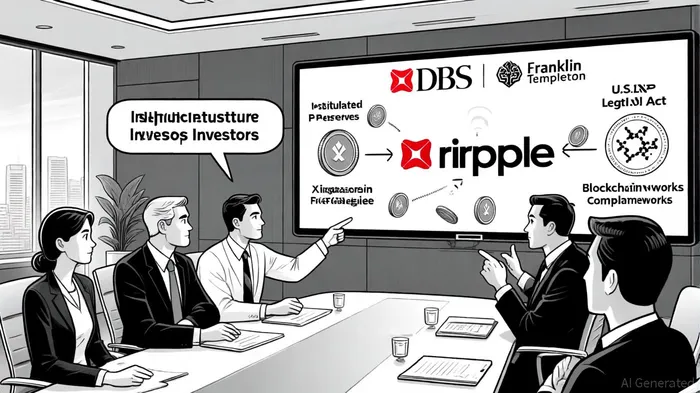
In 2025, the institutionalization of digital assets has reached a tipping point. As global markets grapple with macroeconomic uncertainty and the need for liquidity, stablecoins have emerged as a critical bridge between traditional finance and blockchain innovation. Among the most compelling cases is the collaboration between DBS Bank, Franklin Templeton, and Ripple, which has positioned sgBENJI and RLUSD as pillars of institutional-grade digital finance. These stablecoins are notNOT-- merely speculative assets—they are strategic tools for portfolio rebalancing, collateral optimization, and cross-border efficiency, all underpinned by regulatory alignment and institutional-grade compliance.
Regulatory Alignment: Singapore's MAS Framework as a Global Benchmark
Singapore's Monetary Authority of Singapore (MAS) has set a gold standard for stablecoin regulation. Under the Payment Services Act (PSA), single-currency stablecoins (SCS) like RLUSD and sgBENJI must maintain 100% reserve backing in cash or short-term government securities, with monthly audits and transparent stabilisation mechanisms [1]. This framework ensures that stablecoins are not just “pegged” to fiat but are fully collateralized and redeemable at par value within five business days. For institutions, this eliminates the volatility and trust risks that plagued earlier stablecoin experiments.
The MAS framework also restricts stablecoin issuers to non-lending, non-staking activities, ensuring that reserves remain untouched and liquid. This aligns with the U.S. GENIUS Act (enacted July 2025), which mandates similar reserve requirements and restricts stablecoin issuance to regulated entities like insured bank subsidiaries [5]. By adhering to both Singaporean and U.S. regulatory standards, RLUSD and sgBENJI have achieved a dual compliance edge, making them attractive to global institutional investors seeking cross-jurisdictional legitimacy.
sgBENJI: Tokenizing Yield and Liquidity for Institutional Portfolios
Franklin Templeton's sgBENJI token represents a digitized U.S. dollar money market fund, offering institutional investors a 24/7, on-chain solution for yield generation and liquidity management. Built on the XRPXRP-- Ledger (XRPL), sgBENJI enables near-instant settlements between RLUSD and tokenized cash equivalents, allowing investors to rebalance portfolios in real time [1]. This is a game-changer for asset managers navigating volatile markets, where traditional settlement cycles (T+2 or longer) can erode opportunities.
Moreover, sgBENJI is being explored as collateral for repurchase agreements (repos), a use case that could unlock billions in liquidity without requiring asset sales [3]. By tokenizing a money market fund, Franklin Templeton and DBS have created a digital asset that combines the safety of traditional cash equivalents with the programmability of blockchain. This innovation is particularly appealing in a world where 43% of B2B cross-border payments in Southeast Asia now use stablecoins [2].
RLUSD: Scaling Institutional Liquidity on the XRP Ledger
Ripple's RLUSD has emerged as a cornerstone of institutional liquidity, with a market capitalization of $800 million as of Q3 2025—a 441% year-over-year increase [5]. Fully collateralized by U.S. dollar deposits and short-term government securities, RLUSD's credibility was further bolstered by BNY Mellon's custodial partnership, which added a layer of institutional trust [2]. This alignment with legacy banking infrastructure is critical for adoption, as it addresses the “reputational risk” concerns that once deterred traditional institutions from engaging with crypto.
RLUSD's integration with the XRP Ledger (XRPL) also offers low-latency, high-volume transaction processing, making it ideal for tokenized real-world assets (RWAs) and cross-border settlements [4]. For example, DBS's Digital Exchange (DDEx) now allows accredited investors to trade RLUSD for sgBENJI, creating a seamless bridge between stablecoins and tokenized cash equivalents [1]. This interoperability is a key driver of tokenization's next phase, where digital assets will compete directly with traditional instruments in yield, liquidity, and efficiency.
The Strategic Case: Why Institutions Are All-In
The strategic case for sgBENJI and RLUSD rests on three pillars: regulatory clarity, institutional-grade utility, and macroeconomic relevance.
- Regulatory Clarity: Both stablecoins operate within the MAS and GENIUS Act frameworks, ensuring compliance with the most stringent global standards. This reduces legal and operational risks for institutions, which are now allocating 87% of their digital asset budgets to regulated products [5].
- Institutional Utility: sgBENJI's role as a yield-generating, tokenized cash equivalent and RLUSD's use in repos and cross-border settlements address core pain points in institutional finance. For example, 73% of institutional investors prioritize yield generation, and sgBENJI's intraday liquidity features directly cater to this demand [4].
- Macro Relevance: As central banks grapple with inflation and liquidity management, stablecoins offer a programmable, transparent alternative to traditional reserves. The U.S. government's endorsement of stablecoins as part of its Strategic BitcoinBTC-- Reserve in 2025 further legitimizes their role in institutional portfolios [3].
The Road Ahead: Tokenization as a Mainstream Infrastructure
The DBS-Franklin Templeton-Ripple partnership is not an isolated experiment—it is a blueprint for the future of institutional finance. By 2025, 83% of institutional investors plan to increase digital asset allocations, with tokenized assets (like sgBENJI) and stablecoins (like RLUSD) forming the backbone of this shift [4]. The next frontier will involve expanding these models to tokenized real estate, private equity, and government bonds, all while maintaining regulatory alignment.
For investors, the takeaway is clear: sgBENJI and RLUSD are not just stablecoins—they are infrastructure. They represent a new era where blockchain and traditional finance converge, driven by institutional demand for transparency, efficiency, and compliance. As the lines between digital and fiat assets blurBLUR--, those who embrace this transition will redefine the future of capital markets.







Comentarios
Aún no hay comentarios