
Redefining Commodity "Comfort Zones": Oil Volatility and Inflation in the Post-Pandemic Era
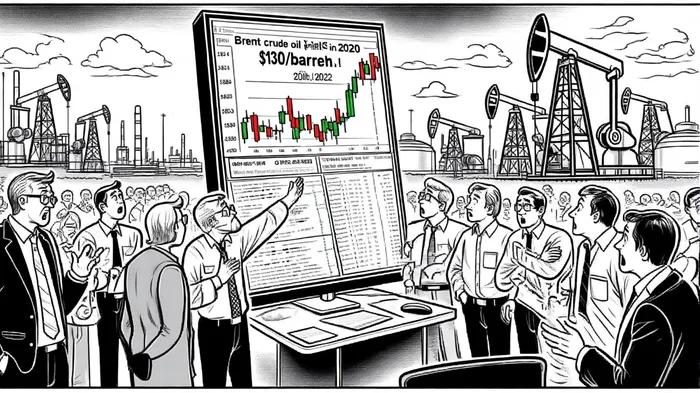
The post-pandemic era has shattered the "comfort zones" investors once associated with commodity markets. For oil, a sector historically defined by cyclical predictability, the past five years have rewritten the rules. From record-negative prices in 2020 to geopolitical-driven surges exceeding $130/barrel in 2022, Brent crude has become a barometer of global economic fragility. This volatility, compounded by inflationary second-order effects, demands a reevaluation of how investors perceive energy markets—and their role in macroeconomic stability.
The Shattered Pre-Pandemic "Comfort Zone"
Before 2020, oil markets operated within a relatively narrow volatility framework. Between 2015 and 2019, Brent crude averaged $52/barrel, with a standard deviation of $30.46 across the period[2]. While this range reflected occasional shocks (e.g., the 2015 oversupply crisis, which pushed prices to $38.01/barrel[4]), the pre-pandemic era was characterized by a predictable rhythm of OPEC+ interventions and demand cycles.
Post-pandemic, this predictability evaporated. From 2020 to 2025, Brent crude's price range exceeded $40/barrel[5], with daily standard deviations reflecting a volatility index far beyond historical norms. The April 2020 storage crisis—where prices briefly turned negative—exposed the fragility of supply chains, while the 2022 Russia-Ukraine war drove prices to $130/barrel[1]. By September 2025, prices had settled at $66.11/barrel, a 7.37% decline year-over-year[3], but the path to this equilibrium was anything but smooth.
Oil Volatility as an Inflationary Catalyst
The link between oil price swings and inflation has never been clearer. Data from the Federal Reserve reveals that post-pandemic oil shocks contributed to a 0.5 percentage point increase in headline inflation in advanced economies since late 2022[1]. This is not merely a direct effect—higher fuel costs—but a cascading chain of second-round impacts.
When oil prices surge, transportation and production costs rise, squeezing margins across industries. These cost pressures ripple into food and core inflation, as seen in 2022 when global food prices spiked by 14% year-over-year[1]. Meanwhile, oil-dependent economies face asymmetric impacts: producer price indices (PPI) rise more sharply than consumer price indices (CPI), amplifying inflationary asymmetry[3]. For investors, this means oil volatility is no longer a standalone commodity risk—it is a systemic inflationary force.
Strategic Implications for Investors
The redefined "comfort zone" for oil markets requires a recalibration of investment strategies. Traditional hedging tools, such as futures and options, remain critical, but investors must now factor in inflationary tail risks. For example, energy equities with strong balance sheets (e.g., integrated majors like ExxonMobil) may offer dual protection against both price swings and inflation, whereas leveraged producers face heightened exposure to margin compression[5].
Moreover, the interplay between oil and inflation suggests a role for diversified commodity baskets. Gold, natural gas, and even agricultural commodities can act as inflation hedges in a world where energy price shocks are more frequent and severe. Policymakers, too, must grapple with this reality: central banks that once dismissed oil volatility as transitory now face the challenge of anchoring inflation expectations in a structurally more volatile environment[1].
Conclusion
The post-pandemic era has irrevocably altered the dynamics of oil markets. What was once a cyclical commodity has become a linchpin of macroeconomic stability. For investors, the lesson is clear: comfort zones are obsolete. The new paradigm demands agility, diversification, and a deep understanding of how energy shocks translate into inflationary pressures. As the world navigates this volatile landscape, those who adapt to the new "normal"—or lack thereof—will be best positioned to thrive.





Comentarios
Aún no hay comentarios