
Redefining Blockchain Investment Narratives: Why BlockDAG's Record Coin Sales Signal a Paradigm Shift
The post-Ethereum merge era has ushered in a new era of blockchain innovation, with scalability and throughput emerging as the defining challenges for next-generation protocols. Ethereum's transition to a Proof-of-Stake (PoS) consensus model in September 2022 prioritized energy efficiency but left unresolved bottlenecks in transaction processing. As layer-two solutions and alternative architectures gain traction, projects like BlockDAG are redefining the investment landscape by offering hybrid models that balance security, decentralization, and performance. With record-breaking presale figures and a rapidly expanding ecosystem, BlockDAG's rise signals a paradigm shift in how investors and developers approach blockchain scalability.
The Post-Merge Scalability Dilemma
Ethereum's merge marked a pivotal shift in blockchain economics, reducing energy consumption by 99.95% while maintaining its dominance in decentralized applications (dApps) and smart contracts. However, the transition to PoS did not inherently solve Ethereum's throughput limitations, which remain constrained by its linear block structure and average 15–45 transactions per second (TPS) [2]. This has created a vacuum for protocols that can deliver high-throughput architectures without compromising security or decentralization.
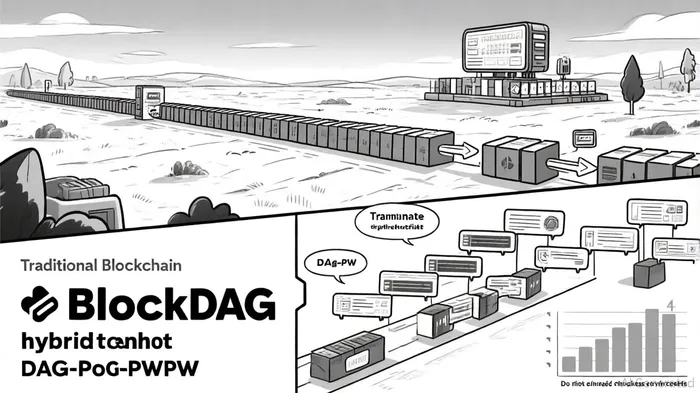
According to a report by A Survey on Blockchain Scalability: From Hardware to Layer-Two Protocols, the industry is increasingly exploring alternatives such as Directed Acyclic Graphs (DAGs) and hybrid consensus models to address these challenges [2]. BlockDAG's innovative approach—combining DAG's parallel processing with Proof-of-Work (PoW)—positions it as a compelling solution. By enabling 2,000–15,000 TPS while maintaining PoW's security guarantees, BlockDAG bridges the gap between traditional blockchain and next-gen scalability demands [3].
BlockDAG's Market Validation: A Retail-Driven Revolution
BlockDAG's record $385 million presale, with 26 billion coins sold and a 2,900% return on investment for early participants, underscores its appeal to both retail and institutional investors [1]. This unprecedented adoption has created a distributed base of 312,000 holders, many of whom are incentivized to participate in the network's growth through the X1 mobile mining app (3 million daily users) and X-Series hardware miners (19,700+ shipped) [3].
The project's success is not merely speculative; it reflects a tangible shift in user behavior. By democratizing mining access—allowing smartphone users to contribute to network security—BlockDAG has created a self-sustaining ecosystem. This aligns with broader industry trends where user participation and decentralization are increasingly valued over centralized control.
Ecosystem Growth and Developer Adoption
BlockDAG's ecosystem is rapidly maturing, with 4,500+ developers and over 300 decentralized applications (dApps) in development [4]. Full EthereumETH-- Virtual Machine (EVM) compatibility further accelerates adoption, enabling Ethereum-based projects to migrate seamlessly while leveraging BlockDAG's superior throughput. This interoperability is critical in a post-merge landscape where developers seek scalable infrastructure without sacrificing compatibility with existing tools.
Data from MEXC highlights the project's potential for long-term strength, noting that its developer activity and dApp pipeline rival those of established chains like SolanaSOL-- [4]. However, the challenge lies in translating this technical promise into real-world utility, particularly as competition intensifies.
Challenges and the Path Forward
Despite its momentum, BlockDAG faces hurdles. Sustaining network stability and ensuring meaningful use cases for its high-throughput architecture will be critical. The project must also navigate regulatory scrutiny and competition from Ethereum's layer-two solutions (e.g., Arbitrum, Optimism) and other high-performance chains like Solana.
Nevertheless, the market's response to BlockDAG's presale and ecosystem growth suggests a growing appetite for scalable, decentralized infrastructure. As Ethereum's post-merge limitations become more apparent, projects that offer hybrid solutions—like BlockDAG's DAG-PoW model—will likely dominate the next phase of blockchain innovation.
Conclusion: A New Investment Paradigm
BlockDAG's record coin sales and technical achievements signal a paradigm shift in blockchain investment narratives. By addressing scalability through a hybrid DAG-PoW model, it caters to the post-merge demand for high-throughput architectures while maintaining decentralization. For investors, this represents a unique opportunity to back a project that is not only solving critical infrastructure challenges but also building a community-driven ecosystem. As the industry evolves, BlockDAG's ability to sustain utility and outperform competitors will determine its long-term success—but its current trajectory suggests it is well-positioned to lead the next wave of blockchain innovation.






Comentarios
Aún no hay comentarios