
Red Robin's 2026 Turnaround Potential: A Value Play with Leverage to Consumer Spending Recovery
In a cautious consumer landscape marked by inflationary pressures and shifting dining preferences, Red Robin Gourmet BurgersRRGB--, Inc. (RRGB) has emerged as a compelling value play. The company's "First Choice" strategic plan, launched to stabilize traffic and rebuild profitability, has shown early signs of success, positioning it for a potential re-rating in 2026. By combining aggressive cost discipline, targeted marketing, and operational reinvention, Red RobinRRGB-- is leveraging its unique position in the casual dining sector to capitalize on a recovering consumer environment.
Strategic Marketing: Rebuilding Traffic with Data-Driven Precision
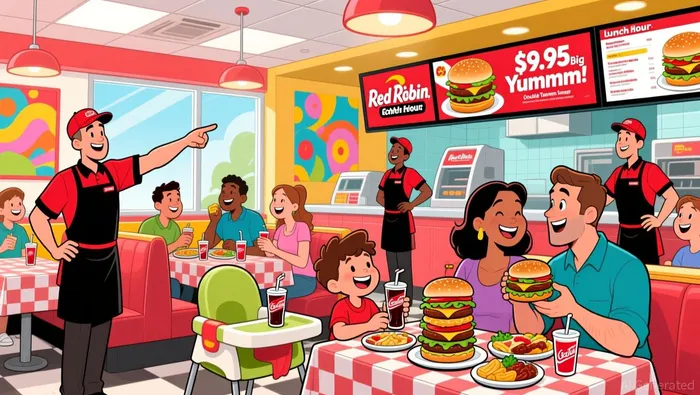
Red Robin's "Big Yummm" promotion, a $9.99 combo meal featuring a Double Tavern Burger, bottomless sides, and beverages, has been a cornerstone of its 2025 marketing strategy. This initiative drove a 250-basis point sequential traffic improvement in Q1 2026, particularly resonating during mid-week and lunchday dining occasions. The promotion's success underscores the power of value-driven offerings in a price-sensitive market.
Complementing this, the company has adopted a data-driven marketing approach, utilizing micro-targeted messaging to engage guests more effectively. By analyzing customer behavior and preferences, Red Robin has optimized its promotional cadence and messaging, resulting in a 90-basis point year-over-year improvement in restaurant-level operating profit margins in Q1 2026. These efforts align with the broader "Win Together" pillar of the First Choice plan, which emphasizes collaboration with franchisees and employees to enhance the guest experience.
Traffic Stabilization: A Gradual but Measurable Recovery
Despite a 1.2% year-over-year decline in same-store sales in Q3 2025, Red Robin has demonstrated sequential improvement in traffic trends. The "Big Yummm" promotion, introduced in earlier quarters, helped mitigate softness, with management noting a 250-basis point sequential traffic lift in Q1 2026. While the company still anticipates a 3% same-store sales decline in Q4 2025, the trajectory suggests stabilization as promotional effectiveness and operational efficiencies take hold.
The key to sustained recovery lies in maintaining momentum. Red Robin's focus on labor efficiency gains-which contributed to a 90-basis point improvement in operating margins-has provided a buffer against rising costs, allowing the company to reinvest in marketing and store-level enhancements.
Balance Sheet Discipline: Strengthening the Foundation
Red Robin's financial strategy under the First Choice plan has prioritized debt reduction and liquidity management. As of October 2025, the company had $177.7 million in outstanding borrowings, a $11.8 million reduction from fiscal 2024 levels, with liquidity standing at $50.7 million. A critical milestone was the Fourth Amendment to its credit facility, which extended the maturity date to September 2027, providing additional flexibility for reinvestment.
This balance sheet discipline is crucial for a company historically burdened by volatility. For instance, Red Robin's EV/EBITDA multiple averaged -17.1x from 2020 to 2024, reflecting periods of negative EBITDA. However, recent improvements in adjusted EBITDA-up to $27.9 million in Q1 2026-signal a path toward financial stability.
EBITDA Multiple Compression: A Catalyst for Re-Rating
Red Robin's current valuation remains attractively compressed relative to peers. As of 2025, its EV/EBITDA multiple stands at 3.41x, significantly lower than the 5.5x to 10.5x range for industry peers like McDonald's and Starbucks. This discount reflects lingering skepticism about its turnaround but also creates a margin of safety for investors.
Analysts at Jefferies have highlighted this as a key catalyst, projecting a 4.5x EBITDA multiple for 2026 as traffic and profitability stabilize. Such a re-rating would align Red Robin with its peers and unlock significant upside, particularly if consumer spending continues to recover.
Conclusion: A Value Play with Leverage to Recovery
Red Robin's 2026 turnaround potential hinges on its ability to sustain traffic gains, maintain operational efficiency, and execute on its balance sheet strategy. The "First Choice" plan has already delivered measurable improvements in EBITDA and liquidity, while the company's compressed valuation offers a compelling entry point. As consumer spending normalizes and the casual dining sector rebounds, Red Robin is well-positioned to capitalize on its strategic reinvention. For investors seeking a value-driven play with clear catalysts, the burger chain's journey from trough to recovery presents a compelling case.





Comentarios
Aún no hay comentarios